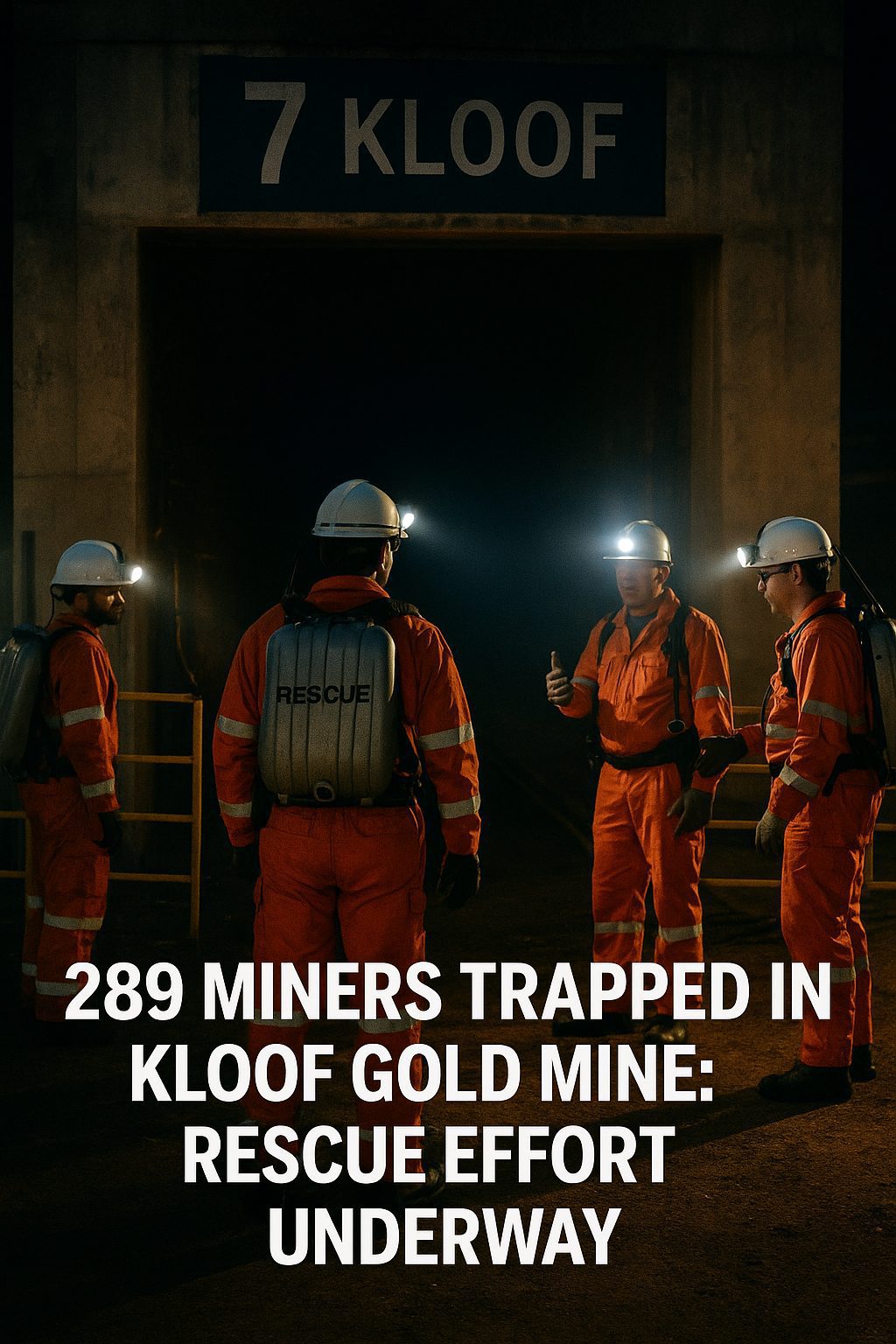
289 miners trapped beneath the surface of South Africa’s Kloof gold mine are at the center of a high-stakes rescue mission following a shaft malfunction on Thursday night. The incident at Sibanye-Stillwater’s Kloof 7 shaft—one of the country’s deepest—has triggered an urgent and complex operation aimed at extracting the workers safely.
Emergency Response Launched for Kloof Gold Mine Rescue
The Kloof gold mine rescue began shortly after a mechanical failure disrupted hoisting infrastructure, rendering the shaft temporarily inoperable. According to Sibanye-Stillwater, all miners affected have been located and are currently gathered at a secure underground assembly point.
While no injuries have yet been reported, the mining company has deployed critical supplies such as food and water underground and is actively coordinating engineering teams to assess structural safety before initiating evacuation procedures.
The company stated it hopes to begin hoisting operations before midday local time on Friday, contingent on the results of ongoing inspections.
Related News
- TOMRA LASER Sorting Revolutionizes Gold Mining at Vertex’s Hill End Project
- Carney Assembles Economic Team with Ex-Goldman Banker and Quebec Power Broker
- Sanatana Resources Secures Gold Strike Two in Yukon Mining Project Expansion
- Critical One Energy Closes $1.2M Private Placement to Advance Howells Lake Antimony-Gold Project
National Union Monitors Conditions Underground
The National Union of Mineworkers (NUM), which represents a significant portion of Sibanye’s workforce, has confirmed that it was alerted to the incident shortly after the shaft failure occurred. “Our concern is for the safety and health of the 289 miners trapped,” a NUM spokesperson told local media, urging a full investigation into the mechanical cause once rescue efforts conclude.
Deep Mining Risks Reemerge
The Kloof complex, located near Carletonville in Gauteng province, is part of South Africa’s aging gold mining infrastructure where shafts routinely exceed 3,000 meters in depth. These extreme depths compound the risk during emergencies, making the Kloof gold mine rescue particularly perilous.
South Africa has long contended with deep-level mining hazards. Earlier this year, 78 miners died in an illegal operation collapse in a separate region, drawing scrutiny to overall mine safety across the industry. Sibanye-Stillwater, one of the last remaining major producers in South Africa’s gold sector, has previously been praised for maintaining relatively stringent safety protocols.
Sibanye-Stillwater in the Spotlight
The company, which derives about 14% of its gold production from the Kloof shaft, is now under public and regulatory scrutiny. Its stock dipped marginally on Friday morning following news of the 289 miners trapped.
“We are doing everything we can to bring them home safely,” said a spokesperson for the mining giant. The company has also pledged to conduct a comprehensive audit of the shaft’s mechanical integrity post-rescue.
Human and Economic Stakes Run High
With lives on the line and production temporarily halted, the Kloof gold mine rescue has drawn national attention. Emergency services, engineers, and government safety inspectors are all collaborating in what may become one of the largest underground extractions in South Africa in recent years.
Updates will be provided as the situation develops.