At least 60 artisanal gold miners were killed after interconnected shafts collapsed at a mine in Sudan’s West Kordofan state, survivors and monitoring groups said, with dozens more feared trapped underground and rescue efforts hampered by a lack of heavy equipment.
The death toll from the collapse at the Al-Zara, also reported as Al-Zaraa, mine near Nuhud varied among early reports. The Sudan Doctors Network said at least 67 people had died, while survivors told Xinhua that 63 bodies had been recovered. The Kordofan Observatory, a local monitoring group, said more than 70 miners were dead or missing.
The mine is located in an area controlled by the Rapid Support Forces, the paramilitary group fighting Sudan’s army in a war that has disrupted transport, public services and emergency response across the country. The combination of fragile ground, closely spaced shafts and limited access to machinery has made it difficult to determine how many workers remain underground.
“There are still people stuck inside,” survivor Al-Amin Suliman told the Associated Press, saying 60 bodies had been recovered by Wednesday morning.
The disaster is the latest reminder of the operational and governance risks surrounding Sudan’s largely informal gold sector. For mining operators and investors, the collapse also underscores the challenges of assessing supply-chain exposure in a conflict zone where much of the country’s gold is produced outside formal industrial operations.
What is known about the collapse
| Detail | Reported information |
|---|---|
| Location | Al-Zara/Al-Zaraa mine near Nuhud, West Kordofan |
| Mine type | Informal artisanal gold operation |
| Reported fatalities | At least 60; other reports cite 63 or 67 |
| Missing miners | Dozens, with higher estimates reported by local observers |
| Rescue conditions | Deep shafts, unstable sandy ground and limited machinery |
| Area control | Territory held by the Rapid Support Forces, according to AP |
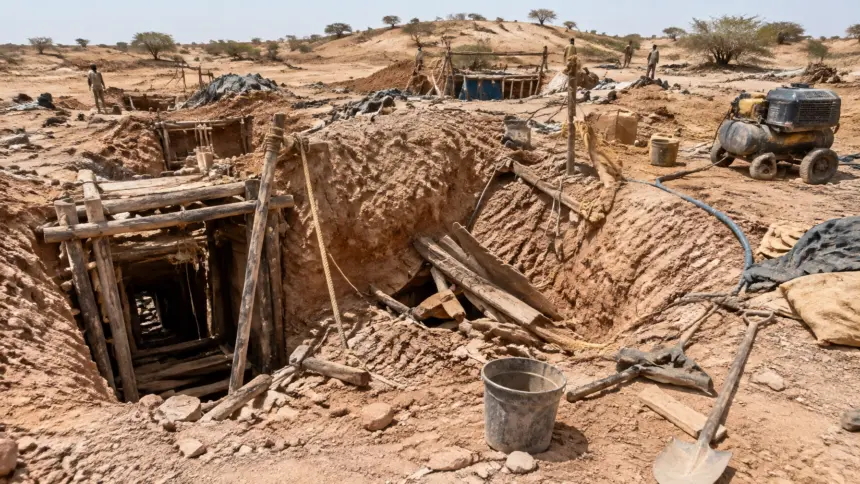
According to survivors cited by Xinhua, the accident occurred when several of about 10 shafts collapsed in sequence. One survivor estimated that more than 300 people could have been inside the affected workings, although that figure could not be independently verified.
The Kordofan Observatory said the interconnected shafts extended for more than 1 kilometer and were built through fragile, sandy ground. The group reported that at least 70 miners were either dead or missing.
Accounts also differed over when the collapse occurred. Survivors and the Sudan Doctors Network said it took place on Tuesday evening, while the Kordofan Observatory reported that the collapse occurred on Sunday. The discrepancies could not immediately be reconciled.

Rescue work faces severe constraints
Fellow miners and local residents began recovery efforts using hand tools, ropes and buckets. Survivors said the site lacked specialized rescue equipment capable of removing large volumes of collapsed sand and rock from shafts more than 30 meters deep.
Khairal-Sayed Gabara, another survivor, described the collapse as “massive” and said the absence of machinery had slowed efforts to reach trapped miners.
“ We do not have the machinery to lift dirt and stones and search for survivors at depths of more than 30 meters,” Gabara said, according to AP.
The conditions present a serious secondary risk for rescue teams. Unstable shaft walls and interconnected workings can collapse again when workers remove material or enter unsupported areas. In informal mines, the absence of surveyed plans and reliable records can further complicate the identification of access points and the location of miners.
The Sudan Doctors Network said the operation lacked basic safety and protective measures. Those conditions are common across Sudan’s small-scale mining sites, where workers often operate in narrow shafts with limited ventilation, timber supports and little formal oversight.
Sudan’s gold sector remains central to the economy
Gold is one of Sudan’s most important sources of foreign currency. Xinhua reported that artisanal mining accounts for about 80% of national gold production and supports more than 1.5 million miners across over 800 sites in northern and western Sudan.
The agency also reported that Sudan produced 70 metric tons of gold in 2025, citing official statistics. The figure includes production from a sector that is difficult to monitor because of informal trading networks, limited regulatory capacity and insecurity in major producing regions.
The scale of artisanal production means that accidents at individual sites can have wider implications. A collapse may be a local humanitarian emergency, but repeated disasters can also indicate broader weaknesses in licensing, geological surveying, worker protection and emergency preparedness.
For formal mining companies, the environment creates challenges in due diligence and responsible sourcing. Companies and financial institutions assessing exposure to Sudan must consider not only geological and operating risks, but also the origin of gold, the reliability of production records and the possibility that revenues are diverted through conflict-linked networks.
Experts commissioned by the United Nations have reported that large quantities of Sudanese gold have been smuggled out of the country and used to help finance the Rapid Support Forces. The finding, reported by AP, has increased scrutiny of gold traders, refiners and financial intermediaries handling material linked to Sudan.
Conflict makes mine safety harder to enforce
Sudan’s war began in April 2023 after fighting broke out between the Rapid Support Forces and the Sudanese military. The conflict has divided territory, displaced millions of people and weakened government control over many mining districts.
West Kordofan is strategically important because of its location and resource base, but access for regulators, medical teams and international organizations remains restricted. In areas controlled by armed groups, inspectors may lack the authority or security needed to visit mine sites, enforce safety rules or coordinate rescue operations.
That makes formalizing artisanal mining especially difficult. Authorities may seek to register workers, improve shaft design and channel gold through licensed buyers, but those efforts require stable administration, transport links and a functioning security environment.
The immediate priority at Al-Zara remains the recovery of miners and identification of victims. But the scale of the disaster is likely to renew questions about how Sudan’s gold sector operates during wartime and whether external buyers can verify the conditions under which the metal was produced.

A recurring pattern of fatal collapses
Deadly mine collapses are not unusual in Sudan. AP reported that a 2023 collapse killed 14 miners, while another accident in 2021 claimed 38 lives.
The repeated incidents point to risks that go beyond a single mine or region. Informal shafts are often developed rapidly in response to changes in gold prices or new discoveries, with workers excavating beneath unstable ground and without standardized engineering assessments.
The risks increase when several workings are connected or when miners deepen shafts without adequate reinforcement. Water intrusion, poor ventilation, blasting and the removal of supporting pillars can also weaken underground structures, although investigators had not yet established the specific cause of the Al-Zara collapse.
For investors and operators evaluating Sudan’s gold output, the incident adds to a risk profile shaped by conflict, supply-chain opacity, sanctions exposure and weak infrastructure. It does not by itself indicate a change in global gold supply, but it highlights the difficulty of separating reported production from recoverable, traceable and responsibly sourced material.
The Sudan Doctors Network and local monitoring groups said the death toll could rise as recovery teams reach deeper sections of the mine. With specialized equipment unavailable and parts of the site still unstable, the final number of victims may not be known immediately.
The collapse has left families and fellow miners searching through the rubble with limited tools. It has also exposed the human cost of a gold economy that remains vital to Sudan’s finances while operating across a landscape shaped by insecurity and inadequate regulation.
Sources: Associated Press report, Reuters report, Xinhua report. Further context on gold markets is available in Skillings’ coverage of gold and silver markets.