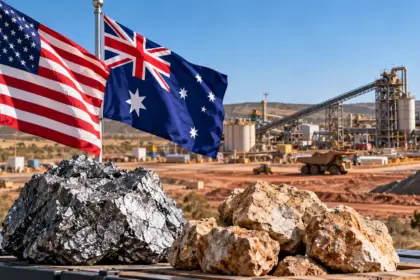
A critical-minerals processing plant requires significant upfront capital. Increasingly, U.S. states want to influence where that investment lands.
The competition is no longer only about mineral deposits, labor or electricity costs. States are using tax credits, grants, infrastructure programs and permitting reforms to attract processing and manufacturing capacity.
Missouri offers one of the clearest examples. Its new incentive program allows qualifying companies to seek tax credits worth 20% or 25% of eligible project costs beginning in 2027.
But the headline percentage does not tell the whole story.
The program has strict eligibility rules, a $40 million annual authorization cap and requirements tied to the companies, contractors and materials involved. Its structure also shows how states are beginning to treat mineral processing as part of a broader economic and national-security strategy.
Why processing has become the battleground
Mining produces the raw material. Processing can determine whether that production feeds a domestic industrial supply chain or remains dependent on overseas capacity.
That distinction matters for critical minerals. A country may have mineral resources but still rely on foreign facilities for separation, refining, chemical conversion or advanced manufacturing.
Building those missing capabilities requires major investment.
A processing plant needs specialized equipment, reliable utilities, environmental systems and skilled workers. Developers also need feedstock, customers, financing and permits before the facility can generate revenue.
That creates an opening for state governments.
A tax credit cannot solve every project risk. It can, however, reduce part of the upfront cost and improve the economics of one location relative to another.
For a developer comparing states, that difference can matter.
Missouri puts a value on qualifying investment
Missouri’s Defense and Energy Independence Act took effect on August 28, 2026.
The law allows the Missouri Department of Economic Development to award tax credits for qualifying project costs incurred on or after January 1, 2027. The Missouri Department of Economic Development lists the tax-credit program for implementation in April 2027.
The structure is straightforward.
Projects with at least $5 million but less than $15 million in qualifying costs can receive a credit equal to 20% of those costs.
Projects with $15 million or more in qualifying costs can receive a credit equal to 25%.
The credit is non-refundable. Companies can carry unused credits forward for up to 10 subsequent tax years, or until the credit is fully redeemed, whichever comes first.
What the credit could mean in project terms
| Qualifying project cost | Credit rate | Illustrative credit* |
|---|---|---|
| $5 million | 20% | $1 million |
| $10 million | 20% | $2 million |
| $15 million | 25% | $3.75 million |
| $20 million | 25% | $5 million |
| $40 million | 25% | $10 million |
*Illustrative calculation assuming all project costs qualify and the company receives the applicable credit.
The table shows why the incentive could matter to a capital-intensive project.
But the figures should not be treated as automatic cash payments. Missouri’s law says the department may award credits, subject to the program’s eligibility requirements and annual authorization limit.
The statutory percentage is therefore a measure of potential tax benefit, not a cash subsidy equal to 25% of construction cost.
The 25% headline comes with conditions
Missouri’s program is not a general tax credit for every company building a processing plant.
The law targets qualifying companies involved in critical materials and critical pharmaceuticals. A qualifying company must meet specific statutory requirements, including the federal definition of a nontraditional defense contractor.
The law also excludes companies headquartered in countries identified by the U.S. Director of National Intelligence as posing a national-security risk in at least one of the three most recent annual intelligence-community threat assessments.
The material itself must meet Missouri’s definition of a critical material.
That definition covers metals or metal complexes on the U.S. Department of the Interior’s critical-materials list that serve essential functions in key energy, defense or consumer technologies and face a high risk of supply disruption.
That makes the program more targeted than a conventional manufacturing incentive.
Missouri is tying the tax benefit to domestic supply-chain resilience and strategic industrial capacity.
What counts toward the project
The incentive reaches beyond production equipment.
Qualifying project costs can include facility construction, expansion or conversion, machinery and equipment, site preparation, building renovation, utility infrastructure and environmental compliance systems.
That matters because a processing project accumulates costs long before it produces its first tonne of material.
Missouri also places conditions on contractors.
Contractor costs generally qualify only when the contractor is selected through open bidding, is headquartered in Missouri, uses a workforce in which at least 85% of workers on the project reside in Missouri, and maintains an existing U.S. Department of Labor registered apprenticeship program.
The structure therefore does more than subsidize a facility.
It attempts to keep part of the construction and workforce benefit inside the state.
The $40 million cap changes the calculation
Missouri has also capped annual tax-credit authorizations at $40 million.
That matters because the 25% rate does not mean every eligible project will receive its full theoretical credit. Multiple projects could compete for limited annual authorization.
For developers, timing therefore becomes part of the investment equation.
The question is not simply:
How large is the tax credit?
It is also:
Can the project secure the credit when the capital decision is being made?
That distinction could become important if several large projects seek support during the same fiscal year.
The credit offers flexibility, but not unlimited value
Missouri’s structure gives companies two important forms of flexibility.
Unused credits can be carried forward for up to 10 subsequent tax years. The law also allows credits to be transferred, sold or assigned through the statutory process.
That could improve the usefulness of the incentive for a capital-intensive project whose early tax liability is smaller than the available credit.
But the face value of the credit is not necessarily its economic value.
Its practical worth depends on the company’s tax position, timing, financing structure and ability to monetize the credit.
For investors, that distinction matters.
A $5 million tax credit on paper is not equivalent to $5 million of immediate cash.
Missouri is adding a grant layer
The tax credit is only one part of Missouri’s package.
The law creates the Grants for Independence from Foreign Influence Fund, with at least $10 million appropriated by the General Assembly, plus potential additional contributions from federal, private or other sources.
Approved grants can provide up to $500,000 per application for qualifying project costs incurred before completion of the facility.
The grant program is subject to legislative appropriation and administrative requirements. Missouri’s Department of Economic Development also identifies legislative appropriation as a condition for implementation.
That distinction is important.
The tax credit has a statutory framework. The grant provides another potential source of project support, but it should not be treated as guaranteed funding.
Missouri is also changing the wider tax environment
Missouri’s 2026 legislation also expanded sales-tax treatment for activities involving critical materials.
The amended law defines critical materials using the federal critical-materials framework and provides exemptions covering certain energy, utilities, chemicals, machinery, equipment and materials used or consumed in qualifying manufacturing, processing, mining and related activities.
For a processing developer, this matters because project economics extend beyond construction costs.
Electricity, equipment, utilities and operating inputs can all affect the cost of establishing and running a facility.
The result is a broader incentive package rather than a single headline tax credit.
Utah is building a broader critical-minerals framework
Missouri is not alone in trying to make its state more attractive to critical-minerals investment.
Utah’s 2026 SB 254 takes a broader approach.
The law modifies the mining exploration tax credit, establishes critical-minerals objectives, creates a Critical Minerals Council, establishes critical-minerals zones and creates mechanisms involving property-tax differentials and critical-minerals development.
It also sets state objectives around domestic critical-minerals demand, in-state processing and permitting.
One objective calls for Utah to process within the state 50% of critical minerals extracted there.
Another seeks to reduce average permitting timelines to less than 18 months.
Utah’s model is therefore different from Missouri’s.
Rather than relying primarily on a project-cost tax credit, Utah is building a wider policy framework around extraction, processing, infrastructure, permitting and development zones.
For a project developer, those factors can matter just as much as the headline value of a tax incentive.
Texas shows another model
Texas provides another example of state competition without relying on a specific critical-minerals processing tax credit.
In February 2026, Governor Greg Abbott announced a planned MP Materials rare-earth magnet manufacturing campus in Northlake.
The project represents more than $1.25 billion in capital investment and more than 1,500 planned jobs.
Texas awarded the project a $12.88 million Texas Enterprise Fund grant and a $53.46 million Texas Semiconductor Innovation Fund grant.
These are grants, not the same type of statutory tax credit used by Missouri.
That difference is important.
States do not need identical programs to compete for similar investments.
Texas is using project-specific grants. Missouri has created a statutory tax-credit framework alongside grants and tax exemptions. Utah is combining fiscal tools with permitting and development policies.
The methods differ. The objective is similar: make the state a more attractive location for strategic industrial investment.
The competition is becoming a stack
For a mineral-processing developer, the most important question may not be which state offers the largest tax credit.
It may be which state offers the strongest combination of incentives and operating conditions.
A project developer could compare:
- tax credits;
- grants;
- infrastructure support;
- electricity cost and availability;
- water supply;
- workforce availability;
- permitting timelines;
- environmental requirements;
- feedstock access;
- transportation;
- customer proximity;
- financing conditions; and
- the ability to monetize incentives.
A 25% tax credit may look attractive on paper.
But if a project cannot secure reliable feedstock or affordable power, the credit may not make the location competitive.
The opposite can also be true.
A state offering a smaller direct incentive could still produce better project economics if it provides stronger infrastructure, faster permitting or better access to customers.
That is why the incentive percentage should never be viewed in isolation.
What this means for investors
The rise of state-level incentives changes how critical-minerals projects should be evaluated.
Investors should model the incentive alongside construction costs, operating expenses, financing, tax liability, infrastructure and execution risk.
Timing matters too.
A tax credit that becomes available after qualifying expenditure is incurred has a different financing impact from an upfront grant or infrastructure commitment.
The ability to carry forward or transfer a credit can also affect its real economic value.
For developers, the key question is not simply how much support a state advertises.
It is how much of that support can actually translate into lower project costs, stronger financing and a more competitive operating position.
The shift is from resource policy to location policy
Mineral policy has often centered on resource access and mine production.
The critical-minerals race is pushing governments further downstream.
Processing and refining determine whether mineral production can feed domestic manufacturing or remains dependent on foreign capacity.
That creates a new competition between states.
A deposit may exist in one state while the processing plant is built in another. The location decision can depend on incentives, infrastructure, labor, energy, permitting and proximity to customers.
For states, the prize is not simply a new mine.
It is the processing and manufacturing activity that can follow the mine.
The real competition is for capital
Missouri’s 2027 program illustrates how state-level competition is evolving.
The incentive is substantial enough to affect project economics, but it comes with eligibility requirements, a limited annual authorization and a defined policy objective.
Utah is building a broader critical-minerals ecosystem. Texas is using large project-specific grants to attract downstream manufacturing.
These approaches are different, but they point in the same direction.
U.S. states are increasingly competing not just to mine critical minerals, but to capture the processing and manufacturing investment that turns those minerals into strategic industrial capacity.
The competition is not ultimately about which state can advertise the largest percentage.
It is about where investors believe the combination of incentives, feedstock, infrastructure, energy, permitting and policy certainty creates the strongest project economics.
The next U.S. critical-minerals race may therefore be decided less by who controls the ore and more by who can finance and operate the processing capacity between the mine and the factory.