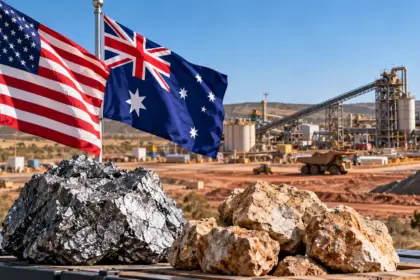
A proposed financing model could help the United States rebuild its rare earth industry. But can it turn public investment into commercially viable mines, processing plants and magnet factories?
In June 2026, China added MP Materials and USA Rare Earth to its export-control list. The move highlighted a major weakness in America’s rare earth strategy. Even companies at the centre of its domestic supply-chain plans remain exposed to Chinese export restrictions.
The problem extends beyond mining. Rare earth supply chains require extraction, separation, refining, metal production and permanent-magnet manufacturing. A country may have abundant mineral resources but still depend on foreign suppliers for processed materials.
On October 14, 2026, Kirsten Asdal, Tom Koch and Tao Tan proposed a new financing approach in Lawfare. Their proposal uses a contingent convertible security, or CoCo bond, to connect investment returns with production milestones and geopolitical risks.
For the mining industry, the key question is straightforward: can this instrument make strategic projects commercially viable without placing excessive risk on taxpayers?
China’s Advantage Extends Beyond Mining
The decline of the US rare earth industry reflected more than geology. Environmental liabilities, operating costs and international competition all contributed to the industry’s contraction.
Mountain Pass in California once served as a major centre of US rare earth production. Environmental problems and operational challenges contributed to its decline. Mining operations stopped in 2002, and the mine later required substantial investment to resume production.
The downstream industry also contracted. General Motors sold its Magnequench rare earth magnet business to a Chinese-backed consortium in 1995. US magnet manufacturing subsequently declined, and production equipment moved to China.
China invested heavily in mining, separation, refining and downstream manufacturing. This integrated industrial system gave Chinese producers advantages beyond access to mineral deposits.
The US Geological Survey reported that China accounted for more than 70% of global rare earth extraction and 87% of processing in 2024. China also accounted for all reported processing of the heavy rare earth elements dysprosium and terbium.
The International Energy Agency’s 2026 Global Critical Minerals Outlook reported modest reductions in rare earth refining concentration. New US projects and increased production in Malaysia contributed to that change. However, the industry still faces significant supply-chain vulnerabilities.
Why Processing Capacity Matters
A new mine does not automatically create an alternative to Chinese supply. Developers must establish separation technology, meet product specifications and qualify their materials with customers.
The same challenge applies to magnet production. Manufacturers need suitable rare earth metals and alloys before they can produce permanent magnets for industrial applications.
The strategic objective is not simply to mine more rare earths. It is to build an integrated supply chain that can deliver usable materials reliably and competitively.
Why Conventional Financing Struggles
Rare earth projects face a difficult investment environment. Established suppliers can maintain low prices during periods of abundant supply. Alternative producers may struggle to compete, even when their products have strategic value.
A supply disruption can change that equation. Demand for alternative production may rise sharply, but developers cannot build mines and processing plants overnight.
Private investors must finance years of development while accounting for uncertain prices, construction delays and geopolitical risks. These conditions can discourage investment in projects that governments consider strategically essential.
Government financing can help bridge this gap. However, different instruments address different risks.
- Loans provide capital but require repayment.
- Equity investments provide ownership exposure and potential returns.
- Price floors protect eligible production against specified price declines.
- Offtake agreements help secure demand through purchasing commitments.
These instruments can improve project economics. Yet their effectiveness depends on contract terms, operating performance and the allocation of risk between public and private investors.
The Political Risk
Mining and processing projects can take a decade or longer to develop. Government budgets and industrial priorities can change much faster.
A project may therefore depend on public support long before it reaches commercial production. Changes in policy could weaken investor confidence or interrupt financing.
A durable strategy must address both commercial risk and political uncertainty. Otherwise, projects may struggle to survive until their new capacity becomes commercially productive.
What the Existing US Financing Model Demonstrates
The July 2025 agreement between the US Department of Defense and MP Materials illustrates Washington’s approach to strategic mineral financing.
MP Materials’ transaction announcement included a $400 million purchase of convertible preferred stock, a commitment for up to $350 million in additional preferred-stock funding and a $150 million loan commitment. The package also included a warrant for additional common shares, a 10-year price-floor commitment for neodymium-praseodymium products and a 10-year offtake agreement for planned magnet production at the 10X facility.
The company also announced debt financing commitments from JPMorgan Chase and Goldman Sachs.
Each component addresses a different risk. Preferred stock and warrants provide equity-linked exposure. The loan supports project financing. The price floor protects eligible material against specified price declines, while the offtake agreement helps secure demand.
The agreement demonstrates Washington’s willingness to combine financial instruments to support strategic production. It does not prove that the same structure will suit every rare earth project.
Understanding the $100 Billion Financing Figure
The One Big Beautiful Bill Act, signed into law on July 4, 2025, provides $500 million in credit-subsidy funding for the Department of Defense’s Office of Strategic Capital.
The department says this funding can support up to $100 billion in loan financing for critical-mineral production and related industries.
That figure represents potential lending capacity, not $100 billion in cash already disbursed to mining companies. Actual financing depends on programme implementation, eligible projects and applicable requirements.
The remaining challenge is to determine how public and private investors should share the risks and returns associated with strategically important production.
How the Proposed CoCo Security Would Work
Asdal, Koch and Tan propose a security that begins as an interest-paying loan. Its terms would give investors additional rights when specified conditions occur.
The proposal has two main triggers.
Trigger One: Production Capacity
The producer must reach a defined output threshold by an agreed deadline.
Once the producer meets this target, government lenders and participating investors would receive a pro-rata share of the producer’s free cash flow under the proposed arrangement.
This structure would reward investors for helping establish capacity that ordinary market financing might not support.
However, the contract must define production milestones carefully. Installed capacity does not necessarily mean commercially usable output. The terms should account for product quality, operational reliability and the difference between planned production and actual sales.
Trigger Two: Chinese Supply Restrictions
The second trigger responds to geopolitical developments. It could activate after a sustained breach of an agreed price band or an observable supply restriction.
Potential qualifying events include export-licence denials and administrative delays that materially interrupt deliveries to the United States or allied countries.
The proposal gives lenders the right to convert their holdings into common equity when both triggers have been met.
This distinction matters. If China restricts supply before a project reaches its capacity target, the geopolitical event alone would not activate the proposed conversion right. Likewise, a producer that meets its target would not trigger conversion merely because the facility becomes operational.
Who Bears the Risk?
The producer would exchange some future cash flow and potential crisis-period equity value for financing support during weaker market conditions.
Government lenders and private investors would gain a potential return linked to the successful development of capacity and the materialisation of geopolitical risk.
The result would depend on the contract. Interest rates, conversion valuation, cash-flow participation, price-floor coverage and loss allocation would all affect the economics.
The CoCo security remains a proposal, not an established US government financing programme. Its benefits will depend on its final design and actual performance.
Four Scenarios That Test the Proposal
The proposed instrument must work under several different market and operating conditions.
1. Production Rises but Prices Stay Low
A producer meets its output target, but Chinese supply keeps prices low. Investors may gain the right to participate in free cash flow under the proposed terms.
However, low margins could leave little cash to distribute. Meeting a production target does not guarantee profitability.
Developers would still need competitive operating costs, credible purchasing agreements and realistic market assumptions.
2. China Restricts Supply Before a Project Opens
A supply interruption occurs while a new processing plant remains under construction. The market needs alternative supply, but the project cannot deliver it immediately.
The proposed conversion right would not activate until the producer also meets its capacity milestone. Investors would therefore remain exposed to construction delays and execution risk.
Stockpiles, alternative suppliers and existing inventories would still be necessary to bridge the immediate supply gap.
3. A Plant Produces Materials That Customers Cannot Use
A facility reaches its nominal output target but fails to meet customer specifications. Alternatively, the producer may struggle to qualify its products for downstream applications.
A capacity trigger based only on production volume could reward a project that fails to deliver usable industrial materials.
Contracts should therefore define milestones that reflect saleable output, product quality and operational reliability. Customer qualification may also matter, depending on the facility.
4. Supply Is Restricted Without a Broad Price Increase
China restricts exports of a particular product or interrupts deliveries to specific customers. The disruption may not cause a market-wide price increase.
A price-band trigger might miss this event. Conversely, an overly broad definition of supply restrictions could activate conversion rights too easily.
The agreement would need objective evidence requirements. It should define qualifying products, material disruptions, administrative delays and procedures for resolving disputes.
These scenarios show that the proposed instrument can redistribute financial risk. It cannot eliminate the technical, commercial and operational uncertainties associated with mining and processing.
The Downstream Capacity Test
The United States must measure supply-chain progress by actual industrial output, not just announced investments.
A mine that exports concentrate for overseas processing remains exposed to foreign processing bottlenecks. A separation plant without reliable customers may struggle to maintain commercially viable utilisation. A magnet factory that cannot qualify its products may fail to provide a dependable alternative to established suppliers.
The government should assess projects against five sets of indicators.
- Production: Saleable output, recovery rates, operational uptime and progress against commissioning targets.
- Processing: Domestic separation capacity, the range of rare earth elements processed and dependence on overseas facilities.
- Downstream manufacturing: Commercial metal, alloy and magnet production, customer qualification and deliveries to industrial buyers.
- Commercial viability: Operating costs, capacity utilisation, contracted demand and dependence on continuing public support.
- Supply resilience: Qualified alternative suppliers, inventory coverage, delivery reliability and the ability to maintain production during a disruption.
These indicators would distinguish announced capacity from functioning industrial capability.
They would also help policymakers decide which projects need specialised financing. A commercially competitive project with conventional loans and contracted offtake may not need a complex contingent security. A strategically important project with significant geopolitical exposure may justify a different structure.
The financing model should match the project’s risks rather than assume one instrument can solve every supply-chain problem.
Allied Investment Could Share the Burden
The proposed CoCo security could attract investment from industrial buyers and allied governments that face direct exposure to Chinese supply restrictions.
Defence contractors, automakers and magnet manufacturers have an incentive to secure dependable access to materials. Under the proposal, eligible co-investors could participate alongside government lenders and receive proportional offtake rights.
Japan’s financing relationship with Australia’s Lynas Rare Earths offers a relevant precedent. In 2011, Japan’s Sojitz and the Japan Oil, Gas and Metals National Corporation provided a combined $250 million in loan and equity financing to Lynas. The arrangement included a long-term supply agreement allocating at least 8,500 tonnes of rare earth products annually to Japan.
The proposed CoCo security would differ in its contingent equity-conversion mechanism. However, both approaches link financing with supply security.
Foreign participation in a US facility would require appropriate national-security screening, including consideration of the Committee on Foreign Investment in the United States where applicable.
Investors’ rights would also need to align with defence requirements, domestic industrial priorities and restrictions on access to strategically sensitive materials.
Allied participation could reduce the US government’s financing burden. It could also create a broader group of investors with a direct economic interest in maintaining alternative supply. However, participation would not guarantee commercial success or ensure that every buyer receives materials during a shortage.
Legal Authority and Political Durability
The proposal raises unresolved questions about statutory authority, trigger definitions, corporate governance and foreign-investor screening.
The Department of Defense already uses equity-linked financing and other instruments in critical-mineral transactions. However, those precedents do not automatically establish authority for every feature of the proposed CoCo security.
The legal framework would need to clarify the permitted structure, conversion conditions, government investor rights and procedures for exercising those rights.
Corporate governance rules would also need to address conflicts between national-security objectives and commercial decision-making.
The authors point to the National Defense Authorization Act for 2027 as an opportunity to clarify the authority of the Office of Strategic Capital. The final legislative text and implementing rules must be checked before anyone claims that the proposal has received statutory approval.
Protecting Long-Term Investment
Political durability remains another challenge. Investors may hesitate if they believe the government could withdraw support before a project becomes commercially established.
Long-term agreements, transparent project selection and independently verifiable milestones could improve predictability. Clear contractual rules could also help investors understand how the government would allocate risks and exercise its rights.
These measures cannot eliminate political risk. They can, however, make long-term commitments easier to evaluate.
What to Watch
Four developments will help determine whether the proposal can move from concept to practical application.
- Legislative authority: The final National Defense Authorization Act for 2027 and subsequent rules will help establish whether the government can use the proposed equity-conversion structure.
- Export-control developments: The Lawfare analysis identifies November 10, 2026, as the deadline for the suspension of broader Chinese rare earth export controls. It identifies January 10, 2027, as the end date of the wider trade truce. These dates refer to separate arrangements. Neither date alone proves that restrictions will automatically resume in their previous form.
- Delivery against project commitments: Actual production, separation performance, magnet output and customer deliveries will show whether US-backed projects are establishing dependable industrial capacity.
- Private and allied participation: Commitments from industrial buyers and allied investors will help test whether the proposed risk-sharing model can attract capital beyond government financing.
Policymakers and investors should assess these developments against operational and commercial evidence, not merely announcements of funding or policy intent.
Conclusion: Measure Supply Security by What the Industry Delivers
The proposed CoCo security offers a different approach to financing strategically important mineral capacity. It links investor returns to production milestones and observable supply restrictions.
Its potential value lies in addressing a mismatch between commercial financing and the long-term strategic value of alternative supply. However, the instrument cannot replace technical execution, processing expertise, downstream manufacturing, customer qualification or competitive operating economics.
For the mining industry, the central lesson is clear. Supply security must extend from extraction to usable industrial materials.
A financing commitment is only the beginning. The meaningful test is whether a project can deliver reliable, specification-compliant materials at a commercially sustainable scale when international trade conditions change.
The CoCo proposal could form part of a broader financing strategy if policymakers design its legal foundations, economic incentives and operational milestones carefully. Its success should ultimately depend on the additional resilient capacity it creates, the reduction in concentrated supply risks and the ability of supported projects to operate without indefinite extraordinary assistance.