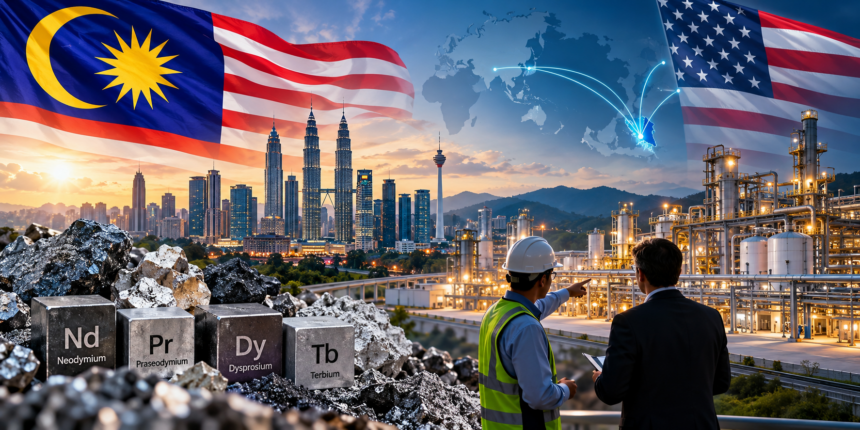
Malaysia’s established processing operations and emerging separation and magnet projects are attracting US interest. The challenge now is to turn exploratory discussions into commercially viable projects.
More than a dozen US companies are exploring opportunities in Malaysia’s rare earth sector. They are considering mining projects with local partners and potential investments in processing facilities, according to the US Embassy in Kuala Lumpur. The Embassy announced the interest on October 14, 2026, following a forum involving American executives, Malaysian officials and investors. It did not identify the companies or disclose their proposed investments. [1]
The announcement highlights growing interest in supply chains outside China. However, the companies have not publicly confirmed investment commitments through the forum announcement. Their next steps will depend on project studies, financing, permits and customer agreements.
A separate announcement offers a named example of US corporate activity. American Resources Corporation formed a new regional business unit, American Resources Indo Pacific, and appointed Datuk Wira Mark Ling as its chief executive. The company plans to develop a connected rare earth supply chain in Malaysia, using technology from ReElement Technologies. It has not disclosed proposed facility locations, investment amounts or a development timetable. [2]
Malaysia already hosts Lynas Rare Earths, an established processor of rare earth concentrate from Australia. Other international partnerships are also advancing proposals for separation and magnet manufacturing.
These developments raise a key question: can Malaysia turn growing interest into reliable production without creating new bottlenecks in feedstock, processing or environmental management?
Why Malaysia Matters to US Rare Earth Supply Chains
China remains the dominant force in the rare earth supply chain, particularly in processing and magnet manufacturing.
The International Energy Agency (IEA) reported that China accounted for 60% of global mined production of magnet rare earths in 2024. It also supplied 91% of refined output and 94% of sintered permanent magnets. These figures cover magnet rare earths and related products, not every rare earth element. [3]
The supply chain involves several distinct stages. Mines extract mineral-bearing material, and beneficiation plants concentrate it. Chemical processing then separates individual rare earth oxides. Further refining converts those oxides into metals and alloys, which manufacturers use to produce permanent magnets.
Each stage requires different skills, equipment and investment. A country can mine rare earths without having the capacity to separate them into usable products.
Malaysia offers a potential alternative because it already has commercial processing experience. Investors could explore domestic mining, new separation facilities or downstream manufacturing. Yet a plant outside China does not automatically create a secure supply chain. It still needs reliable feedstock, suitable chemicals, specialised equipment and customers willing to buy its products.
American Resources Outlines a Malaysian Plan
American Resources Corporation’s October 14 announcement provides a concrete example of a US company pursuing this opportunity. Its new regional unit will lead plans to develop a connected rare earth supply chain in Malaysia. [2]
The proposed model combines mineral sourcing, separation, refining, traceability and downstream industrial applications. American Resources intends to use ReElement Technologies’ proprietary processing technology in its planned Malaysian operations.
The company also plans to incorporate digital traceability technology from SAGINT. Its Digital Warehouse Receipt system records information about a material batch, including its origin, processing history, custody and movement. According to the company, the system has tracked ReElement production material since January 2026. [2]
Traceability could help buyers verify where materials originated and how they moved through the supply chain. However, a tracking system cannot replace independent checks of mineral quality, production practices or environmental performance.
The project also remains at an early stage. American Resources has not disclosed a Malaysian facility location, capital budget, production target or construction schedule. It has not announced binding feedstock or offtake agreements for the proposed facilities.
The appointment of a regional chief executive and the creation of a dedicated business unit establish an organisational base. They do not prove that the company will build or operate the planned facilities.
Lynas Provides an Established Processing Base
Lynas gives Malaysia a practical foundation for further investment. The Australian producer operates a rare earth processing facility in Gebeng, Pahang, using concentrate from its Mount Weld mine in Western Australia.
The US Geological Survey reported that Lynas Malaysia produced 11,072 tonnes of rare earth oxides in 2024, down from approximately 14,000 tonnes in 2023. The report attributed the decline to planned maintenance at the facility. It also highlighted the operation’s reliance on imported concentrate. [4]
That reliance illustrates a central supply-chain issue. A country can host processing capacity without producing all the raw material that feeds it.
Lynas has also developed the capability to separate heavy rare earths, including dysprosium and terbium. Manufacturers use these elements in high-performance permanent magnets for demanding applications. Additional production outside China could diversify supply, but buyers will still need reliable volumes and consistent product quality.
For new investors, Lynas demonstrates that large-scale processing can operate in Malaysia. It does not guarantee that another facility will achieve similar results. Each project must prove its own technical performance, feedstock access and commercial viability.
New Partnerships Are Expanding the Competitive Landscape
US companies will not enter an empty market. European and Asian businesses are already pursuing projects across Malaysia’s rare earth value chain.
Carester and Malaco target separation
French rare earth specialist Carester plans to build a separation plant in Perak through a ten-year partnership with Malaysian miner Malaco Mining Group. The companies are also seeking permission for potential mining projects using in-situ leaching. [5]
Reporting in July 2026 put the proposed plant’s capacity at approximately 13,000 tonnes of rare earth material annually. That figure describes planned capacity, not actual production.
The partnership combines Carester’s processing expertise with Malaco’s local mining interests. Its success will depend on approvals, feedstock availability, plant performance and customer demand.
The project also shows why mining and processing plans must progress together. A separation plant needs a dependable supply of suitable material. A mine, in turn, needs a reliable route to market.
Lynas and JS Link move downstream
Lynas has also partnered with South Korean manufacturer JS Link to develop a permanent magnet factory in Kuantan. The planned facility would produce up to 3,000 tonnes of sintered neodymium-iron-boron magnets annually. Lynas announced an investment of about A$50 million in JS Link and a long-term supply arrangement extending to January 2038. [6]
This project targets a different part of the value chain. Carester–Malaco focuses on separation, while the JS Link partnership aims to expand magnet manufacturing.
That distinction matters. A resilient supply chain needs more than mines and refineries. It also needs manufacturers that can convert separated materials into products that meet industrial specifications.
Together, these proposals show that Malaysia is attracting interest across several stages of the industry. Their planned capacities should not be confused with facilities already operating at full production.
Malaysia’s Resource Estimates Need Careful Interpretation
Malaysia has reported substantial rare earth resource potential. However, investors must distinguish geological estimates from economically recoverable reserves.
A Malaysian parliamentary response in July 2025 cited 16.1 million tonnes of inferred rare earth resources. It also said further studies were needed to establish measured resources and identify material that could be mined. [7]
An inferred resource carries geological uncertainty. It does not establish that a deposit can support profitable extraction. The mineral composition, recoveries, processing requirements, capital costs and environmental obligations all affect commercial value.
Investors evaluating a Malaysian deposit should ask five questions:
- What does the deposit contain? Geological studies must identify the relevant rare earth elements and their distribution.
- Can the project recover them efficiently? Metallurgical testing must establish recovery rates and product quality.
- What will production cost? The financial model should account for mining, chemicals, energy, labour, transport and waste management.
- Can the project obtain permits? Developers need approvals for extraction, processing, water use and waste handling.
- Who will buy the output? Producers need customers and commercially workable sales agreements.
Malaysia also restricts exports of unprocessed rare earth materials to encourage domestic value addition. The government has maintained this policy since January 2024, with limited exceptions for approved arrangements. [8]
The policy could encourage investment in local processing. At the same time, it makes access to suitable domestic processing facilities more important for new mining projects. Developers must understand how the rules affect their specific feedstock and product routes.
Environmental Approvals Could Shape Project Timelines
Rare earth mining and processing can create environmental challenges. Some deposits contain naturally occurring radioactive elements, including thorium and uranium. Depending on the ore and processing method, operators may need to manage radioactive residues, process water and other waste streams.
Malaysia’s experience with Lynas shows how environmental reviews can affect expansion plans.
In June 2026, Malaysia’s Department of Environment rejected the initial environmental impact assessment for a proposed expansion of Lynas’s Gebeng operations. The department’s published notice did not state why it rejected the report. The decision did not establish that the expansion was permanently cancelled, but the proposal could not proceed on the basis of that assessment. [9]
The proposed expansion would raise lanthanide concentrate processing capacity from 95,000 to 110,000 tonnes annually. Any revised proposal must follow the applicable environmental assessment process.
New investors should account for these requirements from the beginning. Waste treatment, residue storage, water management and community engagement can affect both project costs and schedules.
Companies should not assume that a technology described as cleaner or more efficient will automatically win approval. Regulators must assess the specific project, its impacts and its proposed safeguards.
The US–Malaysia Agreement Does Not Guarantee Investment
The current interest builds on a critical minerals memorandum of understanding signed by the United States and Malaysia on October 26, 2025. The agreement supports cooperation in exploration, extraction, processing, refining, manufacturing and recycling. [10]
The memorandum provides a framework for cooperation. It does not guarantee funding for individual projects or replace commercial agreements and regulatory approvals.
Government forums can help companies identify partners, discuss technical needs and understand policy priorities. But each project must still demonstrate that it can attract capital and earn a sustainable return.
Investors will need to establish whether projects qualify for relevant financing programmes. They must also secure suitable feedstock, agree on product specifications and find customers willing to sign commercial contracts.
The clearest signs of progress will be completed feasibility studies, named partners, financing commitments, permits and binding supply agreements.
What Will Determine Commercial Viability?
For investors, the main question is not simply whether Malaysia can host another rare earth plant. It is whether that plant can operate reliably and sell its products at prices that cover its costs.
- Feedstock security: Developers must establish the quantity, composition and consistency of available material. Different deposits may require different processing routes.
- Recovery and product quality: Metallurgical tests must show how much of each target element the process can recover. Buyers also need products that meet their specifications.
- Operating costs: Chemicals, energy, labour, maintenance, logistics and waste treatment all affect production costs. Investors need project-specific estimates rather than broad assumptions about Malaysia’s cost advantages.
- Customer commitments: Long-term offtake agreements can support financing. Their value depends on price, volume, product quality and delivery terms.
- Execution risk: Permitting delays, equipment shortages and commissioning problems can push back revenue and increase funding needs.
The October forum did not identify the participating US companies or disclose their project details. American Resources has announced its own Malaysian plan, but available information does not establish whether it attended the forum.
Until more details emerge, the industry should treat the wider opportunity as a pipeline of potential projects—not as confirmed new supply.
Developments to Watch
Several milestones will help determine whether Malaysia’s rare earth ambitions translate into operating capacity.
- US company announcements: Names, project locations, budgets and proposed capacities will show how far exploratory discussions have advanced.
- American Resources’ Malaysian plans: Facility locations, permits, financing and binding customer agreements will help establish whether the plan moves beyond its announcement stage.
- Carester–Malaco development: Permitting, feedstock arrangements and construction milestones will clarify the timeline for new separation capacity.
- JS Link factory progress: Construction, customer qualification and production will show whether Malaysia can expand its magnet manufacturing base.
- Lynas’s environmental assessment: The outcome of the revised assessment process will affect its proposed Gebeng expansion.
- Commercial contracts: Feedstock and offtake agreements will help distinguish viable projects from early-stage proposals.
- China’s export policies: Changes to Chinese restrictions could alter the urgency and economics of diversification. Investors should track confirmed measures and effective dates rather than assume every diplomatic announcement changes market access.
Conclusion: The Next Test Is Commercial Execution
More than a dozen US companies are exploring Malaysia’s rare earth sector as businesses and governments seek alternatives to China-centred supply chains. Malaysia has an established processor, reported domestic resources and emerging projects in separation and magnet manufacturing.
American Resources’ new regional unit provides a named example of a US company planning an integrated supply chain in Malaysia. Carester–Malaco and Lynas–JS Link illustrate other approaches to expanding processing and downstream capacity.
But announcements alone will not diversify the market. New projects must secure feedstock, demonstrate reliable processing, meet environmental requirements and win customers. Their commercial prospects will depend on capital costs, operating performance, product prices and long-term contracts.
Malaysia has a foundation on which investors can build. The real test is whether companies can turn exploratory discussions into funded projects that deliver consistent, competitive rare earth products.
For the industry, the strongest evidence of progress will be approved projects, completed facilities, qualified products and actual production—not the number of companies attending a forum.
Malaysia’s established processing operations and emerging separation and magnet projects are attracting US interest. The challenge now is to turn exploratory discussions into commercially viable projects.
More than a dozen US companies are exploring opportunities in Malaysia’s rare earth sector. They are considering mining projects with local partners and potential investments in processing facilities, according to the US Embassy in Kuala Lumpur. The Embassy announced the interest on October 14, 2026, following a forum involving American executives, Malaysian officials and investors. It did not identify the companies or disclose their proposed investments. [1]
The announcement highlights growing interest in supply chains outside China. However, the companies have not publicly confirmed investment commitments through the forum announcement. Their next steps will depend on project studies, financing, permits and customer agreements.
A separate announcement offers a named example of US corporate activity. American Resources Corporation formed a new regional business unit, American Resources Indo Pacific, and appointed Datuk Wira Mark Ling as its chief executive. The company plans to develop a connected rare earth supply chain in Malaysia, using technology from ReElement Technologies. It has not disclosed proposed facility locations, investment amounts or a development timetable. [2]
Malaysia already hosts Lynas Rare Earths, an established processor of rare earth concentrate from Australia. Other international partnerships are also advancing proposals for separation and magnet manufacturing.
These developments raise a key question: can Malaysia turn growing interest into reliable production without creating new bottlenecks in feedstock, processing or environmental management?
Why Malaysia Matters to US Rare Earth Supply Chains
China remains the dominant force in the rare earth supply chain, particularly in processing and magnet manufacturing.
The International Energy Agency (IEA) reported that China accounted for 60% of global mined production of magnet rare earths in 2024. It also supplied 91% of refined output and 94% of sintered permanent magnets. These figures cover magnet rare earths and related products, not every rare earth element. [3]
The supply chain involves several distinct stages. Mines extract mineral-bearing material, and beneficiation plants concentrate it. Chemical processing then separates individual rare earth oxides. Further refining converts those oxides into metals and alloys, which manufacturers use to produce permanent magnets.
Each stage requires different skills, equipment and investment. A country can mine rare earths without having the capacity to separate them into usable products.
Malaysia offers a potential alternative because it already has commercial processing experience. Investors could explore domestic mining, new separation facilities or downstream manufacturing. Yet a plant outside China does not automatically create a secure supply chain. It still needs reliable feedstock, suitable chemicals, specialised equipment and customers willing to buy its products.
American Resources Outlines a Malaysian Plan
American Resources Corporation’s October 14 announcement provides a concrete example of a US company pursuing this opportunity. Its new regional unit will lead plans to develop a connected rare earth supply chain in Malaysia. [2]
The proposed model combines mineral sourcing, separation, refining, traceability and downstream industrial applications. American Resources intends to use ReElement Technologies’ proprietary processing technology in its planned Malaysian operations.
The company also plans to incorporate digital traceability technology from SAGINT. Its Digital Warehouse Receipt system records information about a material batch, including its origin, processing history, custody and movement. According to the company, the system has tracked ReElement production material since January 2026. [2]
Traceability could help buyers verify where materials originated and how they moved through the supply chain. However, a tracking system cannot replace independent checks of mineral quality, production practices or environmental performance.
The project also remains at an early stage. American Resources has not disclosed a Malaysian facility location, capital budget, production target or construction schedule. It has not announced binding feedstock or offtake agreements for the proposed facilities.
The appointment of a regional chief executive and the creation of a dedicated business unit establish an organisational base. They do not prove that the company will build or operate the planned facilities.
Lynas Provides an Established Processing Base
Lynas gives Malaysia a practical foundation for further investment. The Australian producer operates a rare earth processing facility in Gebeng, Pahang, using concentrate from its Mount Weld mine in Western Australia.
The US Geological Survey reported that Lynas Malaysia produced 11,072 tonnes of rare earth oxides in 2024, down from approximately 14,000 tonnes in 2023. The report attributed the decline to planned maintenance at the facility. It also highlighted the operation’s reliance on imported concentrate. [4]
That reliance illustrates a central supply-chain issue. A country can host processing capacity without producing all the raw material that feeds it.
Lynas has also developed the capability to separate heavy rare earths, including dysprosium and terbium. Manufacturers use these elements in high-performance permanent magnets for demanding applications. Additional production outside China could diversify supply, but buyers will still need reliable volumes and consistent product quality.
For new investors, Lynas demonstrates that large-scale processing can operate in Malaysia. It does not guarantee that another facility will achieve similar results. Each project must prove its own technical performance, feedstock access and commercial viability.
New Partnerships Are Expanding the Competitive Landscape
US companies will not enter an empty market. European and Asian businesses are already pursuing projects across Malaysia’s rare earth value chain.
Carester and Malaco target separation
French rare earth specialist Carester plans to build a separation plant in Perak through a ten-year partnership with Malaysian miner Malaco Mining Group. The companies are also seeking permission for potential mining projects using in-situ leaching. [5]
Reporting in July 2026 put the proposed plant’s capacity at approximately 13,000 tonnes of rare earth material annually. That figure describes planned capacity, not actual production.
The partnership combines Carester’s processing expertise with Malaco’s local mining interests. Its success will depend on approvals, feedstock availability, plant performance and customer demand.
The project also shows why mining and processing plans must progress together. A separation plant needs a dependable supply of suitable material. A mine, in turn, needs a reliable route to market.
Lynas and JS Link move downstream
Lynas has also partnered with South Korean manufacturer JS Link to develop a permanent magnet factory in Kuantan. The planned facility would produce up to 3,000 tonnes of sintered neodymium-iron-boron magnets annually. Lynas announced an investment of about A$50 million in JS Link and a long-term supply arrangement extending to January 2038. [6]
This project targets a different part of the value chain. Carester–Malaco focuses on separation, while the JS Link partnership aims to expand magnet manufacturing.
That distinction matters. A resilient supply chain needs more than mines and refineries. It also needs manufacturers that can convert separated materials into products that meet industrial specifications.
Together, these proposals show that Malaysia is attracting interest across several stages of the industry. Their planned capacities should not be confused with facilities already operating at full production.
Malaysia’s Resource Estimates Need Careful Interpretation
Malaysia has reported substantial rare earth resource potential. However, investors must distinguish geological estimates from economically recoverable reserves.
A Malaysian parliamentary response in July 2025 cited 16.1 million tonnes of inferred rare earth resources. It also said further studies were needed to establish measured resources and identify material that could be mined. [7]
An inferred resource carries geological uncertainty. It does not establish that a deposit can support profitable extraction. The mineral composition, recoveries, processing requirements, capital costs and environmental obligations all affect commercial value.
Investors evaluating a Malaysian deposit should ask five questions:
- What does the deposit contain? Geological studies must identify the relevant rare earth elements and their distribution.
- Can the project recover them efficiently? Metallurgical testing must establish recovery rates and product quality.
- What will production cost? The financial model should account for mining, chemicals, energy, labour, transport and waste management.
- Can the project obtain permits? Developers need approvals for extraction, processing, water use and waste handling.
- Who will buy the output? Producers need customers and commercially workable sales agreements.
Malaysia also restricts exports of unprocessed rare earth materials to encourage domestic value addition. The government has maintained this policy since January 2024, with limited exceptions for approved arrangements. [8]
The policy could encourage investment in local processing. At the same time, it makes access to suitable domestic processing facilities more important for new mining projects. Developers must understand how the rules affect their specific feedstock and product routes.
Environmental Approvals Could Shape Project Timelines
Rare earth mining and processing can create environmental challenges. Some deposits contain naturally occurring radioactive elements, including thorium and uranium. Depending on the ore and processing method, operators may need to manage radioactive residues, process water and other waste streams.
Malaysia’s experience with Lynas shows how environmental reviews can affect expansion plans.
In June 2026, Malaysia’s Department of Environment rejected the initial environmental impact assessment for a proposed expansion of Lynas’s Gebeng operations. The department’s published notice did not state why it rejected the report. The decision did not establish that the expansion was permanently cancelled, but the proposal could not proceed on the basis of that assessment. [9]
The proposed expansion would raise lanthanide concentrate processing capacity from 95,000 to 110,000 tonnes annually. Any revised proposal must follow the applicable environmental assessment process.
New investors should account for these requirements from the beginning. Waste treatment, residue storage, water management and community engagement can affect both project costs and schedules.
Companies should not assume that a technology described as cleaner or more efficient will automatically win approval. Regulators must assess the specific project, its impacts and its proposed safeguards.
The US–Malaysia Agreement Does Not Guarantee Investment
The current interest builds on a critical minerals memorandum of understanding signed by the United States and Malaysia on October 26, 2025. The agreement supports cooperation in exploration, extraction, processing, refining, manufacturing and recycling. [10]
The memorandum provides a framework for cooperation. It does not guarantee funding for individual projects or replace commercial agreements and regulatory approvals.
Government forums can help companies identify partners, discuss technical needs and understand policy priorities. But each project must still demonstrate that it can attract capital and earn a sustainable return.
Investors will need to establish whether projects qualify for relevant financing programmes. They must also secure suitable feedstock, agree on product specifications and find customers willing to sign commercial contracts.
The clearest signs of progress will be completed feasibility studies, named partners, financing commitments, permits and binding supply agreements.
What Will Determine Commercial Viability?
For investors, the main question is not simply whether Malaysia can host another rare earth plant. It is whether that plant can operate reliably and sell its products at prices that cover its costs.
Feedstock security: Developers must establish the quantity, composition and consistency of available material. Different deposits may require different processing routes.
Recovery and product quality: Metallurgical tests must show how much of each target element the process can recover. Buyers also need products that meet their specifications.
Operating costs: Chemicals, energy, labour, maintenance, logistics and waste treatment all affect production costs. Investors need project-specific estimates rather than broad assumptions about Malaysia’s cost advantages.
Customer commitments: Long-term offtake agreements can support financing. Their value depends on price, volume, product quality and delivery terms.
Execution risk: Permitting delays, equipment shortages and commissioning problems can push back revenue and increase funding needs.
The October forum did not identify the participating US companies or disclose their project details. American Resources has announced its own Malaysian plan, but available information does not establish whether it attended the forum.
Until more details emerge, the industry should treat the wider opportunity as a pipeline of potential projects—not as confirmed new supply.
Developments to Watch
Several milestones will help determine whether Malaysia’s rare earth ambitions translate into operating capacity.
- US company announcements: Names, project locations, budgets and proposed capacities will show how far exploratory discussions have advanced.
- American Resources’ Malaysian plans: Facility locations, permits, financing and binding customer agreements will help establish whether the plan moves beyond its announcement stage.
- Carester–Malaco development: Permitting, feedstock arrangements and construction milestones will clarify the timeline for new separation capacity.
- JS Link factory progress: Construction, customer qualification and production will show whether Malaysia can expand its magnet manufacturing base.
- Lynas’s environmental assessment: The outcome of the revised assessment process will affect its proposed Gebeng expansion.
- Commercial contracts: Feedstock and offtake agreements will help distinguish viable projects from early-stage proposals.
- China’s export policies: Changes to Chinese restrictions could alter the urgency and economics of diversification. Investors should track confirmed measures and effective dates rather than assume every diplomatic announcement changes market access.
Conclusion: The Next Test Is Commercial Execution
More than a dozen US companies are exploring Malaysia’s rare earth sector as businesses and governments seek alternatives to China-centred supply chains. Malaysia has an established processor, reported domestic resources and emerging projects in separation and magnet manufacturing.
American Resources’ new regional unit provides a named example of a US company planning an integrated supply chain in Malaysia. Carester–Malaco and Lynas–JS Link illustrate other approaches to expanding processing and downstream capacity.
But announcements alone will not diversify the market. New projects must secure feedstock, demonstrate reliable processing, meet environmental requirements and win customers. Their commercial prospects will depend on capital costs, operating performance, product prices and long-term contracts.
Malaysia has a foundation on which investors can build. The real test is whether companies can turn exploratory discussions into funded projects that deliver consistent, competitive rare earth products.
For the industry, the strongest evidence of progress will be approved projects, completed facilities, qualified products and actual production—not the number of companies attending a forum.