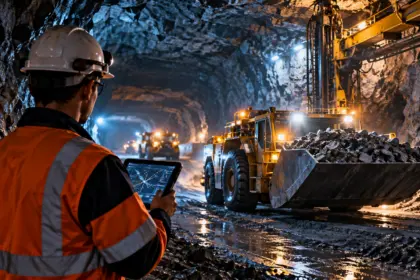

South Africa’s recent announcement of a R400-million exploration fund, a joint initiative by the Industrial Development Corporation (IDC) and the Department of Mineral Resources and Energy (DMRE), has been hailed as a positive step. However, industry experts warn that this fund is “a drop in the ocean” and more substantial efforts are needed to bridge the significant funding gap for exploration in the country. With under-explored areas and evolving exploration technologies, South Africa could unlock vast potential, but barriers such as regulatory delays, insufficient infrastructure, and investor hesitancy must be addressed to truly benefit junior miners and exploration companies.
Exploration Funding Gap and Missed Opportunities
The exploration funding gap remains a significant challenge for South Africa. While the R400-million fund is a welcome contribution, it pales compared to the investments made in other mining regions like Canada, which used tax incentives and flow-through shares in the 1960s to grow its thriving junior miner sector. According to Public Investment Corporation (PIC) mining specialist Heidi Sternberg, South Africa must implement similar measures, such as tax incentives or grants, to build a robust pipeline of exploration projects.
Sternberg emphasized during the recent Joburg Indaba panel discussion that “exploration technologies have changed, and the country is under-explored.” This opens up potential for discoveries, particularly in regions far from established mining hubs like Johannesburg and Cape Town, which could spur local economic growth.
Investor Hesitancy and Regulatory Roadblocks
Despite the growing interest in South Africa’s mining potential, investor hesitancy remains a significant barrier. Caroline Donally, managing partner at Sprott Resource Streaming and Royalty, pointed out the “chicken-and-egg” challenge: investors are willing to fund exploration, but only if exploration and drilling activities are already taking place. Without visible progress, funds may be directed elsewhere.
Furthermore, regulatory hurdles such as inconsistent legislation and the absence of a cadastre system—an online tool allowing investors to see who owns mining rights—deter foreign investment. Until these issues are addressed, there will continue to be a level of caution among international investors.
Logistics and Infrastructure: Key to Unlocking Potential
Improving logistics, particularly in electricity supply and transportation, is vital for attracting investment into South Africa’s mining sector. Sternberg pointed out that regions across the border from South Africa are rich in lithium and rare earth elements, but South Africa has the potential to become a hub for these industries if it can reduce electricity costs or allow companies to self-generate power. This would be a game changer for South Africa, enabling it to compete with neighboring countries for international investment.
Piet Viljoen, director at Merchant West Investments, echoed this sentiment, noting that while the country shows positive trends, much more evidence of improvement is needed before investors will commit to larger-scale projects. “Good feelings after elections are not enough; investors need to see things happening,” he said.
South Africa’s Path to Decarbonization and the Future of Mining
Another promising trend is South Africa’s push towards decarbonization. Research by the PIC revealed that seven out of eight mining companies in the country reduced their carbon emissions in the past year, with some companies achieving a 5% reduction in a single year. This is a notable achievement as the mining sector gears up to meet the global demand for greener products.
While South Africa’s copper exploration remains limited, Sternberg highlighted the potential for new projects in the near future if exploration efforts are scaled up. However, this will require more substantial funding and a clearer regulatory framework.
Conclusion: Will the R400-Million Fund Be Enough?
The R400-million exploration fund is a start, but it is clear that much more needs to be done to attract significant investments into South Africa’s exploration sector. As other regions continue to capitalize on their resources through tax incentives, improved logistics, and regulatory clarity, South Africa must step up its game to remain competitive. If the country can address these challenges, it holds the potential to become a significant player in the global mining industry, but the clock is ticking.