Steel Sector’s Resilience Faces Mounting Global Trade Risks
In a global market beset by rising tariffs and geopolitical tensions, iron ore price trends are emerging as a rare beacon of stability. Despite a flurry of trade barriers between the U.S. and China, iron ore has largely resisted the price shocks hammering other industrial commodities.
While copper and oil have plunged by double digits in recent weeks, iron ore has seen only a modest decline—down roughly 6% from $103 to $96 per ton. The question now is: how long can this relative strength hold?
Iron Ore Price Trends Signal Stability Amid Volatility
The current iron ore price trends reflect strong underlying demand—particularly from China. Futures prices on several exchanges have even ticked upward, defying expectations amid a backdrop of global economic uncertainty.
“Iron ore has outperformed expectations, buoyed by robust Chinese steel production and continued industrial activity,” said BHP Chief Commercial Officer Rag Udd. “We see prices remaining above $80 per ton in the near term.”
This resilience has been a tailwind for major producers like BHP, Fortescue, Vale, and Rio Tinto, many of which have recouped recent share price losses despite broader market volatility.
Related News
- New Cobalt Alternative Alloy Developed by U.S. Lab to Curb Reliance on China
- Ghana Tightens Resource Control with Takeover of Damang Mine in Mining Policy Shift
- U.S. Targets Cobalt Mining and Mineral Resources in Congo for Strategic Supply Chain Security
- Bank of Canada in Tight Spot as Trump’s Tariff Volatility Clouds Rate Decision
China’s Steel Engine Drives Upward Momentum
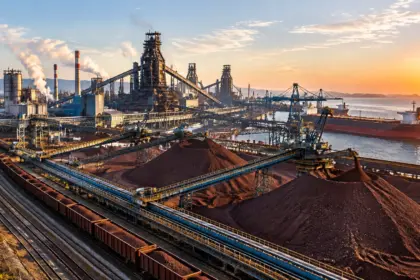
China remains the linchpin of iron ore price trends. More than 60% of BHP’s revenues last year came from Chinese steelmakers, who rely heavily on ore from Australia’s Pilbara region.
Despite a cooling property market, demand for steel from infrastructure and electric vehicle manufacturers has supported ore imports. ANZ analysts forecast continued strength in April, citing a slight increase in steel output and steady consumption levels.
“Markets have overlooked growth in newer sectors like EV manufacturing,” Udd added. “This demand could keep prices elevated longer than many anticipate.”
Tariff Anxiety and Trade Wars Pose Long-Term Risk
While short-term iron ore price trends appear bullish, trade tensions between the U.S. and China continue to cast a shadow over the outlook.
“If China retaliates further or if tariffs expand to include steel derivatives, we could see a swift downturn,” said Alex Glass, an analyst with RawMet Strategies. “For now, the market is pricing in resilience—but sentiment can turn quickly.”
Australia Faces Emerging Competition from Guinea
Australia may also face a structural challenge to its dominance in the export market. The Simandou mountains of Guinea—one of the world’s largest untapped iron ore reserves—are being developed by Rio Tinto in partnership with Chinese state-owned firms.
If fully operational by 2026, Simandou could alter global iron ore price trends, especially as it provides China with a non-Australian source of high-grade ore.
According to the Australian Department of Industry, the country still expects to export 900 million tons of iron ore this year, generating $117 billion in value. But long-term projections are increasingly factoring in the Simandou impact.
Looking Ahead: Resilience or Correction?
While iron ore price trends remain comparatively stable in 2025, they are highly sensitive to global events. If Chinese demand continues at pace and new supply remains constrained, prices may hold—or even climb. But a sudden escalation in trade friction, or faster-than-expected development of new mines, could shift momentum.
For now, iron ore remains the most resilient among core raw materials, offering miners and investors alike a rare pocket of stability in an otherwise stormy global market.