The China-Pakistan Economic Corridor (CPEC) is emerging as a pivotal force in reshaping Pakistan’s mining sector, as Islamabad courts global investors and leverages Chinese-backed infrastructure to unlock vast, underutilized mineral wealth.
Government officials have underscored CPEC as a strategic channel for revitalizing the mining industry, which remains largely dormant despite trillions in estimated reserves of copper, gold, lithium, and rare earths. With global demand for critical minerals accelerating, Pakistan is repositioning itself as a high-potential destination for mining capital—anchored by the physical and diplomatic foundation of the China-Pakistan Economic Corridor.
Related News
- U.S.-Led Peace Talks Could Unleash Rwandan Processing of Congo’s Critical Minerals
- Rare Earth Supply Chain Splinters as U.S. and Brazil Ramp Up Processing Capacity
- Green Hydrogen and Automation Are Redefining Mining—But Skills Lag Behind
- Mined Grassland Restoration in China: 7 Strategies to Tackle Carbon Loss Crisis
- Europe’s Critical Minerals Push Stalls Amid Poor Public Perception
CPEC Infrastructure Lays the Groundwork for Exploration
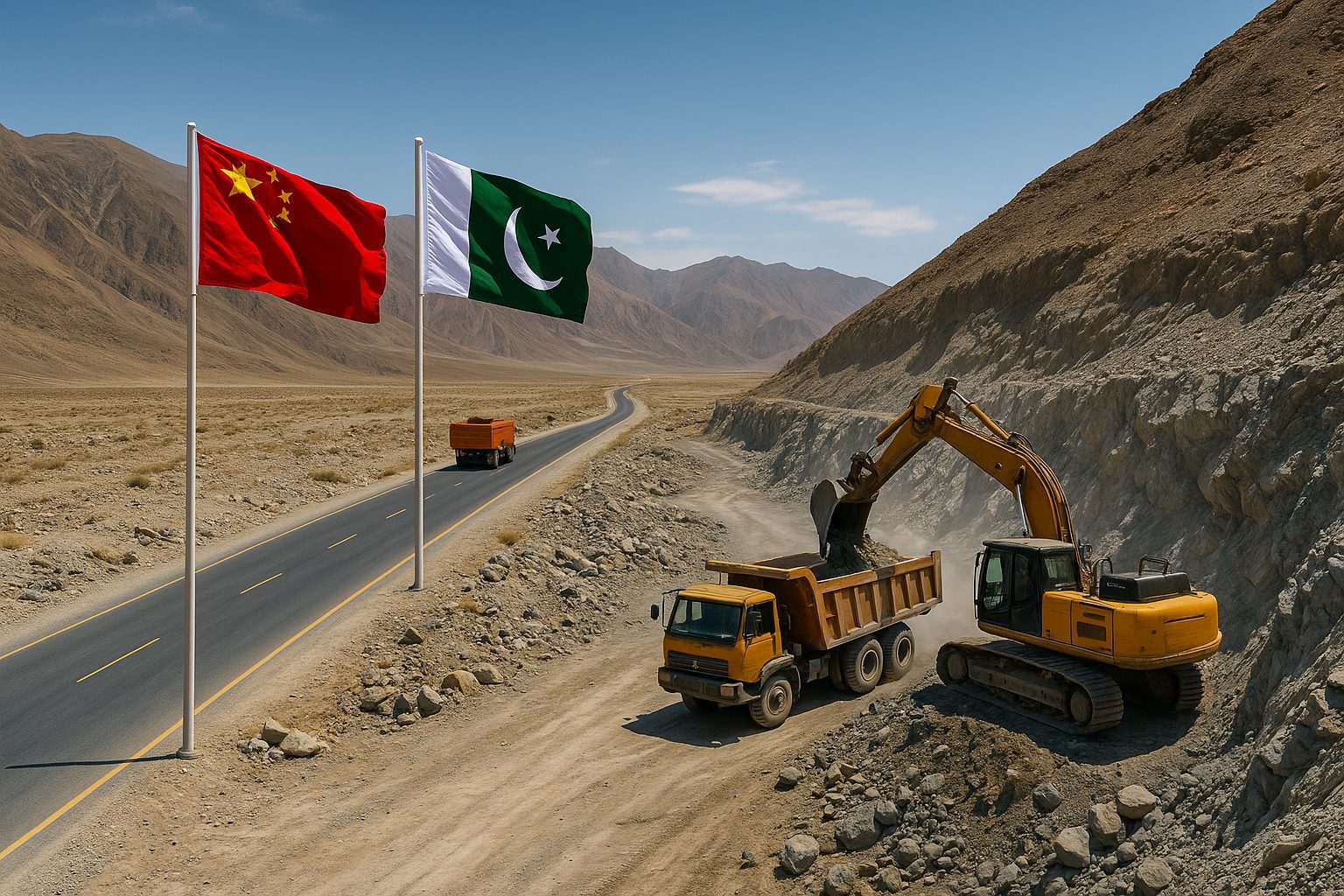
Under CPEC, a $62 billion initiative spearheaded by Beijing, Pakistan has made sweeping improvements to its transport, energy, and logistics networks. These upgrades are critical for mining feasibility, opening up previously inaccessible resource-rich zones such as Balochistan and Gilgit-Baltistan.
“The China-Pakistan Economic Corridor effectively de-risks mining logistics,” said Lahore-based consultant Ali Raza. “What was once a remote operation is now a connected hub.”
Roads funded under China-Pakistan Economic Corridor have drastically cut travel times to mineral belts, while new transmission lines help power-intensive extractive operations. These infrastructure wins are now a cornerstone in Pakistan’s mineral pitch to foreign investors.
FDI in Mining Attracts Global Attention
The mining sector’s share in Pakistan’s total foreign direct investment (FDI) has begun to inch upward, fueled in part by improved access and operational viability under China-Pakistan Economic Corridor. Mining giants from Australia, Saudi Arabia, and Canada have opened exploratory talks, while China continues to deepen its involvement via state-backed firms.
Projects like Saindak and Reko Diq—jointly developed by Chinese and Pakistani entities—embody the corridor’s multiphase model: infrastructure first, extraction second.
Beijing’s state-owned Metallurgical Corporation of China (MCC), a CPEC beneficiary, remains a key stakeholder in these flagship projects. Meanwhile, new entrants eye strategic minerals aligned with EV and green energy demand—industries where the China-Pakistan Economic Corridor could anchor supply chains.
Regulatory Overhaul Aims to Attract Investment
To complement CPEC’s physical progress, Islamabad is advancing legal reforms. These include digitized licensing, clearer royalty structures, and ESG-aligned environmental protocols—measures intended to bring Pakistan’s regulatory landscape closer to global standards.
“There’s a realization that CPEC infrastructure alone won’t draw capital,” said Dr. Fawad Khan of Quaid-e-Azam University. “You need investor certainty and institutional clarity.”
The Pakistani Senate recently passed amendments to the Mines Act to streamline approval processes—changes explicitly designed to attract multinational resource firms operating under the China-Pakistan Economic Corridor framework.
Security Remains a Pivotal Concern
Despite structural gains, security threats still hang over CPEC-linked mining projects, particularly in Balochistan. Militant attacks targeting CPEC personnel and sites have prompted government responses, including the deployment of a dedicated CPEC Security Division, backed by the military and local law enforcement.
While risks persist, officials say coordination has improved, and threat assessments are now integrated into planning for each China-Pakistan Economic Corridor mining zone.
Strategic Minerals and the Global Stakes
As Western countries attempt to reduce dependency on China for critical minerals, Pakistan’s deposits are drawing geopolitical interest. In this context, CPEC offers more than bilateral gains—it positions Pakistan as a central node in the global mineral supply chain.
Several Gulf nations, including the UAE and Saudi Arabia, are exploring joint ventures that would connect extraction sites in Pakistan with CPEC logistics corridors and the Gwadar deep-sea port, offering streamlined export routes.
Public-Private Models Under CPEC Gaining Ground
Beyond Chinese state-owned entities, Pakistan is piloting new public-private partnerships that combine domestic oversight with foreign capital and technology. These CPEC-aligned ventures aim to push beyond raw extraction toward beneficiation and local value creation.
“We’re building the architecture for an integrated mining economy,” said Fatima Asad of the Pakistan Mining Development Corporation. “CPEC is not just a road—it’s a multiplier.”
Outlook: CPEC as a Long-Term Mining Enabler
With geopolitical tailwinds and commodity prices rising, the China-Pakistan Economic Corridor is providing Pakistan with a rare second chance to turn mineral potential into fiscal reality. If Islamabad can sustain reforms and maintain security, CPEC may not just reshape transport routes—it could redefine Pakistan’s place in the global mining economy.