KEY TAKEAWAYS
- Iran launches 30 mining investment packages to court private-sector capital
- Forum aims to pivot toward technology-driven mining
- Over 70 joint public-private exploration projects completed in past five years
- Only half of Iran’s mineral resources fully mapped, officials say
- Analysts cite global competition, sanctions as key hurdles
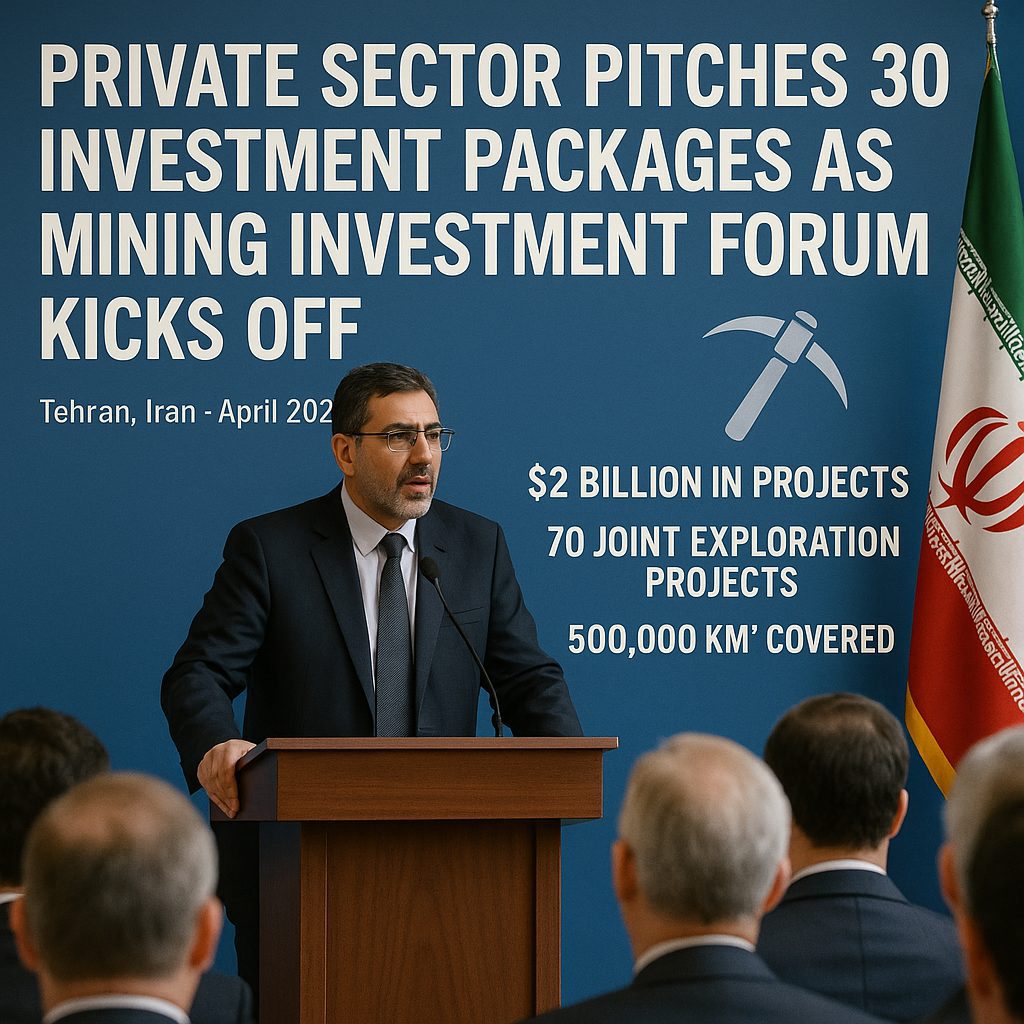
Tehran — In a packed convention hall buzzing with dealmakers and geologists, Iran’s mining authorities launched 30 private-sector investment packages on Sunday, opening the door to an estimated $2 billion in new capital inflows, according to industry analysts.
The move, unveiled at the Iranian Mining Investment Forum in Tehran, signals an ambitious pivot toward technology-led partnerships, at a time when global mining giants are racing to modernize operations amid rising demand for critical minerals.
“Global investment models have evolved — from resource-driven to capital-based, and now to technology-led,” said Touraj Zare’, head of the Iranian Mines and Mining Industries Development and Renovation Organization (IMIDRO)’s subsidiary IMPASCO. “Our goal is to empower the private sector at every step, forging strategic alliances that drive a smarter, more sustainable mining future.”
Zare’ outlined a new model that positions private firms not merely as financiers but as full-spectrum development partners — spanning data collection, analysis, exploration and operations.
The forum showcased tangible progress: in the past five years, IMPASCO has spearheaded more than 70 joint exploration projects with domestic companies, covering 500,000 square kilometers via aerial geophysics and geochemical surveys. Over 60 local firms have participated under various joint venture models.
Related News
- Rio Tinto’s Tomago Smelter Faces Uncertain Future Amid Bailout Talks
- Algeria’s Mining Shake-Up: Foreign Investors Could Own 80% Under New Plan
- Québec’s HE Mining Investment Event Draws Global Investors to Explore Sector Opportunities
- Rio Tinto’s Groundbreaking Deal Gives PKKP Owners New Power Over Mining Rights
Mapping Untapped Potential
Deputy Minister of Mining and Mineral Industries Vajiollah Jafari told attendees that Iran’s known mineral wealth remains underutilized. Of 80 identified mineral types in the country, only 40 have been properly surveyed and documented.
“Asset identification is our critical weakness,” Jafari said bluntly. “We must clearly know what resources we have — and address this challenge head-on if we are to achieve the 13% annual growth target.”
To that end, the Seventh National Development Plan now mandates greater private-sector involvement across both exploration and operational phases. The government has released new data packages, operational licenses and detailed 1:50,000-scale geological maps to incentivize investment.
What’s on Offer
Among the offerings: 270 exploration licenses bundled into 30 investment packages — designed to streamline entry for private firms.
“This is about activating dormant assets,” one government advisor said on condition of anonymity. “Private capital and modern technologies are essential to making these mines commercially viable.”
Industry Voices: Opportunities and Risks
Analysts welcomed the initiative but cautioned that structural hurdles remain.
“There’s clear potential here, particularly in copper, iron ore and rare earths,” said Dr. Sara Jalali, mining economist at the University of Tehran. “But international sanctions, financing constraints and outdated infrastructure could temper investor enthusiasm.”
In a global context, Iran’s drive echoes trends seen in other mineral-rich nations like Kazakhstan, which recently fast-tracked foreign partnerships in its mining sector to align with green transition demand.
“Global players are hungry for new supply chains outside China, but political risk remains a concern in Iran,” noted a recent International Council on Mining & Metals (ICMM) briefing.
Global Market Context
The forum’s timing is strategic. Global mining investment rose 8% year-on-year in 2024, according to World Bank data, driven by a surge in demand for lithium, copper and rare earths tied to the energy transition.
Iran’s mineral exports, however, lag regional peers — constrained by sanctions and logistical bottlenecks. In comparison, Turkey’s mining exports hit a record $6.5 billion in 2024, driven by aggressive private-sector integration.
The Road Ahead
Industry participants said unlocking Iran’s mineral potential hinges on fostering trust between state bodies and private actors — and navigating geopolitical complexities.
“Success in today’s market requires organizational agility, strategic collaboration and mutual trust,” Zare’ emphasized.
NGO voices urged transparency and environmental safeguards.
“We welcome private investment, but it must be paired with rigorous environmental standards and community engagement,” said a spokesperson for Iran’s Environmental Policy Think Tank (EPTT).
Looking ahead, officials pledged to revise regulatory frameworks and facilitate export pathways.
“If implemented effectively, these reforms could position Iran as a competitive regional player in mining,” said ICMM’s regional analyst in a forward-looking note. “But the window of opportunity is narrowing as global players race to secure critical mineral sources.”
FAQ SECTION
1. What are Iran’s new mining investment packages?
The government has introduced 30 investment packages bundling 270 exploration licenses to attract private-sector capital and expertise.
2. What minerals is Iran focusing on?
Key targets include copper, iron ore, rare earth elements, and other critical minerals needed for global supply chains.
3. What role will private firms play?
Private companies will act as full partners — from exploration through to development — under new strategic alliance models.
4. How does Iran compare to regional mining peers?
Iran lags countries like Turkey and Kazakhstan in private-sector integration and mineral export volumes, but seeks to close the gap.
5. What are the main risks for investors?
Sanctions, financing barriers, and infrastructure limitations remain key challenges for foreign and domestic investors.