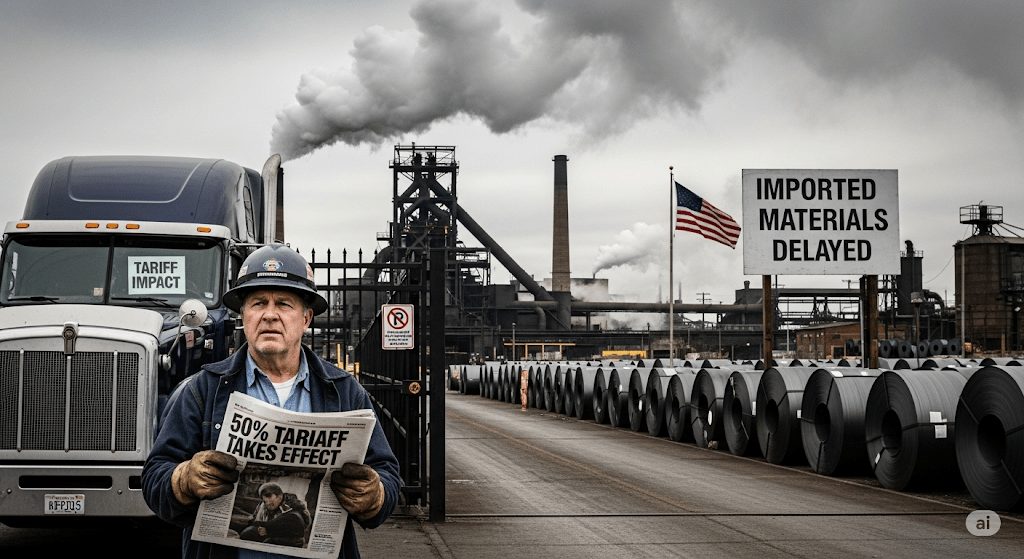
Trump tariffs 2025 are reshaping U.S. trade, raising steel and aluminum costs, and delivering a fresh economic shock to manufacturers and consumers.
A 50% levy on imported steel. Another 50% on aluminum. Tariffs on washing machines, refrigerators, even garbage disposals. In his second term, President Donald Trump has rearmed the U.S. economy with a weapon last wielded at scale a century ago: tariffs.
These policies—imposed swiftly, expansively, and with minimal Congressional oversight—have already redrawn the cost structure of American life. From new cars to kitchen appliances, prices are climbing. Businesses are delaying investments. And economists warn the economy is on a glide path toward contraction.
The Penn Wharton Budget Model estimates the long-run damage: a 6% reduction in U.S. GDP, a 5% drop in wages, and a $22,000 lifetime loss for the average middle-income household. These are not just numbers—they’re a tax on the everyday lives of American families. By most economic projections, the Trump tariffs 2025 are poised to contract GDP, dampen wage growth, and undercut household purchasing power.
The 2025 Tariff Landscape
An Economic Analysis of Renewed Protectionism
The Price to Pay: Estimated Consumer Price Hikes
Economists anticipate that the tariffs will translate into higher prices for a wide array of consumer goods as companies pass on increased costs.
Macroeconomic Projections
Economic models forecast a significant drag on the U.S. economy due to the comprehensive tariff strategy, affecting growth, wages, and household wealth.
-6%
Reduction in Long-Run GDP
-5%
Decrease in Long-Run Wages
$22,000
Lifetime Loss for Middle-Income Household
Source: Penn Wharton Budget Model (PWBM)
50%
Tariff on Imported Steel & Aluminum
Aimed at bolstering domestic industry, this significant levy impacts raw material costs across numerous sectors.
10%
Baseline Tariff on All U.S. Imports
A universal import tax establishing a new foundation for U.S. trade policy, with higher rates for specific countries.
Economic Policy Uncertainty
The erratic nature of tariff announcements has caused a spike in economic uncertainty, leading firms to postpone investment and hiring. The Economic Policy Uncertainty (EPU) Index doubled in early 2025.
A Volatile Relationship: US-China Tariff Timeline (2025)
The trade relationship between the US and China has been marked by a rapid and dramatic series of escalations and temporary de-escalations, creating immense global market uncertainty.
Feb 4
US: 10% Tariff ➔ China: Retaliation
US imposes 10% tariff on Chinese goods, citing opioid concerns. China counters with tariffs on US energy and machinery.
Apr 2 – 11
Rapid Escalation: US Tariffs Peak at 145%
A series of rapid increases sees US tariffs surge to 145%. China responds in kind, with its tariffs on US goods reaching 125%.
May 12
De-escalation: Tariffs Slashed After Talks
Following talks in Geneva, the US lowers its tariff rate to 30%, and China reduces its rate to 10% for a 90-day period.
Jun 11
New Claims: “Total of 55% Tariffs”
President Trump states the US will receive a “total of 55% tariffs” from China, a figure including pre-existing duties.
The “Protectionist Paradox”
While designed to protect domestic industries, tariffs on raw materials like steel create a “hidden tax” that can undermine the competitiveness of the very American manufacturers they are meant to help.
①
High Tariffs on Imported Steel
→
②
Higher Costs for US Manufacturers
(e.g., Whirlpool)
→
③
Higher Prices for US Consumers
→
④
Eroded US Competitiveness
Global Headwinds: Tariffs by Country/Region
The tariff policies have not been limited to China, affecting key allies and trading partners worldwide, sparking international condemnation and threats of retaliation.
Trump Tariffs 2025: Strategy, Shock, and Legal Risks
The administration presents its trade strategy as patriotic economics: a push to revive American industry and reduce dependence on foreign manufacturing. A 10% baseline tariff now covers nearly all U.S. imports, while targeted duties—such as the 50% rates on steel and aluminum—aim to punish countries seen as dumping low-cost goods into U.S. markets.
Home appliances face new levies calculated by steel content, ensnaring products from global brands like Samsung and LG. Even American manufacturers aren’t spared: many rely on imported components, which now cost more, eroding competitiveness and shrinking margins.
The Trump tariffs 2025 are among the most sweeping in modern history, targeting broad sectors with rate hikes rarely seen outside wartime.
? Trump tariffs 2025 Summary Table
| Category | Tariff Rate | Effective Date | Notable Impact |
|---|---|---|---|
| Imported Steel | 50% | June 4, 2025 | Price spike in cars, appliances, construction |
| Imported Aluminum | 50% | June 5, 2025 | Beverage packaging, housing materials affected |
| Appliances (steel-content) | Up to 50% | June 23, 2025 | Price hikes for washers, fridges, disposals |
| Universal Import Tariff | 10% | April 5, 2025 | Across-the-board cost increases |
Human Cost in Economic Clothing
Inflation, once tamed, is beginning to stir. May saw a 2.4% rise in consumer prices, with core inflation holding at 2.8%. Appliance prices jumped 4.3%. Homebuilders report material cost increases of over $10,000 per new home.
The regressive nature of these hikes hits hardest at the lower and middle class. Food, clothing, school supplies—all are getting more expensive. The Yale Budget Lab calls tariffs “functionally a backdoor income tax hike.”
Business Paralysis, Strategic Confusion
Manufacturers are absorbing costs or passing them on. Walmart and Smucker are already raising prices. Other firms are evaluating automation, or reshoring—though the policy uncertainty discourages long-term capital spending. The Conference Board’s confidence index has fallen five straight months.
Critically, it’s not just the tariffs. It’s the whiplash. Overnight tariff hikes followed by partial reversals—like China’s drop from 145% to 30%—make forward planning nearly impossible. “This is not a rules-based system anymore,” said Michael Peers, CFO of a Midwestern tools supplier. “It’s a coin toss.”
Legal Earthquake Underfoot
On May 28, two federal courts ruled the President’s use of the International Emergency Economic Powers Act (IEEPA) exceeded legal limits. Tariffs on Canada, Mexico, and China were found to be unlawfully imposed. Though stayed on appeal, the rulings cast doubt on the legal scaffolding of the entire tariff regime.
Businesses are now operating in limbo—charged import duties that may soon be ruled invalid, refunded, or altered. The appeals process stretches into late summer. The uncertainty alone is already exerting an economic toll. The legal fragility of the Trump tariffs 2025 introduces further volatility for industries reliant on predictable trade policy.
A Global Response — And Retaliation
America’s trading partners are not standing still. The EU is preparing $26 billion in countermeasures. China, Japan, South Korea, and even Canada have issued sharp rebukes and retaliatory duties. The IMF warns of a broader slowdown. JPMorgan forecasts a higher risk of U.S. recession before year-end.
The Protectionist Pivot: Trump Tariffs 2025 in Historical Context
The shift is not just tactical. It’s philosophical. Trump’s policies evoke the “restriction period” of U.S. trade history—1861 to 1933—when tariffs routinely hovered at 50% and free trade was a dirty phrase. Today’s average effective U.S. tariff, estimated at 27%, is the highest in over a century.
Whether this approach delivers long-term manufacturing gains remains to be seen. What is already clear: American consumers and businesses are footing the bill for an experiment whose costs are rising by the day.
Key Takeaways
- 50% tariffs imposed on imported steel and aluminum, effective June 2025.
- Trump Tariffs 2025 expanded to home appliances based on steel content — affecting Samsung, LG, and Whirlpool.
- Penn Wharton Budget Model forecasts 6% GDP contraction, 5% wage drop, $22,000 lifetime income hit for middle-income families.
- Legal challenges cite overreach under IEEPA; appeals are pending.
- U.S. allies respond with retaliatory tariffs; global trade uncertainty intensifies.