Key Takeaways
- Jharkhand becomes the first Indian state to launch formal mining tourism.
- Project opens operational coal sites to public tours, combining industrial education with regional tourism.
- Pilot phase begins at North Urimari open-cast mine in Ramgarh, supported by Coal India’s CCL.
- Plans underway to add religious, ecological, and underground mining circuits.
- Officials position the initiative as long-term investment in economic diversification.
In Ramgarh district, the steady hum of draglines and dump trucks will soon compete with camera shutters and tour guides.
Jharkhand, India’s coal-rich eastern state, is launching the country’s first formal mining tourism program—a rare move to open operational coal mines to the public. The initiative marks a turning point in how the extractive sector interacts with civil society: not as a backdrop to economic statistics, but as a centerpiece of curated exploration.
Reframing Extraction
The state’s pivot toward tourism was catalyzed by Chief Minister Hemant Soren’s visit to Barcelona’s Gava Museum of Mines, where relics of ancient extraction are displayed with pride. Inspired by how Europe has repurposed its industrial past for public engagement, Soren returned determined to reimagine Jharkhand’s legacy.
“Jharkhand has always been known as a mining state,” said Tourism Minister Sudivya Kumar. “Now, it becomes one where mining is part of the public experience.”
A memorandum of understanding with Central Coalfields Limited (CCL), a Coal India subsidiary, formalized the effort. The Jharkhand Tourism Development Corporation (JTDC) will run the program, backed logistically by CCL.
From Temple Stops to Coal Pits
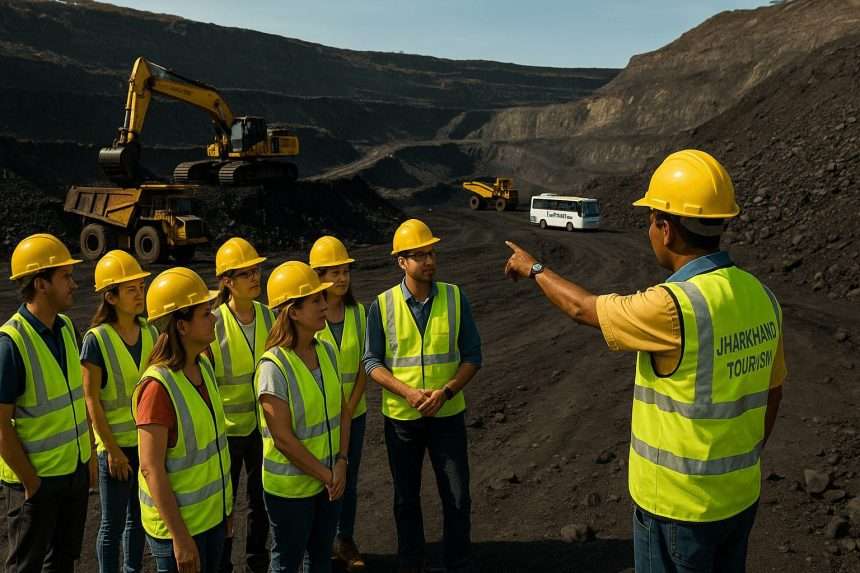
The pilot begins with twice-weekly tours of the North Urimari (Birsa) open-cast coal mine. Two curated routes offer a blend of industrial and cultural landmarks:
- Rajrappa Route (₹2,800 + GST): includes the Chinnamastika temple and Patratu valley.
- Patratu Route (₹2,500 + GST): visits Paryatan Vihar en route to the mine.
Each tour is capped at 20 participants, includes lunch, and features guided site access to active mining areas. Officials say safety protocols are modeled on standards used for internal inspections.
But unlike heritage mines turned into museums abroad, North Urimari remains operational—a fact that lends authenticity, and risk.
Long-Term Vision, Uncertain Payoff
JTDC Managing Director Prem Ranjan called the project “a long-term investment in alternative tourism,” declining to estimate revenue potential. More circuits are in planning, including a tie-up with Bharat Coking Coal Limited (BCCL) in Dhanbad.
Officials say three routes are being conceptualized: Eco-Mining Circuit-1, Eco-Mining Circuit-2, and a Religious Circuit. These will combine tribal heritage sites, scenic corridors, and live mine visits into thematic tours.
Jharkhand, which holds nearly 40% of India’s known mineral reserves, has historically struggled to convert its geological wealth into broad-based tourism. The mining initiative aims to change that, while also creating new employment paths beyond extraction.
Between Transparency and Theater
Skeptics worry the project could drift into soft-focus storytelling, sanitizing the sector’s long record of displacement and environmental damage.
“If these tours become PR events without reckoning with the sector’s impacts, the public will see through it,” said Arvind Chaudhary, professor of anthropology at Ranchi University. “But if it includes honest education—on labor, on pollution, on safety—it could actually bridge a critical gap.”
Government planners say interpretive exhibits, oral histories, and educational modules are part of future phases. School partnerships and rotating art installations have also been discussed.
Global Precedent, Local Identity
Mining tourism isn’t new. Post-industrial Europe has long capitalized on its pits and quarries, transforming decline into nostalgia. In Germany’s Ruhr Valley and the UK’s Cornwall, defunct mines now draw millions.
But Jharkhand’s model is unique—melding live extraction with cultural landmarks in one itinerary. It is also rooted in a region where industrial development has often marginalized tribal populations and degraded the environment.
Officials insist the program aims to reverse that.
“We’re not hiding anything,” Kumar said. “We’re inviting the world to see what mining really is—its machinery, its workers, its impact, and its place in our identity.”