Key Takeaways
- Ghana mining law reform introduces shorter leases and ends automatic renewals.
- Firms must share mineral revenues directly with local communities.
- Reform reflects West Africa’s broader trend to capture more resource value.
- Medium-scale mining category created to formalize informal operations.
- Stability agreements to be restricted to capital recovery periods only.
Ghana has unveiled sweeping changes under its 2025 mining law reform, aiming to shorten licence durations, eliminate automatic renewals, and mandate direct revenue sharing with host communities. It’s the country’s most ambitious update to its minerals policy in nearly two decades.
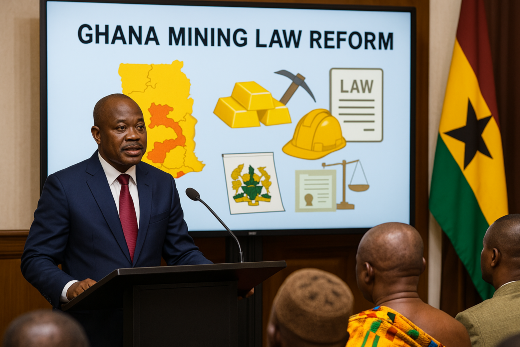
Emmanuel Armah Kofi Buah, Minister for Lands and Natural Resources, said the Ghana mining law reform is 85% complete and stems from extensive consultations with stakeholders across the country. Speaking in Accra, Buah confirmed that the reform will apply only to new contracts, avoiding retroactive enforcement that has sparked investor unrest in neighboring countries.
“In Ghana, we don’t do retrospective laws,” Buah said. “Existing agreements are sanctified and will be respected.”
Shorter Leases, Stricter Compliance
Under the new legislation, prospecting licences will no longer be held indefinitely. The maximum term for mining leases—currently capped at 30 years—will be shortened, with exact durations negotiated per project. Companies that fail to meet environmental or social obligations will lose the right to automatic renewal.
This clause is at the heart of the Ghana mining law reform, aligning the country’s legal framework with international accountability standards.
Key Elements of Ghana’s 2025 Mining Law Reform
| Reform Category | Previous Policy | Proposed Change (2025) |
|---|---|---|
| Licence Duration | Up to 30 years | Reduced, negotiated per contract |
| Auto Renewal | Common for compliant firms | Only upon full environmental & social compliance |
| Revenue Distribution | Sent to Central Government | Fixed % of gross sales to local development |
| Development Agreements | Permitted | Abolished |
| Stability Agreements | Up to 15 years | Limited to capital recovery period |
| Medium-Scale Licences | No legal category | New tier introduced |
Revenue Shift to Communities
A landmark change within the mining law reform in Ghana is the end of development agreements in which revenues are routed through the central government. Instead, mining companies will be obligated to contribute a fixed percentage of gross mineral sales directly to local development initiatives.
Communities have long complained that they see little benefit from gold, bauxite, and manganese extraction in their regions. “The minerals belong to the people,” Buah said. “They must see the benefit—not just hear about it.”
Mid-Sized Miners Get Legal Recognition
The 2025 Ghana mining law reform also introduces a new medium-scale licence category—aimed at closing the regulatory gap between artisanal miners and large multinational operators. The move is expected to formalize a sizable segment of informal miners, offering legal protections and clearer obligations.
Dr. Emmanuel Abbey, a mining policy scholar at the University of Ghana, said the new licence class “could unlock local entrepreneurship if properly enforced.”
Investor Outlook: Stability in Question
Currently, stability agreements offer tax and regulatory protection for up to 15 years. The reform will restrict these to capital recovery phases only, a move likely to affect the risk calculus of foreign investors.
Still, Ghana is sending signals of continuity. “We’re not tearing up contracts—we’re building forward,” a senior official said.
Analysts say Ghana’s approach diverges from Mali and Burkina Faso, which have rewritten mining codes retroactively. Instead, Accra’s version of mining nationalism aims to balance community equity with investor clarity.
What Comes Next
The Ghana mining law reform bill is expected to reach Parliament before year-end. Once enacted, it will reposition Ghana within West Africa’s shifting extractive landscape—where the debate is no longer just about how much is mined, but who benefits.