Key Takeaways
- GSI confirms gold-bearing soil in Mahgawan Keolari, Jabalpur, Madhya Pradesh.
- Discovery could influence global gold supply and reduce India’s import reliance.
- Potential reserves span ~100 hectares, with copper also detected.
- Proximity to Katni’s Imliya gold belt adds geological significance.
- Commercial viability yet to be proven; detailed exploration ahead.
A gold discovery in central India’s Madhya Pradesh could influence global bullion flows if early estimates hold true, adding a new source of supply to a market dominated by a handful of producing nations. But India’s Geological Survey is urging restraint until the deposit’s size and economic viability are proven.
Geologists have confirmed the presence of gold-bearing soil in the Mahgawan Keolari area of Jabalpur district, a site spanning about 100 hectares and situated near the established Imliya gold block in neighbouring Katni. Preliminary data suggest reserves could reach into lakhs of tonnes, potentially ranking among the largest finds in recent Indian history.
“This is an encouraging start, but it would be premature to speak of a large-scale mine,” said Asit Saha, Director General of the Geological Survey of India (GSI). He noted that mining is commercially viable only when the concentration of recoverable gold outweighs the costs of extraction — a determination that will require months of drilling and laboratory analysis.
From Regional Deposit to Global Relevance
The discovery comes at a time when gold miners worldwide are under pressure to replace aging deposits. Global production has plateaued in recent years, while demand — driven by central bank purchases, retail investment and industrial use — remains strong.
India, a major gold consumer but a minor producer, could alter its role in the market if Jabalpur’s reserves prove significant. A viable mine could reduce import dependence, ease the country’s trade deficit and feed directly into the global supply chain, especially in Asia, where most bullion is refined and traded.
Table: India’s Key Mineral Reserves and Share of National Output
| Mineral | MP Share (%) | National Rank | Notes |
| Diamond | 90% | 1st | Only active diamond mining state |
| Diaspore | 74% | 1st | Major industrial mineral |
| Laterite | 55% | 1st | Used in alumina production |
| Pyrophyllite | 48% | 1st | Ceramic and paint industry |
| Molybdenum | 41% | 1st | High-strength steel alloying |
| Copper Ore | 19% | 2nd | Found alongside gold in Jabalpur |
| Gold (potential) | TBD | — | Under exploration in Mahgawan Keolari |
Strategic Geography
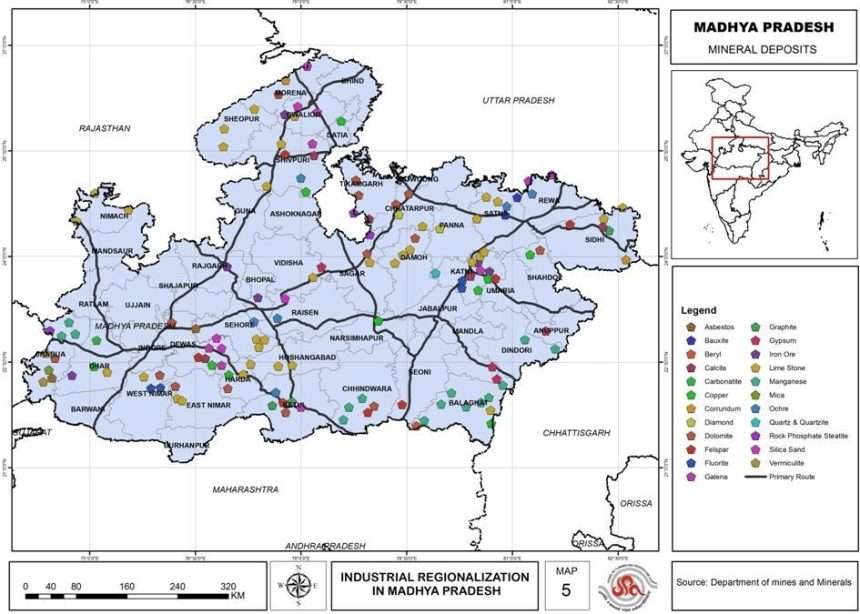
Jabalpur sits within a broader mineral belt already hosting iron ore, manganese, limestone and copper operations. The proximity to Katni’s Imliya gold project, leased for 50 years, hints at a contiguous geological zone ripe for integrated mining. Copper traces found alongside gold at Mahgawan Keolari could also attract interest from multi-metal producers seeking to diversify output.
Investor Interest Meets Local Expectations
Market analysts say the discovery could draw foreign mining investment if India’s regulatory and environmental frameworks support timely development. In Mahgawan, village leaders hope mining will bring jobs, infrastructure and electricity — a familiar set of promises in resource-rich but infrastructure-poor regions.
Madhya Pradesh already dominates India’s diamond production and holds major shares of diaspore (74%), laterite (55%), pyrophyllite (48%) and molybdenum (41%) reserves. Adding gold to that list could make the state a central player in India’s mining portfolio — and a small but meaningful entrant into the global gold supply map.
Next Steps
GSI will now conduct core drilling, geochemical sampling and reserve estimation before any decision on commercial extraction. If confirmed, development would require environmental clearances, infrastructure investment and likely partnerships between state agencies and global mining firms.
For now, the Mahgawan Keolari site remains an early-stage asset — one that has captured market attention but still faces the long path from promising geology to global gold bars.