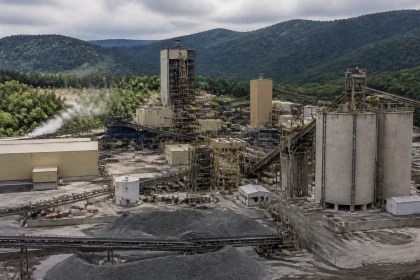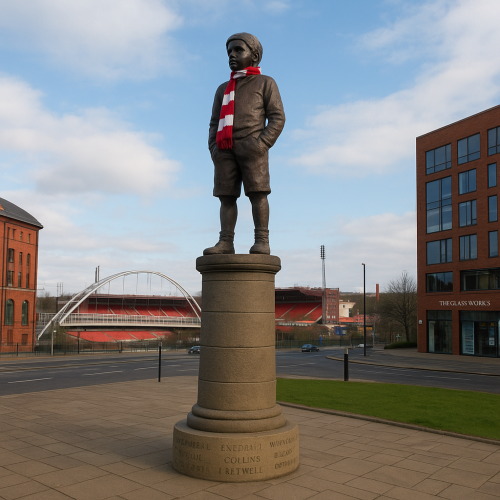
Barnsley’s proud coal heritage was once again placed firmly at the centre of civic life this week as the Barnsley Boy statue returned to the town centre after four years in storage. The six-metre column sculpture, created by Scottish artist Kenny Hunter, now stands on Midland Street beside the Tommy Taylor Memorial Bridge, overlooking Oakwell Stadium and facing the site of the Oaks Colliery disaster of 1866.
The statue’s reinstallation is more than an aesthetic decision. It embodies Barnsley’s ability to reconcile a mining past that built the community, with a regeneration agenda designed to carry it into a more diversified future.
Mining Made This Town
First unveiled in 2012, the Barnsley Boy portrays a child atop a column representing the Barnsley Seam, one of Britain’s most productive coal deposits. At the base, Yorkstone paving stones engraved with the names of local collieries remind residents of a network of pits that once sustained entire villages.
At Thursday’s rededication, Sir Stephen Houghton, leader of Barnsley Council, stressed the importance of embedding history in modern identity:
“Mining made this town, made this borough, made us the people we are – we must not forget that.”
The event featured the Made2Measure Brass Band, echoing the colliery brass band tradition, and was attended by representatives from the National Union of Mineworkers (NUM). The NUM’s continued presence in Barnsley highlights how deeply coal remains woven into the civic fabric, even decades after pit closures.
Symbolism and Memory
Artist Kenny Hunter described himself as “delighted” at the Barnsley Boy’s return to such a “prestigious and prominent position.” The decision to place the figure facing Oakwell Stadium, home of Barnsley FC, reinforces the interplay between mining culture, football culture, and civic pride. Fittingly, the boy was unveiled wearing a Barnsley FC scarf.
Yet the statue is not only about resilience—it is also about remembrance. Chris Skidmore, Yorkshire area chair of the NUM, pointed out that the boy gazes toward the site of the Oaks Colliery disaster, where 361 men and boys perished in a methane explosion in 1866—the worst mining accident in England’s history.
“Far too many kids got killed underground,” Skidmore said. “It is unwise to forget about what happened in those villages and the people not only who worked there, but the people who died there.”
By connecting children, football, and mining tragedies, the Barnsley Boy captures the community’s layered identity: endurance, pride, and loss.
Barnsley’s Regeneration: Past Anchored in the Future
The statue’s reinstatement coincides with Barnsley’s town centre regeneration programme, notably The Glass Works, a £210 million retail and leisure hub completed in 2021. While the Glass Works signals a forward-looking economy built around retail, leisure, and creative industries, the Barnsley Boy ensures that industrial history remains visible within that landscape.
Like other northern towns, Barnsley faces the challenge of post-industrial transformation. Once dependent on coal, its economy today is shifting toward digital services, health, and education. Heritage remains a strategic asset: attractions such as the Elsecar Heritage Centre and the preserved Barnsley Main colliery headgear reinforce identity while contributing to tourism and education.
The Barnsley Boy demonstrates how a mining past can complement—not conflict with—economic renewal. It offers a blueprint for how industrial memory can be integrated into regeneration strategies, ensuring communities do not lose cultural anchors while pursuing future growth.
Skillings Analysis
- Resilience through identity: Mining heritage remains central to Barnsley’s civic narrative. The Barnsley Boy ensures regeneration acknowledges—not erases—that legacy.
- Memory and regeneration: By linking coal history to modern leisure and retail investment, Barnsley illustrates how mining memory can enhance civic renewal.
- Global relevance: For post-industrial communities worldwide, Barnsley shows how mining history can be re-framed as a long-term asset in urban regeneration.
Looking Ahead
The return of the Barnsley Boy is more than symbolic. It marks a moment when Barnsley embraces both its mining past and its post-industrial present, showing residents and investors that regeneration can build without severing roots. As the town heads into the next quarter with its retail hub bedding in and Christmas trade cycles approaching, the Boy stands watch—reminding Barnsley, and those who visit it, that resilience is forged from remembering where you came from while keeping eyes firmly on the future.