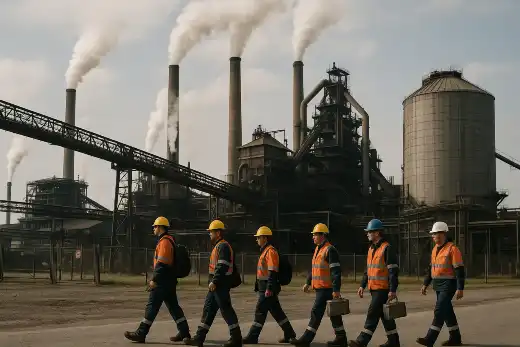
Glencore (LSE: GLEN), one of the world’s largest diversified miners, has begun a formal retrenchment process across its South African ferrochrome and vanadium portfolio, putting thousands of jobs and significant production capacity at risk. The move highlights mounting economic pressures within a sector already grappling with energy instability, rising costs, and policy uncertainty.
Retrenchments Target Core Ferrochrome and Vanadium OperationsThe retrenchments span multiple high-profile assets:
- Boshoek and Wonderkop ferrochrome smelters in Rustenburg.
- The Lion smelter, facing a potential 50% capacity reduction.
- Rhovan vanadium operations in the North West province.
- Glencore’s carbon division in Emalahleni.
- Linked support services across Rustenburg, Lydenburg, and head office operations.
The process remains consultative. Under South African labor law, engagement with unions and employee representatives is mandatory before job cuts can be finalized. Still, Solidarity union deputy general secretary Willie Venter has warned of potentially 2,425 direct job losses, with ripple effects threatening more than 17,000 indirect jobs across supply chains and communities.
This comes on the back of long-standing production challenges: Glencore has already closed—temporarily or permanently—10 of its 22 furnaces in South Africa, reducing ferrochrome output well below pre-pandemic levels.
Structural Headwinds in South Africa’s Ferrochrome Sector
South Africa controls roughly 80% of global chrome ore reserves, historically making it the cornerstone of global ferrochrome production. Yet the country’s smelting industry has been steadily losing competitiveness.
The key drivers include:
- Chronic power cuts (load shedding): Ferrochrome smelters require uninterrupted energy flows; frequent Eskom outages have caused repeated stoppages.
- Escalating electricity tariffs: Energy accounts for up to 40% of ferrochrome production costs, making South African output increasingly uncompetitive compared to China, Kazakhstan, and India.
- Economic distress: Domestic demand has stagnated while export competition has intensified.
Glencore suspended output at several facilities in May due to these combined pressures, underscoring the fragility of the operating environment.
Policy Moves: Chrome Export Tax Debate
In July, the South African government floated a chrome ore export tax while promising reduced power tariffs for ferrochrome producers. The stated aim was to protect domestic smelters by ensuring more ore is beneficiated locally.
However, industry bodies including the Minerals Council South Africa have pushed back strongly, arguing the tax could backfire. Their position: curbing exports would depress prices, strain liquidity, and accelerate job losses rather than stabilizing the sector.
This retrenchment announcement now sharpens the urgency of that debate. For policymakers, the risk is clear: interventions that fail to address structural energy and cost barriers could permanently erode South Africa’s downstream processing industry.
Why This Matters for Global Markets
Ferrochrome is a critical feedstock for stainless steel production, while vanadium is essential in both high-strength steel alloys and emerging battery technologies. South Africa’s retreat from these markets risks further concentrating supply chains in regions with more stable cost structures, notably China and Kazakhstan.
For international buyers, reduced South African output could mean higher reliance on Asian suppliers, adding price volatility at a time when stainless steel demand is projected to expand by 3–4% annually through 2026.
Skillings Analysis
- Strategic drift: Glencore’s retrenchments underline how even vertically integrated majors cannot overcome structural disadvantages when energy reliability collapses.
- Policy bottleneck: Without decisive regulatory reforms—particularly around Eskom’s tariff regime—the ferrochrome industry faces a steady hollowing-out.
- Global supply risk: Vanadium retrenchments are especially concerning, as vanadium redox flow batteries gain traction in grid-scale storage. Any South African supply shrinkage could tighten an already fragile market.
Outlook
The retrenchment process may yet produce negotiated outcomes that reduce the scale of job losses. But the trendline is clear: without affordable, stable energy and a predictable regulatory framework, South Africa’s ferrochrome and vanadium industries will continue to contract.
As the year heads toward the critical fourth-quarter stainless steel demand cycle, the industry will be watching whether Pretoria accelerates energy reforms—or whether further closures mark the start of a long-term structural decline in South Africa’s role as a ferrochrome hub.