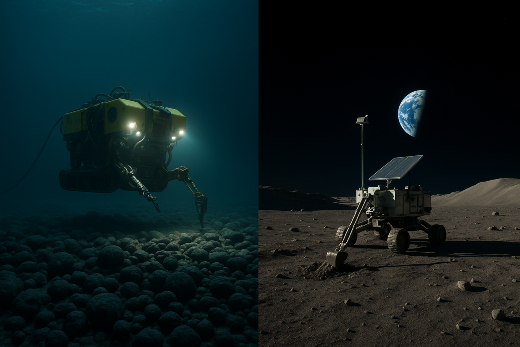
Deep sea mining and space mining 2025 have become the twin frontiers of a global race for critical minerals, redefining how—and where—humanity extracts its future resources.
A race to secure critical minerals is moving off‑planet — and under the ocean
As demand for nickel, cobalt, copper, and rare earths climbs with electrification, policymakers and companies are looking beyond terrestrial deposits. From the abyssal plains of the Pacific to the south‑polar craters of the Moon, new resource plays are taking shape—alongside fierce debates over ethics, law, and biodiversity.
The Deep Sea: Promise, protest, and political gridlock
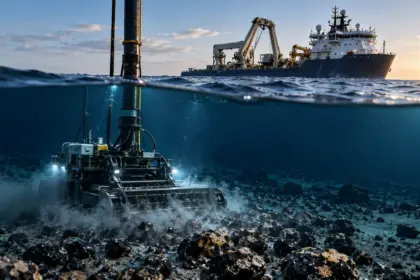
ISA deadlock in 2025. The International Seabed Authority’s July 2025 council session ended without a final Mining Code for exploitation in international waters. That outcome keeps would‑be operators—especially nodule projects in the Clarion‑Clipperton Zone (CCZ)—in holding patterns despite prior pilot‑scale tests.
Environmental alarms grow. New research in 2025 indicates ecological scars from seabed disturbance can persist for decades, strengthening calls for a moratorium. At least three dozen countries now support a pause or ban until deep‑sea ecosystems and plume behavior are better understood, measured, and enforceable under verifiable standards.
National reversals and public pressure. Norway, once out in front, suspended domestic seabed mining in late 2024 amid legal and public scrutiny. Pacific leaders, including French Polynesia’s presidency, warn of irreversible impacts in some of Earth’s most biodiverse waters.
Technology readiness. Seafloor crawlers, riser‑and‑lift systems, and dynamic positioning vessels have proven viable in trials. The missing pieces are large‑scale environmental baselines, third‑party monitoring protocols, and a globally accepted rulebook with liability and benefit‑sharing.
Space Mining: From science fiction to lunar blueprints
ISRU moves to the foreground. NASA’s IM‑2 mission (Feb 2025) tested drilling and mass‑spectrometer hardware aimed at locating and characterizing volatiles in the Moon’s south‑polar regions. The near‑term economics point to in‑situ resource utilization (ISRU)—making fuel, oxygen, and construction feedstock locally—rather than returning bulk metals to Earth.
Commercial cadence. Startups like AstroForge are flight‑testing low‑cost probes to scout and sample near‑Earth asteroids, while scientists spotlight temporary “mini‑moons” as realistic training grounds. The Artemis Accords continue to shape norms for resource activity consistent with the Outer Space Treaty.
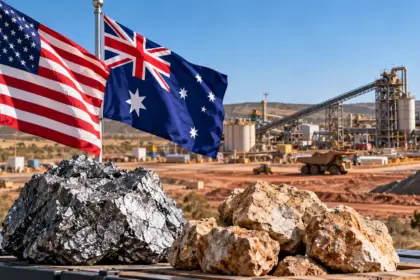
Law and diplomacy. National space‑resource laws (e.g., U.S. 2015; Luxembourg 2017) recognize private rights to extracted resources, but not ownership of celestial bodies. Expect continued debate in UN forums as more nations join lunar logistics and prospecting missions.
Two frontiers, one dilemma
| Domain | Key Opportunity | Key Risk | 2025 Flashpoint |
|---|---|---|---|
| Deep‑Sea Mining | Battery‑metal supply at scale | Biodiversity loss; long‑lived sediment plumes; weak enforcement | ISA fails to adopt exploitation code; moratorium momentum |
| Space Mining | Fuel and materials for a cislunar economy | Legal ambiguity; mission risk; cost | NASA IM‑2 tests; private asteroid probes; Artemis norms |
Both domains promise strategic mineral security yet carry moral weight. Advocates see indispensable inputs for the energy transition; opponents warn of extending extractive models into pristine realms.
What to watch (2025–2035)
Deep sea: 1) Progress on ISA Mining Code; 2) larger environmental trials with independent sensors and eDNA; 3) national EEZ seabed policies in Asia‑Pacific; 4) financing structures that price biodiversity risk.
Space: 1) Artemis lunar surface operations with resource‑handling demos; 2) prospecting flybys and small sample returns; 3) agreements under UN COPUOS clarifying resource rights; 4) maturation of ISRU (regolith sintering, oxygen extraction, water handling).
Skillings Analysis
- The pause is governance in progress. The ISA stalemate reflects an attempt to align science, liability, and equity. The longer the delay, the higher the chance of bilateral workarounds that fragment ocean governance.
- ISRU first, Earth‑return later. Economics favor in‑space use (propellant, life support, shielding) before bulk metal return. Early wins will come from lowering lunar mission costs rather than selling platinum on Earth.
- The resource map is shifting. Whether undersea or off‑world, the frontier signals that easy terrestrial gains are over. The next decade will reveal whether new rules and technologies can avoid old mistakes.