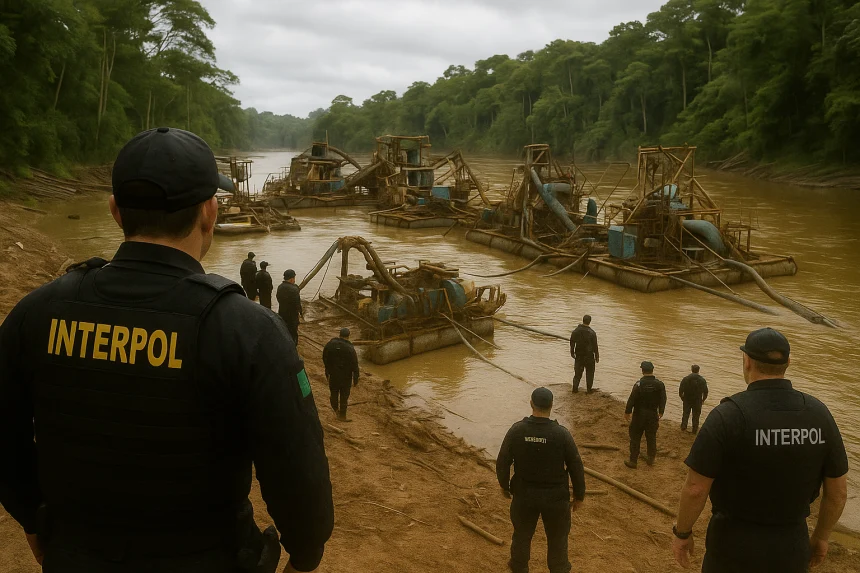
In the early hours of November 2025, Brazil’s federal authorities—backed by the international policing agency INTERPOL—launched a major crackdown on illegal gold mining, shutting down 277 floating dredges operating on the Madeira River, a key tributary of the Amazon. The equipment alone is valued at US $6.8 million, while investigators estimate the broader financial disruption to the criminal mining networks at around US $193 million. For mining industry analysts, firms with Amazon-region exposure, and compliance professionals concerned about minerals supply-chain risks, this operation signals a paradigm shift: what was once resource regulation is increasingly being treated as organised crime and environmental crime combined.
Operation Boiuna: Scope, Scale and Sector Implications
The so-called “Operation Boiuna” deployed more than 100 officers from the Brazilian Federal Police and its specialised Amazon & Environment Protection Division, supported by liaison officers from Bolivia, Colombia, Guyana, Peru and Suriname via the newly formed Amazon International Police Cooperation Centre (CCPI Amazônia). Using satellite imagery and intelligence overlays, authorities mapped roughly 400 km² of river and forest territory impacted by illegal dredging.
From a mining sector perspective, the key takeaway is that an estimated US $193 million disruption includes not just the dredges, but lost gold, environmental remediation, social costs and profit disruption for criminal networks. This raises two issues for legitimate gold producers and miners operating in South America: first, the reputational, regulatory and supply-chain risk posed by illicit operations; second, the collateral environmental and social damage that may impact permit regimes and cost of capital.
Why It Matters for Mining Companies and Professionals
Environmental and Remediation Risk
Illegal dredging along the Amazon does more than strip gold—it causes deforestation, river-bed destabilisation, massive sedimentation and introduces mercury and cyanide into the ecosystem. Authorities collected sediment and fabric samples for forensic analysis and biological samples from local residents to assess mercury exposure. For legitimate mining firms, this highlights the growing regulatory scrutiny of toxic-metal legacy impacts and the potential for extended liability, especially in jurisdictions with weak oversight.
Supply-Chain and Smuggling Exposure
Beyond the physical dredges, the enforcement strategy focuses on the financial, logistical and transnational networks that underpin the illegal gold trade. INTERPOL issued a “Purple Notice” warning of a new modus operandi for gold-smuggling. For mining professionals and compliance officers, this underscores the need to map supply-chain provenance, implement traceability and ensure no link to illicit extraction. The report from the United Nations Office on Drugs and Crime (UNODC) states illegal gold mining is often driven by organised crime, fraud and weak controls.
Governance and Country-Risk Implications
Brazil’s operation comes in the lead-up to the international climate summit COP30 and signals the government’s willingness to deploy advanced enforcement in remote regions. For mining companies with holdings in Amazon-adjacent jurisdictions or emerging-market regimes, this marks a deterrence shift: illegal operations increasingly carry the tag of organised crime rather than mere regulatory nuisance. Risk modelling must factor in stronger state action, cross-border coordination and enhanced forensic capability.
How the Operation Was Carried Out: Intelligence, Tech & Multi-agency Coordination
Brazil’s approach combined satellite imagery, real-time database checks via INTERPOL, and extensive forensic sampling. The gold-tracking “fingerprint” or “DNA” technique—where isotopic and spectroscopic analysis links gold to its origin—was documented previously by Reuters as part of Brazil’s wider crackdown. For mining operation planners, this signals the boundaries of compliance are shifting: traceability and chain-of-custody matter more than ever. Infrastructure providers, equipment suppliers and downstream refiners should be alert to increased scrutiny on inputs tied to Amazon-region extraction.
Timing & Strategic Context for the Mining Sector
This enforcement surge coincides with heightened global gold demand and supply-chain volatility. Illegal gold typically penalises legitimate supply chains by depressing market credibility and increasing regulatory costs. For gold-producing companies, the crackdown may reduce the informal share of the market and support longer-term pricing resilience. For juniors or explorers active in Brasil’s Amazon region, investor sentiment may shift toward higher valuation of legally compliant operations.
Skillings Analysis
- Mining firms with exposure in the Amazon basin must treat illegal extraction as a contingent liability, not just a local disruption.
- Technological tools—satellite, isotopic analysis, chain-of-custody—are increasingly central to enforcement; miners should integrate traceability systems now.
- Market-wide, the crackdown may reduce informal supply, improving transparency—but it may also drive operations further underground and cross-border, raising geo-compliance cost.
What Comes Next: Challenges and Opportunities for the Mining Industry
Follow-on investigations will target financiers, logistics providers and upstream actors—not just miners on site. For legitimate operators, this means tighter financial-crime compliance and risk audits of supply-chain participants. Environmental recovery remains a long-term task; this may open opportunities for companies offering remediation services, sediment repositioning and ecosystem restoration. On the governance front, cross-border cooperation is building: expansion of the gold-DNA database into neighbouring countries, launched by Brazil and INTERPOL, may impose new due-diligence burdens on international mineral businesses.
Conclusion
The dismantling of 277 dredges along the Madeira River and the estimated US $193 million hit to criminal mining networks is more than a law-enforcement milestone—it signals a structural shift for the gold-mining industry. Mining companies, exploration firms and analysts will need to work under the assumption that Amazon-region extraction now operates under the spotlight of organised-crime enforcement, forensic traceability and global stakeholder scrutiny. As we move into next quarter, watch for how regulatory regimes adapt, how supply-chains respond and how mining firms integrate these new dynamics into their ESG, risk and operational frameworks.