The polite conversation around energy transition has finally hit a wall of cold, hard physics. For a decade, the narrative was dominated by intermittent renewables and “digital-first” economies. But as we move through early 2026, that narrative has been unceremoniously shoved aside by the “Industrial Renaissance.”
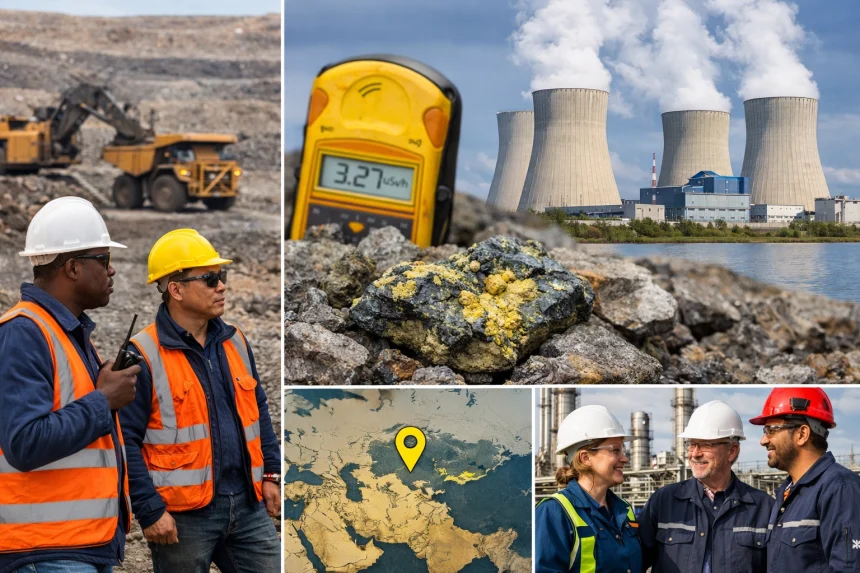
The reality is that you cannot power a global AI revolution, re-shore heavy manufacturing, and decarbonize the grid with hope alone. You need baseload power. You need density. You need uranium.
We aren’t just looking at a price spike. We are witnessing a multi-decade structural realignment: a uranium super-cycle that has officially reached its inflection point. While Silicon Valley’s “Magnificent Seven” struggle with cooling growth and astronomical energy bills, the “Real Economy” is having its moment. Uranium miners surged 25% in the opening weeks of 2026 alone. This isn’t a bubble; it’s a correction for fifteen years of underinvestment.
The Math of a Structural Deficit
The numbers are brutal. In 2025, global reactors consumed roughly 68,900 metric tons of uranium. By 2040, that requirement is projected to hit 150,000 MT. In high-growth scenarios: the kind where every data center operator is scrambling for dedicated power: that number climbs past 200,000 MT.
Here is the kicker: the supply side isn’t even close to keeping up.
The uranium sector is on track for a massive supply deficit this year. We are looking at structural gaps that could exceed 200 million pounds annually in the coming decades. Why? Because you can’t simply flip a switch on a mine. New in-situ recovery (ISR) projects and brownfield expansions have lead times that utilities have ignored for too long.
For years, utilities lived off secondary supplies and under-contracted their future needs. They played a game of chicken with miners, and in 2026, the chickens have come home to roost. Utilities are entering the market for long-term contracts just as inventories have bottomed out. That’s not a rounding error. That’s a crisis for anyone responsible for keeping the lights on.

SMRs: The Catalyst for Localized Power
The “Industrial Renaissance” isn’t just a catchy phrase for a newsletter; it is a physical reality driven by Small Modular Reactors (SMRs). In the past, nuclear power meant massive, multi-decade civil engineering projects. SMRs change the calculus. They offer modular, scalable, and: most importantly: deployable power for industrial hubs.
Mining executives are increasingly bullish because SMRs solve the primary headache of remote operations: energy costs. Whether it’s copper processing or high-intensity bauxite extraction, the demand for localized, carbon-free baseload power is skyrocketing.
We are seeing a convergence where the tech sector and the mining sector are finally speaking the same language. AI data centers require 24/7 power that wind and solar cannot reliably provide without massive, expensive battery backups that don’t yet exist at scale. SMRs are the solution, and uranium is the fuel. This demand wasn’t on the charts five years ago. Now, it’s the primary driver of the super-cycle’s second leg.
The Rotation: From “Shiny Tech” to “Real Assets”
The market movement in early 2026 has been telling. While the tech-heavy Mag 7 index dropped 4% and speculative assets like Bitcoin took a 20% hit, commodities have stood firm. This represents a fundamental shift in capital allocation. Investors are waking up to the fact that software can’t dig a hole or generate a megawatt.

We are seeing a strategic “flight to reality.” This involves securing the raw materials necessary for national security and economic sovereignty. It’s why we saw USA Rare Earth consolidate control of the Round Top project in a $73M buyout recently. The race isn’t just for lithium or copper; it’s for the energy source that makes the entire industrial chain possible.
Mining professionals are no longer just looking at the ground; they’re looking at the geopolitical map. The U.S. has signaled plans to quadruple nuclear capacity by 2050, with ten new large reactors slated for construction by 2030. When government policy aligns with desperate private sector demand, the result is a price floor that is significantly higher than historical norms.
Price Forecasts: $200 Uranium?
Let’s talk about the price. Not long ago, $85/lb was considered a peak. Then we saw a three-day spike to $102/lb. The volatility is a symptom of a dry market.
Analysts have been forced to tear up their 2025 playbooks. Shaw and Partners recently lifted their 2028 uranium price forecast to US$200/lb. Even conservative estimates now view $70/lb as the absolute “floor.”
For mining companies, these margins are transformative. Projects that were marginal at $50/lb are now massive cash-flow engines. However, the bottleneck isn’t just the price: it’s the skilled labor and the equipment. As we’ve seen in other sectors, workforce shortages are starting to impact project timelines. You can have the uranium in the ground and a permit in your hand, but if you don’t have the engineers, the yellowcake stays in the rock.

The Strategic Calculus of 2026
If you are an operator or an investor, the strategic calculus here isn’t subtle. The “easy” uranium has been found and, in many cases, already mined. We are now entering the era of “strategic anchor” assets.
We are seeing a surge in investment in regions like the Lobito Corridor in Africa, which is becoming a strategic anchor for critical minerals. This isn’t just about the minerals themselves; it’s about the infrastructure and the energy required to move them.
The uranium super-cycle is the heartbeat of this entire movement. Without it, the “Industrial Renaissance” stalls. You can’t have a lithium boom or a copper surge without the energy to process the ore.
Why the “Industrial Renaissance” is Different This Time
Unlike previous cycles, the current demand is not driven by a single country or a single technology. It is a global, multi-polar rush for energy independence.
- Decarbonization: Nuclear is the only path to meeting Net Zero goals while maintaining industrial output.
- Energy Security: Reliance on foreign gas is a strategic liability that most nations are no longer willing to accept.
- Data Demand: The power-hungry nature of 2026-era computing requires a level of reliability that only nuclear provides.
The result? A “long cycle.” Most commodity booms are short-lived “up-and-down” affairs. But the uranium super-cycle is built on a 20-year lead time for reactors and a 10-year lead time for mines. Those two clocks do not sync easily.

Closing the Gap
As we head into the second half of 2026, expect the scramble for supply to intensify. Utilities that have been waiting for prices to “normalize” are going to find themselves paying a premium just to ensure they aren’t last in line.
The uranium super-cycle isn’t just a market trend: it’s a fundamental economic realignment. We are moving away from the “software-will-save-us” era and back into the era of steel, concrete, and atoms. 2026 is the year this shift becomes contractual reality.
For the mining industry, the message is clear: the Industrial Renaissance has arrived, and it is powered by uranium. There simply isn’t enough to go around, and that makes the next few years the most significant period in the history of the sector.