As we close out the first half of 2026, the mining sector is witnessing a fundamental divergence between spot price volatility and the structural re-rating of high-quality assets. In the precious metals space, the narrative has shifted from “if” prices will hold to “how fast” developers can reach commercial production to capture the current P/NAV (Price to Net Asset Value) discount. Historically, developers trade at a significant discount to producers; however, as the $4,200 gold floor stabilizes, we are seeing a massive re-rating in names that have successfully de-risked their financing and permitting hurdles.
Simultaneously, the copper market remains in the grip of a generational structural deficit. With the “invisible mine” of recycling and efficiency gains failing to bridge the gap, the industry is turning toward aggressive M&A and creative project financing. Institutional capital is no longer just chasing ounces; it is chasing jurisdiction and execution certainty.
Market Snapshot: June 29, 2026
| Commodity | Price (USD) | Change (24h) | YTD Change |
|---|---|---|---|
| Gold | $4,203.40/oz | +0.45% | +18.2% |
| Silver | $54.12/oz | -0.12% | +22.8% |
| Copper | $13,540/t | +1.10% | +14.5% |
| Uranium (U3O8) | $152.50/lb | +0.00% | +35.1% |
| US Dollar Index (DXY) | 102.15 | -0.22% | -1.4% |
The $1B Blueprint: Generation Mining Finances Ontario’s Copper-Palladium Future
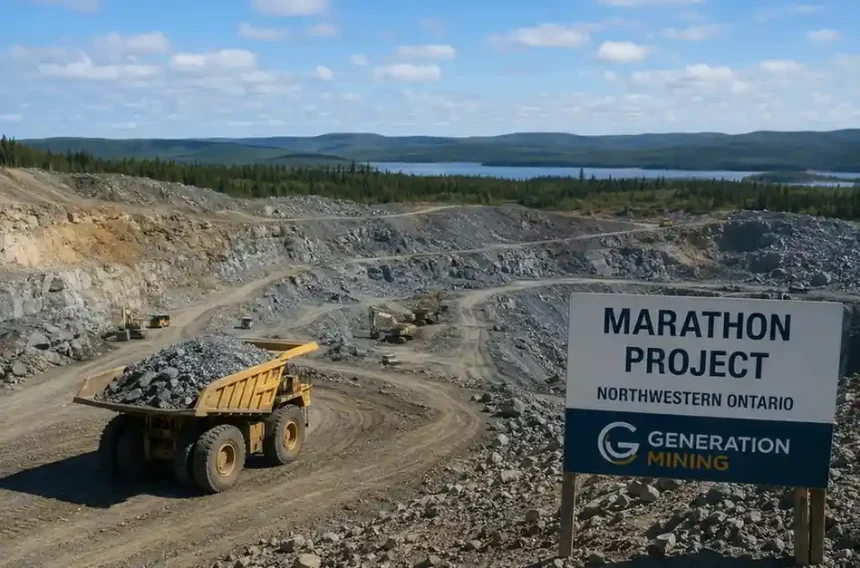
Generation Mining has provided the market with a masterclass in assembly-line project finance. The company’s Marathon copper-palladium project in northwestern Ontario is now within striking distance of a full construction start, having secured nearly C$969 million of its C$1 billion capital requirement.
The financing stack is notable for its diversity, blending traditional debt with strategic government support. The Canada Infrastructure Bank has committed C$200 million, while senior debt facilities from Export Development Canada, ING, and Société Générale provide the foundation. A C$240 million stream with Wheaton Precious Metals further anchors the capital structure.
For investors, the takeaway is clear: the transition from “developer” to “producer” is the single largest catalyst for P/NAV expansion. By securing the bulk of its capital through non-dilutive or low-cost debt during a high-rate environment, Generation Mining is protecting equity upside while ensuring the project meets its 2026 construction targets.
Social Media Snippet (X/LinkedIn):
?️ Generation Mining hits a $1B financing milestone for the Marathon project. With copper at $13.5k/t and palladium in high demand, Ontario’s next major mine is fully funded and ready for construction. This is how you de-risk a Tier-1 asset in 2026. #MiningInvestment #Copper #Palladium #SkillingsMining
Gold’s $4,200 Anchor: Analyzing the Safe-Haven Floor
Gold’s structural support remains firm amidst global geopolitical tension.

The gold price forecast for 2026 has transitioned from a bullish target to a fundamental reality. Gold’s $4,200 level is no longer a “spike” but an “anchor,” supported by a cocktail of central bank accumulation and a volatile geopolitical landscape.
While peace talks in various regions provide temporary cooling, the structural distrust of fiat reserves remains the primary driver. We are seeing a “higher for longer” sentiment not in interest rates, but in the floor price of bullion. This has changed the way mining analysts value the sector; instead of using $1,800 or $2,000 long-term consensus prices, we are seeing NAV calculations being stress-tested at $3,500. This shift essentially triples the projected free cash flow for Tier-1 producers, making the current valuation of many seniors look significantly undervalued.
Nevada Scale: Integra Resources’ Massive Reserve Increase at Florida Canyon
In the Great Basin, Integra Resources has delivered a significant blow to the “depletion” narrative. The company recently announced a 74% increase in proven and probable gold reserves at its Florida Canyon project.
The updated 2026 feasibility study outlines a mine life extension to eight years, with an estimated US$0.8 billion in after-tax free cash flow. In the mining investment world, “reserve replacement” is the lifeblood of a company’s valuation. Integra’s ability to find more ounces within a brownfield site reduces exploration risk and utilizes existing infrastructure: a key theme for 2026 as greenfield permitting remains a bottleneck.
This reserve growth effectively lowers the enterprise value per ounce (EV/oz), making Integra a standout candidate for a mid-tier producer looking to bolster its Nevada portfolio.
Diamond Tactical: Why Alrosa’s Suspension is a Supply-Side Play
Supply discipline remains the primary lever for price stability in the diamond market.

The diamond market has faced headwinds from lab-grown alternatives and cooling luxury demand, but the supply side is fighting back with tactical precision. Alrosa’s decision to suspend operations at its Severalmaz division for three months starting July 1, 2026, is a calculated move to prevent a supply glut.
By pulling roughly 30 million carats of guidance capacity offline temporarily, Alrosa is reinforcing the floor for rough diamond prices. For investors, this represents a broader trend in 2026: commodity producers are choosing “value over volume.” This discipline, while painful for short-term revenue, protects the long-term health of the balance sheet and ensures that when demand returns, it meets a market that is not oversupplied.
Investment Insight: The Era of Creative Financing
With traditional equity markets remaining selective, we have entered the “Golden Age” of royalty and streaming deals. In a high-interest-rate environment, the weighted average cost of capital (WACC) has skyrocketed for traditional bank debt.
Streaming companies like Wheaton Precious Metals and Franco-Nevada are filling the gap, providing capital in exchange for future production. For the project owner, this is often “cheaper” than equity dilution, especially when the market is not yet pricing in the full value of the asset. For the investor, these deals provide a lower-risk entry into high-quality projects like the Marathon copper-palladium mine, offering exposure to commodity upside without the direct operational risk of mining.
Conclusion
The final week of June 2026 underscores a mining market that is professionalizing its approach to risk. From Generation Mining’s sophisticated financing stack to Integra’s relentless focus on reserve expansion, the “Investment Edge” belongs to those who look past the daily ticker and focus on the fundamental de-risking of assets.
As we move into the third quarter, watch for continued M&A in the copper space and the potential for a mid-tier gold producer consolidation wave as the $4,200 price floor becomes the new industry standard.
RESERVE YOUR SPOT: The 2026 North American Lithium Power Map Pre-Sale is now live. Get the definitive guide to the lithium supply chain. Link to Skillings.net/lithium-map