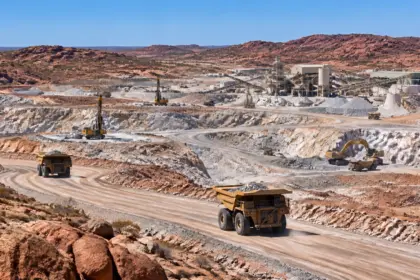
Mountain Pass is the upstream base of MP Materials’ U.S. rare earth supply chain.
MP Materials has secured a long-term offtake agreement with a new U.S. aerospace and defence customer for separated gadolinium, expanding the company’s heavy rare earth business as Washington seeks to reduce reliance on overseas processing.
The rare earths producer disclosed the agreement in its second-quarter 2026 earnings report, describing it as a significant long-term contract with attractive economics. MP Materials did not name the customer, disclose the contract’s duration or provide volume commitments.
The deal adds gadolinium to a portfolio that has been led by light rare earth products such as neodymium-praseodymium, or NdPr. It also gives the company another commercial link between its Mountain Pass mine and processing operation in California and its magnet manufacturing facility in Fort Worth, Texas.
MP Materials is the only fully integrated rare earth producer in the United States, according to the company. Its operations span mining, separation, refining, metal and alloy production, and magnet manufacturing.
The announcement came alongside a sharp increase in NdPr output and sales. MP reported second-quarter NdPr production of 840 tonnes, up 41% from the same period a year earlier, while NdPr sales more than doubled to 1,006 tonnes.
MP Materials’ Q2 operating and financial snapshot
| Metric | Q2 2026 | Year-on-year or context |
|---|---|---|
| NdPr production | 840 tonnes | Up 41% |
| NdPr sales | 1,006 tonnes | More than doubled |
| Materials business revenue | $95.6 million | Includes rare earth materials |
| Magnetics business revenue | $16.5 million | Fort Worth operations |
| Government price support payments | $17.6 million | Included in reported results |
| Total revenue and support income | $126.1 million | Consolidated figure |
| Net loss | $20.3 million | Narrowed from $30.9 million |
| Government support since last year | $110.9 million | Cumulative amount disclosed by the company |
Revenue of $126.1 million included $95.6 million from the materials business and $16.5 million from magnets. The figure also included $17.6 million in government price support payments.
MP’s net loss narrowed to $20.3 million from $30.9 million in the second quarter of 2025. The company said it had received a total of $110.9 million in government support since last year.
“MP Materials built on its strong start to the year,” Chief Executive James Litinsky said in the earnings report.
The improved results reflect higher sales volumes, increasing output from the company’s processing operations and a larger contribution from its downstream magnetics business. Government support also remains an important component of MP’s financial position as it scales a domestic supply chain that has high capital requirements and remains exposed to commodity price volatility.
Gadolinium broadens the product mix
Gadolinium is a heavy rare earth element used in specialised applications, including certain alloys, neutron-shielding materials and medical imaging. Its inclusion in a long-term supply agreement with a U.S. aerospace and defence customer points to demand beyond the NdPr market that underpins most rare earth magnet production.
The company said the agreement expands both its heavy rare earth product portfolio and its customer base. It did not say when commercial deliveries would begin or identify the source and planned production route for the separated gadolinium.
That lack of detail leaves important questions for investors and industrial customers, including the scale of the contract, the timing of production and the extent to which MP can convert the agreement into recurring revenue. The disclosure nevertheless marks a step in the company’s effort to move from a primarily NdPr-focused producer toward a broader separated rare earths platform.
The heavy rare earth segment has strategic importance because processing capacity is concentrated in a small number of countries. For U.S. aerospace and defence manufacturers, access to separated material can be as important as access to mined concentrate. Separation is the stage at which individual rare earth elements are isolated and refined into products that can enter specialised manufacturing chains.

MP Materials separates and refines rare earth compounds at Mountain Pass.
From Mountain Pass to Fort Worth
MP Materials mines and processes rare earth-bearing ore at Mountain Pass, in California’s Mojave Desert. The site produces a high-purity rare earth concentrate through flotation and processes that are being expanded to support domestic separation and refining.
The company’s downstream operations are based at Independence, its rare earth metal, alloy and magnet facility in Fort Worth. There, feedstock from Mountain Pass can be converted into rare earth metal, NdFeB alloy and permanent magnets.
That structure is central to the company’s strategy. Rather than selling only concentrate or oxide, MP is seeking to capture more value by supplying materials further down the industrial chain. The approach also gives U.S. customers greater visibility over the origin and processing route of critical inputs.
The Fort Worth facility was developed to produce approximately 1,000 tonnes of NdFeB magnets per year, according to previous company disclosures, with capacity to support roughly 500,000 electric vehicle traction motors. NdFeB magnets are used in electric vehicles, wind turbines, robotics, electronics and defence systems.

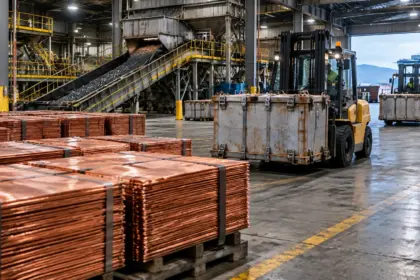
The Fort Worth facility extends MP Materials’ operations into metals, alloys and permanent magnets.
The new gadolinium agreement is separate from the company’s NdPr magnet supply chain, but it reinforces the same industrial logic: secure domestic processing capacity and connect it to customers whose products require reliable, traceable materials.
Government support remains a key factor
MP Materials’ latest results also underline the continuing role of U.S. government support in the development of rare earth capacity.
The company received $17.6 million in government price support payments during the quarter and said total government support since last year had reached $110.9 million. Such programmes are intended to strengthen domestic production and reduce exposure to supply disruptions linked to concentrated overseas refining and magnet manufacturing.
For MP, support helps offset some of the financial pressure involved in building facilities before they reach full utilisation. It also reflects the strategic value policymakers place on domestic rare earth production, particularly for defence and energy-transition applications.
However, government-backed pricing mechanisms do not eliminate operational risks. MP must still expand production consistently, qualify products with customers, manage separation and refining costs, and increase magnet output. The company also remains exposed to global rare earth prices and competition from producers with established processing capacity.
The quarter’s higher NdPr production suggests the California operation is moving more material through the supply chain. Sales of 1,006 tonnes, up more than two times year on year, indicate stronger market placement during the period. The key test will be whether the company can sustain those volumes while adding heavy rare earth products and scaling its magnetics operations.
Strategic implications for U.S. rare earths
The gadolinium agreement arrives as governments and manufacturers are seeking alternatives to highly concentrated rare earth supply chains. China remains the dominant force in global rare earth separation, refining and permanent magnet production, making domestic capacity a strategic priority for the United States and its allies.
A long-term agreement with an aerospace and defence customer can provide MP with greater demand visibility than spot-market sales. It may also support future investment in separation capacity and product qualification, although the company has not disclosed the contract’s financial terms.
For defence manufacturers, supply security requires more than a domestic mine. It depends on the availability of separated elements, metal and alloy conversion, component manufacturing and quality assurance. MP’s Mountain Pass-to-Fort Worth model addresses several of those stages within one corporate network.
The company’s progress will therefore be watched across the broader critical minerals market, not only by rare earth producers. Its results offer an early indication of whether a vertically integrated U.S. supply chain can move from policy support and construction into consistent commercial production.
MP Materials said the new agreement expands its heavy rare earth business at attractive economics. The next milestones will be the disclosure of delivery timing, production volumes and the contribution of gadolinium to revenue as the company continues building out its domestic rare earth platform.
For wider context on critical minerals, market structure and geopolitical supply risks, see Skillings’ weekly executive briefing on critical minerals and mining consolidation.

MP Materials says its operations include water recycling and other environmental controls.