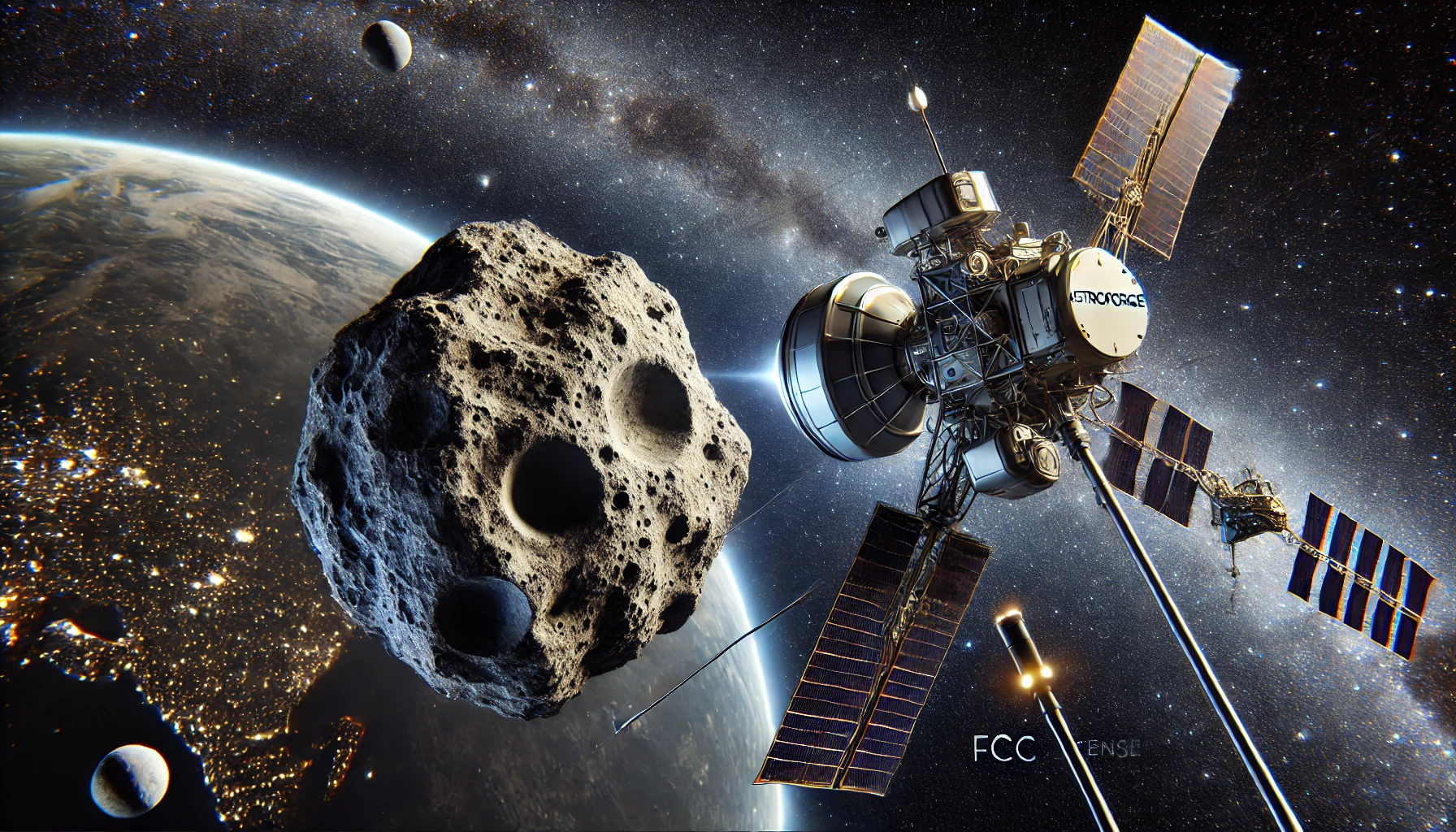
Asteroid mining pioneer AstroForge has achieved a major milestone, becoming the first company to secure a Federal Communications Commission (FCC) license for a deep-space mining mission. This approval allows AstroForge’s Odin spacecraft to maintain communication with Earth as it ventures into the asteroid-rich reaches of the solar system. Slated to launch in early 2025, the mission aims to tap into vast reserves of precious metals on asteroids, marking a significant leap forward in commercial space exploration.
FCC License Opens New Frontier for Private Space Ventures
On October 18, the FCC granted AstroForge a deep-space license, permitting the company to establish a vital communications network with its spacecraft far beyond Earth’s orbit. Deep space, defined by the FCC as over 1.24 million miles from Earth, represents an operational boundary that no private company has previously crossed with U.S. regulatory approval. This license enables AstroForge to command and transmit data with Odin, laying the groundwork for sustained deep-space operations.
AstroForge’s founder and CEO, Matt Gialich, sees the license as a crucial step in developing asteroid mining as a viable industry. “Receiving this license brings us closer to proving that space resources can fuel a real business. We’re blazing a trail for future companies to follow,” Gialich remarked.
Related News
- Uganda Calls On Global Miners to Invest in Critical Minerals
- China’s Lithium Battery Sector Shifts Focus to Energy Storage Systems
- WA Lithium Producers Brace for Tough Times Amid Price Pressure
The Lucrative Potential of Asteroid Mining
AstroForge has its sights set on platinum-rich asteroids, given platinum’s high value and essential role in electronics, medical devices, and renewable technologies such as hydrogen fuel cells. Analysts forecast growing demand for platinum and similar metals as advanced technologies and renewable energy infrastructure expand, while Earth’s reserves dwindle. This dynamic makes the prospect of asteroid mining economically compelling.
If successful, AstroForge’s mission could access resources previously confined to science fiction. NASA estimates that asteroid 16 Psyche alone may hold metals worth over $10,000 quadrillion—enough to meet global demand for centuries. “The economic potential is staggering,” said Dr. Linda Elkins-Tanton, a planetary scientist at MIT. “Asteroids like 16 Psyche contain resources that could fundamentally shift Earth’s resource landscape.”
Mission Odin: Testing AstroForge’s Deep-Space Capabilities
AstroForge’s journey in space mining began with its Brokkr-1 mission in 2023, which aimed to test refining capabilities with simulated asteroid materials. Although Brokkr-1 encountered technical difficulties and lost communication in May 2024, AstroForge considers the mission an invaluable learning experience, setting a stronger foundation for Odin’s launch.
Odin’s mission follows a complex trajectory, first looping around the moon before heading toward a near-Earth asteroid. According to Gialich, this journey aligns with AstroForge’s ideal progression, blending scientific discovery with profitable resource extraction goals. “Reaching the asteroid and capturing an image to confirm it’s the right target will be our first milestone,” he explained.
Challenges Ahead for Space Mining
AstroForge’s ambitious objectives face significant technical and ethical challenges. Asteroid mining demands sophisticated robotics, AI, and propulsion technology—areas still in early development. Additionally, legal issues surrounding extraterrestrial resource extraction remain unresolved, as current treaties, like the 1967 Outer Space Treaty, prohibit national claims over celestial bodies but lack clarity on commercial mining rights.
Despite these challenges, Gialich remains optimistic. AstroForge has raised $40 million, attracting investors who believe in the transformative potential of deep-space mining for global resource markets. Success in this mission could attract further investment, accelerating infrastructure development for space mining.
AstroForge’s progress is likely to inspire more private companies to explore asteroid mining and other space commercializations. “Earth’s demand for metals is only increasing,” said John Logsdon, professor emeritus at George Washington University’s Space Policy Institute. “AstroForge’s success could usher in a new era of space entrepreneurship, extending humanity’s reach and resource base.”
A Groundbreaking Step with Limitless Potential
AstroForge’s FCC license marks a pivotal moment in private-sector space exploration. The Odin mission, with its target asteroid still undisclosed, has the potential to redefine resource extraction boundaries. While technical and legal obstacles remain, AstroForge’s entry into deep-space mining represents a critical step toward harnessing outer space as a valuable resource for Earth.