Key Takeaways
- Australia mineral exports totaled AU$415B in 2023/24, led by iron ore, LNG, coal, gold, and copper.
- Iron ore and coal exports are forecast to drop sharply by 2030, while copper and gold are poised to grow.
- Resource diversity is softening Australia’s dependence on China and shielding it from global volatility.
- Emerging minerals like lithium and rare earths are expected to play a bigger role in future exports.
- Four Australian states rank among the top 20 global mining jurisdictions for investment attractiveness.
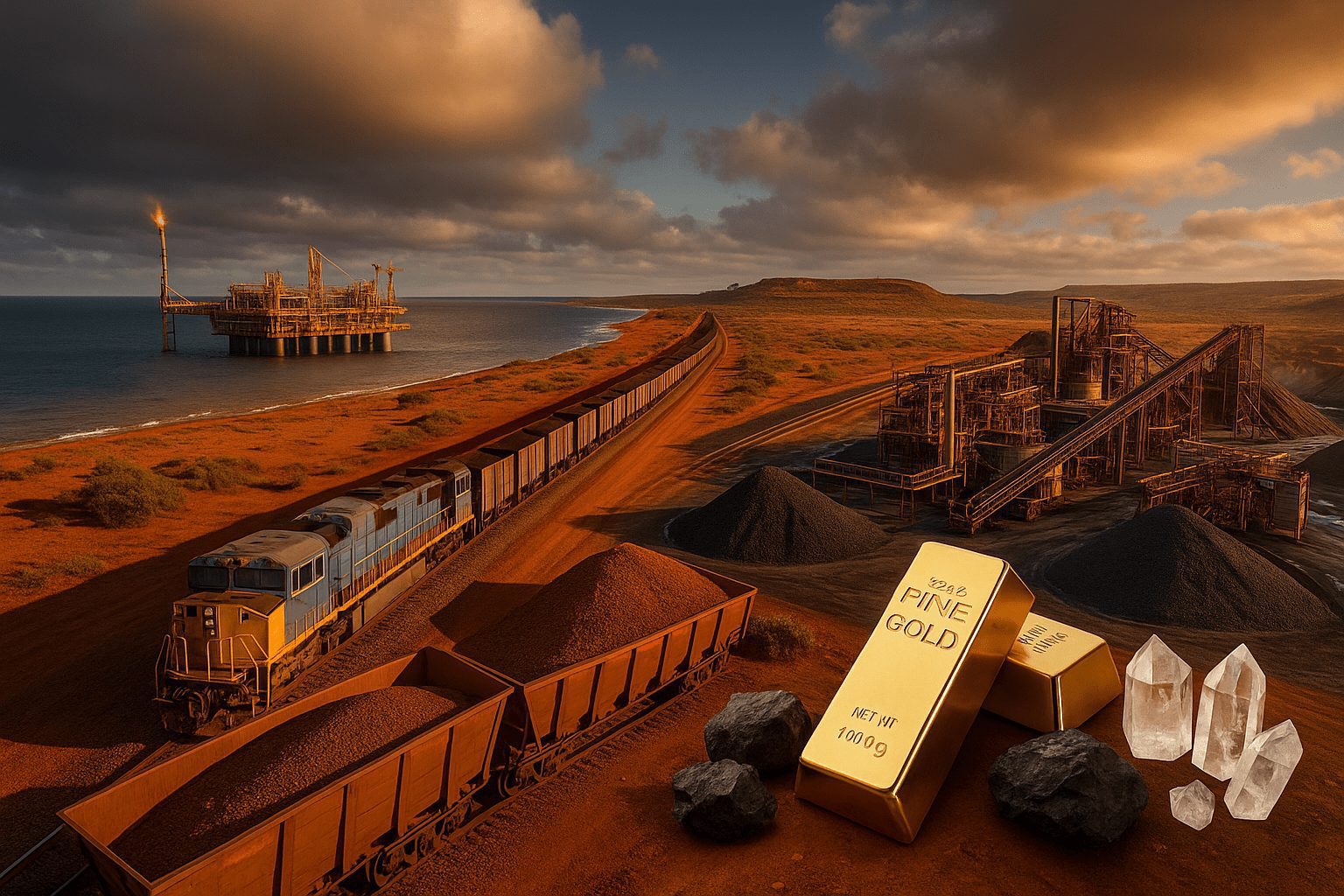
Australia’s resource wealth has long powered its economy, but the real story behind the AU$415 billion in Australia mineral exports last year is not just scale — it’s diversification. From the Pilbara to offshore LNG terminals, the nation’s sprawling mineral portfolio is evolving fast.
Broad Export Base Shields Economy
According to the Department of Industry, Science and Resources, mineral resources accounted for 59% of all Australian exports in 2023/24. The top five — iron ore, liquified natural gas (LNG), coal, gold, and copper — formed the bulk of that figure. Yet long-term forecasts suggest a shifting hierarchy.
“It’s the range of commodities that gives Australia stability,” said a senior Canberra policy advisor. “While others rely on one or two resources, our export model is broad enough to absorb shocks.”
This resilience is reinforced by geography. Four states — Western Australia, Queensland, South Australia, and the Northern Territory — ranked in the top 20 globally for mining investment attractiveness in the Fraser Institute’s 2023 global survey.
Iron Ore: A Giant With Diminishing Returns
Iron ore remains the heavyweight of Australia mineral exports, generating AU$141 billion last year. But a slowdown in Chinese industrial demand has led the government to forecast a decline to AU$81 billion by 2029/30.
“We’re still the world’s biggest exporter,” said a Perth-based analyst. “But the growth is behind us.”
| Mineral | 2023/24 (AU$B) | 2029/30 (AU$B) | Change |
|---|---|---|---|
| Iron Ore | 141 | 81 | -60 |
| LNG | 70 | 45 | -25 |
| Metallurgical Coal | 56 | 33 | -23 |
| Thermal Coal | 38 | 22 | -16 |
| Gold | 34 | 30 | -4 |
| Copper | 12 | 18 | +6 |
LNG: Still Strong, But Sliding
LNG exports brought in AU$70 billion in 2023/24 and are projected to reach AU$72 billion in 2024/25. However, the long-term trend is negative, with forecasts of just AU$45 billion by the end of the decade.
Rising U.S. competition and the global shift to renewables are likely to erode Australia’s LNG dominance. Still, long-term contracts with Japan and South Korea remain a stabilizing factor.
Coal: Declining Revenue, Short-Term Demand
Coal remains a vital component of Australia mineral exports, with metallurgical and thermal coal earning AU$94 billion combined last year. However, demand from the West is tapering, and the transition to renewables is accelerating. By 2029/30, total coal exports are projected to fall to AU$55 billion.
Copper and Gold: Quiet Performers Gaining Ground
Gold earned AU$34 billion in 2023/24, with a modest rise to AU$36 billion expected next year. Most gold mines are located in Western Australia, and Australia ranks third globally in production.
Copper, by contrast, is on a growth path. Exports stood at AU$12 billion last year but are expected to hit AU$18 billion by 2029/30. “Copper demand is only going to grow as the world electrifies,” said a Melbourne-based mining economist.
Lithium and Rare Earths: Tomorrow’s Powerhouses
Though outside the top five, lithium is becoming a central pillar in the evolution of Australia mineral exports. The country produced 88,000 MT in 2024, the most in the world. Despite a price dip in 2024/25, exports are forecast to climb back to AU$9.2 billion by 2028/29.
Rare earths are just beginning to scale, but the launch of Lynas’ Kalgoorlie facility and Iluka’s Eneabba refinery could push exports to AU$3.7 billion by the end of the decade.
Strategic Depth Over Singular Dominance
The future of Australia mineral exports will hinge not on any one resource, but the strength of the nation’s portfolio. Even as coal and iron recede, copper, gold, lithium, and rare earths are set to carry more weight.
“Our GDP is more shielded from global volatility because of this diversification,” noted Export Finance Australia in its March 2025 outlook. “It’s not just volume. It’s spread.”
FAQ
What are Australia’s top mineral exports in 2025?
Australia’s top mineral exports by value are iron ore, liquified natural gas (LNG), coal (thermal and metallurgical), gold, and copper.
How is Australia’s mining economy diversifying?
Australia is expanding into strategic minerals like lithium and rare earths while copper and gold gain export share amid falling coal and iron ore revenues.
Why is diversification important for Australia’s resource sector?
With global shifts away from fossil fuels and China’s waning demand, a diversified mineral portfolio reduces economic exposure and enhances export resilience.