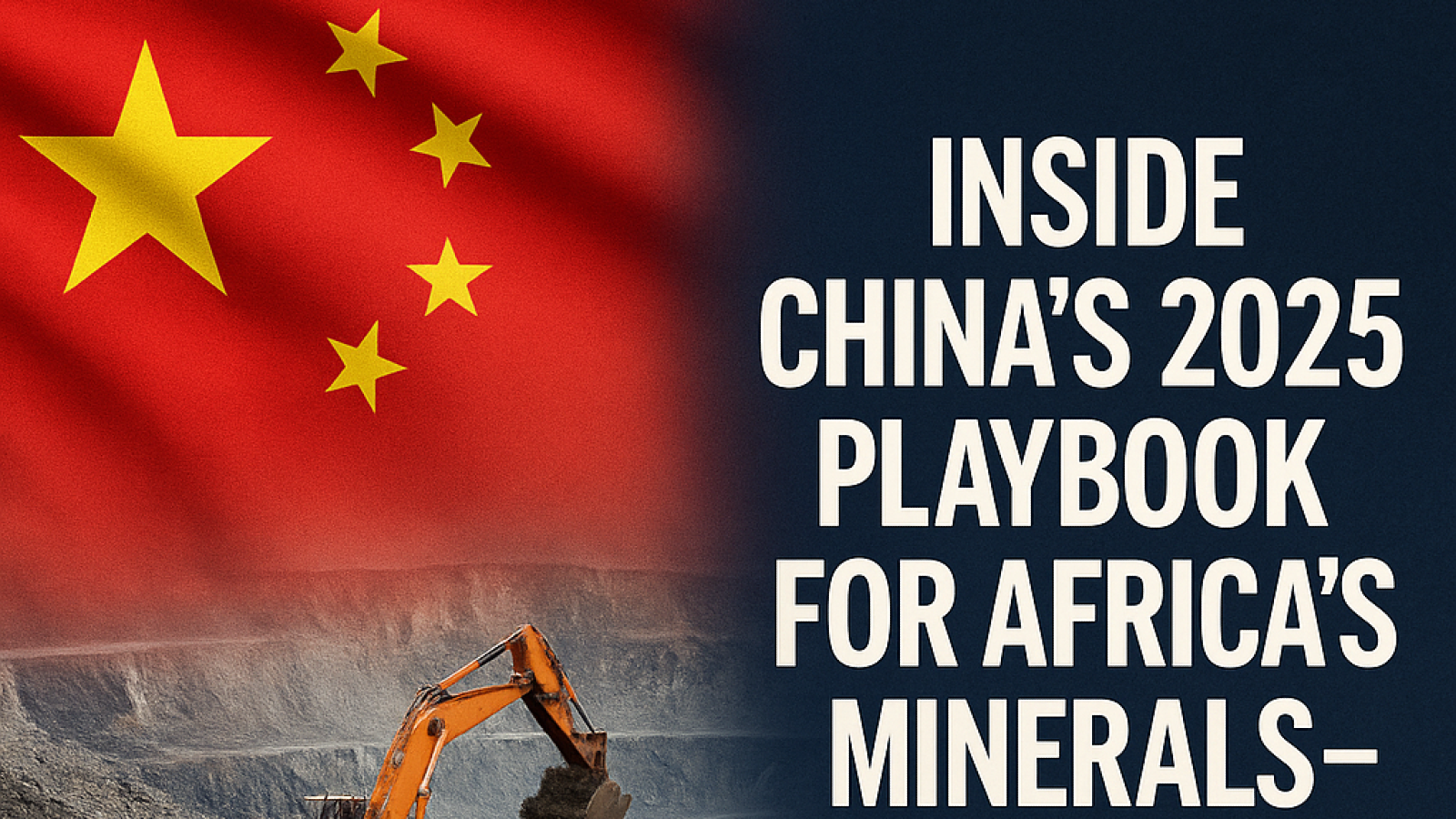
As global powers scramble to secure supply chains for critical minerals, China has surged ahead in Africa—outspending, outbuilding, and outpacing its Western rivals. Chinese firms now control 8% of the continent’s mining output, up 21% since 2019, and Beijing has pledged another $51 billion to reinforce its dominance across Africa’s infrastructure and extraction sectors.
New trade data shows the stakes: China-Africa trade hit $133 billion in the first five months of 2025, a record high and a 12.4% year-on-year increase. The growth reflects Beijing’s pivot from traditional diplomacy to a hard-nosed strategy of resource acquisition and political leverage—one that is redrawing power dynamics across the continent.
Related News
- Biden’s African Visit: Spotlighting Africa’s Critical Minerals and U.S.-China Rivalry
- Türkiye Strengthens Global Mining Footprint with Key Agreements in China and Africa
- China’s Lending to Africa: A Changing Landscape and its Implications
- China Boosts Resource Allocation to Support Africa’s Industrialization
Africa’s Resource Wealth Becomes Strategic Battleground
In minerals, China is closing the gap. While firms like Anglo American still lead in absolute output, Chinese companies have aggressively expanded their footprint in cobalt, copper, and lithium—key ingredients in batteries and renewable technology.
Recent acquisitions in Zambia, Zimbabwe, and the Democratic Republic of Congo have given Beijing control over some of the most strategic mineral reserves on the planet. These are not passive holdings. Chinese firms are vertically integrating operations—securing everything from mine sites to transport infrastructure to export terminals.
“This is no longer just about mining—it’s about who governs the value chain,” said a London-based analyst tracking China’s African operations.
$51 Billion Investment Pledge Signals Long-Term Intent
At this week’s Forum on China-Africa Cooperation (FOCAC) and China-Africa Economic and Trade Expo in Changsha, China unveiled a new three-year commitment: $51 billion in financial support, including $70 billion in direct investments and $210 billion in credit lines. Much of this is aimed at energy, logistics, and industrial development—sectors tightly aligned with China’s broader Belt and Road ambitions.
Also announced: zero-tariff treatment for all product lines from 53 least-developed African countries, and export facilitation for 140 product categories from 33 African nations. The moves deepen economic ties but also reinforce Africa’s role as a supplier of raw materials rather than finished goods.
Geopolitical Implications: U.S. and EU on the Back Foot
Western governments have responded with concern. The U.S. International Development Finance Corporation and EU Global Gateway programs have struggled to match China’s scale or speed. Many African governments, facing urgent infrastructure needs and rising debt burdens, continue to prefer Beijing’s no-strings financing—even amid growing wariness about long-term dependency.
China’s strategic use of soft power—party-to-party ties, military training programs, and security cooperation—has expanded in parallel with its economic outreach. It’s a model that favors regime stability over institutional reform, and one that’s finding traction among African elites.
Trade Imbalances Persist Despite Headline Growth
Despite the record trade figures, Africa’s exports to China remain skewed toward raw, unprocessed materials. Value-added manufacturing on the continent remains limited, and trade surpluses continue to favor Beijing.
Critics argue that this asymmetry, left unchecked, could lock African economies into extractive models that hinder diversification. Others see opportunity in leveraging Chinese interest to demand greater local beneficiation and technology transfer.
Outlook: A Multipolar Contest Intensifies
For African states, the deepening China-U.S. rivalry offers both risk and leverage. Strategic autonomy—balancing foreign interests without capitulating to any—remains a challenge.
Yet the data is unambiguous: China is not retreating. It is embedding. And with each new mine, railway, and investment pledge, the cost of reversing that trend rises.
“The question isn’t whether China is investing,” said a senior African Union official. “It’s whether Africa is setting the terms.”