Key Takeaways
- China successfully extracts 99.9% pure rubidium chloride from salt lake brine — a global first.
- The process achieves industrial purity from trace concentrations as low as 0.001%.
- Breakthrough reduces China’s reliance on Canadian and Zimbabwean imports.
- Rubidium is essential to quantum tech, atomic clocks, solar energy, and military systems.
- Cost-effective method positions China for leadership in critical mineral supply chains.
A Global First: Rubidium Extraction from Salt Brine
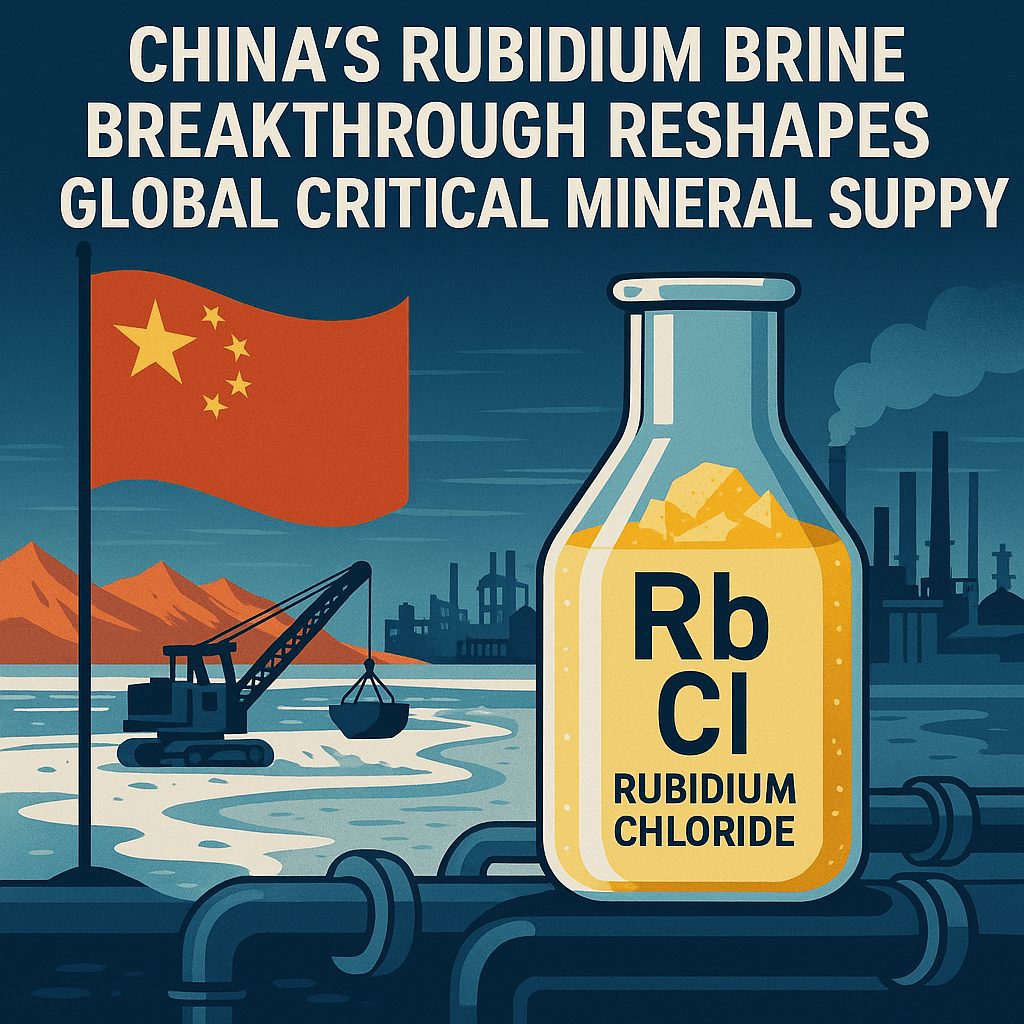
China has achieved the world’s first commercial extraction of rubidium chloride at high purity levels from ultra-dilute salt lake brine, marking a critical leap in mineral self-sufficiency.
The development was announced by the Qinghai Institute of Salt Lakes under the Chinese Academy of Sciences. Researchers produced 99.9% pure rubidium chloride using potassium chloride material containing just 0.001% rubidium. The pilot operation was conducted at Qinghai’s Qarhan Salt Lake, where domestic reserves are technically accessible but historically underutilized.
Related News
- Trump’s New Critical Minerals Push: Defense Production Act to Reshape U.S. Supply Chains
- IEA Sounds Alarm on Critical Mineral Supply Chain Risks, Urges Global Diversification
- Refining Concentration in Critical Minerals Poses Global Supply Risk, IEA Warns
- Rio Tinto Gallium Extraction Breakthrough Anchors North America Supply Chain
Why Rubidium Matters Now
Though often overlooked in commodity markets, rubidium underpins critical functions in high-precision and defense technologies. The metal enhances the stability of perovskite solar cells, is integral to GPS and encrypted communications, and enables rubidium atomic clocks—vital for space navigation and secure networks. These clocks deviate by less than one second over millions of years.
In recognition of its strategic relevance, the U.S. designated rubidium as a critical mineral in 2022, joining a growing list of rare materials seen as vulnerable to geopolitical disruption.
China’s Rubidium Paradox: Reserves Without Access
Despite having sizable reserves, China remains structurally dependent on rubidium imports. The underlying reason is geological.
“Although China is a major global rubidium producer, its industry relies heavily on imported ores,” said He Xinyu, a senior geologist at the China Non-Ferrous Metals Resource Geological Survey. “In 2021, China imported 19,500 tonnes of rubidium concentrate with a 66.3% external procurement rate—primarily from Canada and Zimbabwe.”
Roughly 97% of China’s known rubidium is embedded in hard rock deposits—high-cost, low-yield formations that are difficult to exploit. Only a narrow 3% margin is found in salt lakes and geothermal waters, notably across Qinghai and the Tibet Autonomous Region.
A Two-Pronged Innovation Strategy
The breakthrough stems from years of parallel research—both theoretical and engineering. Scientists first developed a predictive model to trace how rubidium distributes during potassium salt production. This allowed them to identify stages where rubidium resists enrichment and locate windows for capture.
They then engineered a complete process chain: ore washing, rubidium leaching, trace enrichment, solvent extraction, and purification. The resulting product is industrial-grade rubidium chloride—technically competitive, and critically, domestic.
Economically Viable at Scale
The innovation is not just scientific but commercial. A 2022 cost analysis led by ISL researcher Gao Dandan estimated the production cost of rubidium chloride via this method to be one-third the prevailing market price—a rare convergence of technological feasibility and economic incentive.
The project was jointly backed by the National Natural Science Foundation of China and Qinghai provincial authorities, a model increasingly used to reduce mineral import dependence via state-supported R&D.
Strategic Implications: From Rare Earths to Rubidium
The timing is notable. Amid intensified mineral nationalism and supply chain realignment, China is moving to harden control over critical inputs to aerospace, energy, and AI infrastructure.
Its dominance in rare earths markets during the 2010s provides precedent. Rubidium, while still a niche commodity, is poised to gain prominence as next-generation technologies mature. Control over its supply—and the process to extract it economically—could become a lever in broader tech sovereignty strategy.
Global Impact: A New Strategic Variable
For countries reliant on secure, non-Chinese sources of critical minerals, the rubidium breakthrough adds a new pressure point. The West’s attempts to build diversified supply chains may now face a tighter window.
If scaled, China’s process could flood the global rubidium market with low-cost, high-purity material—undercutting competitors and shifting price discovery to domestic platforms. It would also give Beijing added leverage in defense-linked supply chains where rubidium is non-substitutable.
A Quiet Metal, a Loud Signal
The success at Qarhan Salt Lake reframes rubidium as more than a specialty metal. It is now a bellwether for how nations intend to compete in materials science, strategic autonomy, and technological resilience.
As rubidium exits obscurity, China’s chemical engineering edge could shift more than just the market—it may alter the rules of industrial power.