Key Takeaways
- Continuous geochemical scanning reveals patterns traditional XRF misses
- Tool enabled De Beers to correct flawed assumptions in kimberlite geology
- Technology emphasizes pattern recognition over lab precision
- Geologists and data scientists collaborate to build better exploration models
- Broader adoption expected across base and critical mineral sectors
A Scanning Tool That Rewrites the Rocks
Continuous geochemical scanning is forcing geologists to revisit long-held assumptions about kimberlite formation. At a De Beers site, petrologist Alexandrina Fulop watched her magmatic pulse hypothesis collapse. The chemical transitions she thought were from different eruptions? Host rock contamination, revealed only through a full-core scan.
“It shifted everything,” Fulop said. “You think you’re reading the earth’s history, then realize the text was smudged.”
Her discovery highlights a broader disruption occurring quietly within the mineral exploration sector. For decades, interpretations of drill core chemistry relied heavily on sparse, manually captured data points. But new technology is pushing geoscientists toward high-resolution, visual-first interpretations.
From Spot Checks to Full Visibility
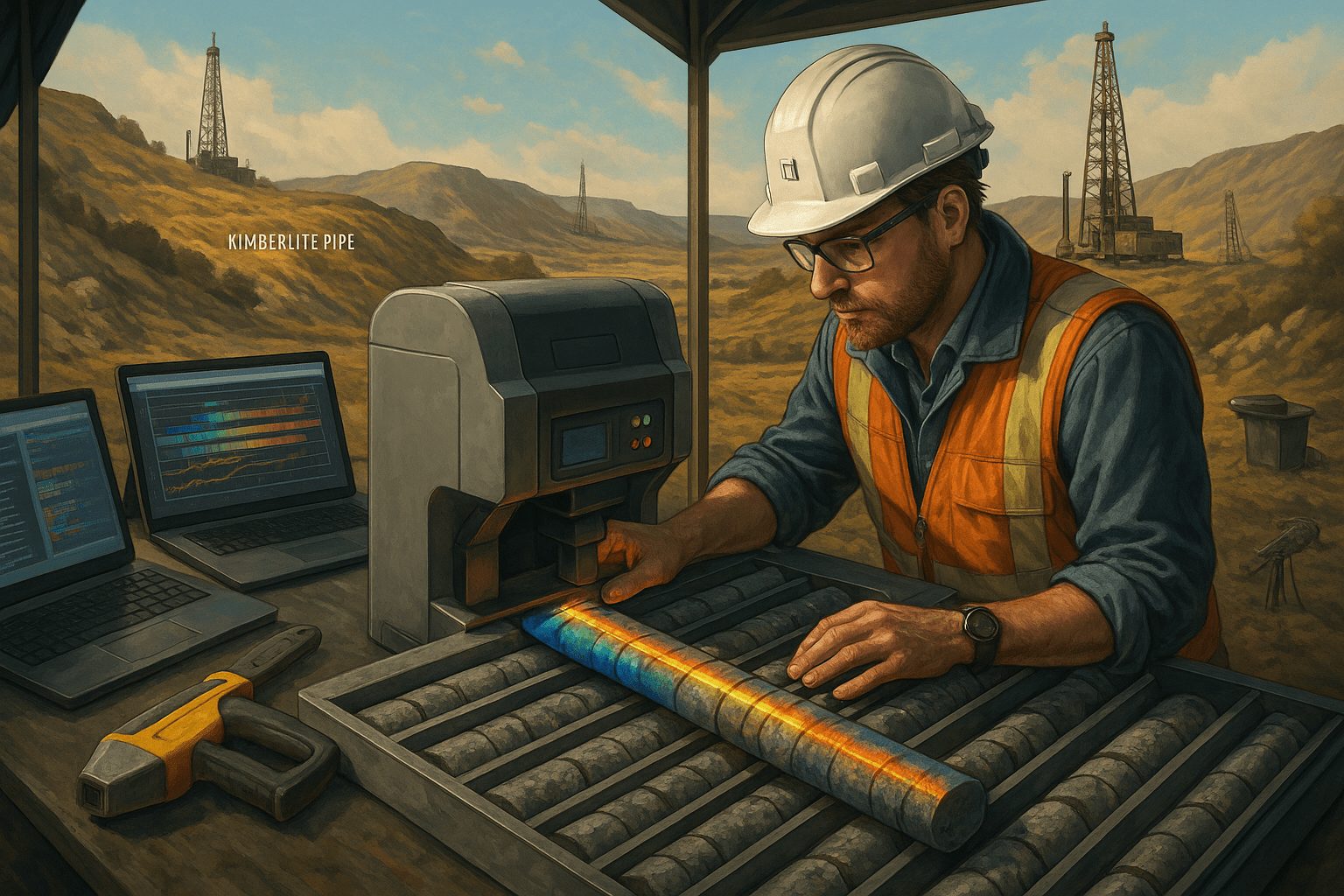
The turning point came with Scan by Veracio, a continuous geochemical scanning tool that captures centimeter-scale data across entire drill cores. Compared to traditional XRF spot checks, the system offers dense, visual, and comparable geochemical data.
“You don’t just get numbers,” Fulop said. “You get patterns, continuity, and insights you never saw coming.”
This change matters most in geologically complex zones like kimberlites, where contamination and fragmentation complicate analysis. With continuous data, trends and correlations emerge across holes and over hundreds of meters.
Geologists using the Scan by Veracio system are able to map subtle shifts in mineralogy, identify alteration halos, and distinguish lithological boundaries with greater certainty. This empowers teams to ask better questions of their cores — and to do so earlier in the exploration process.
| Feature | Handheld XRF | Scan by Veracio |
|---|---|---|
| Data Density | Sparse | Continuous |
| Resolution | Spot-based | Centimeter scale |
| Core Coverage | Selective | 100% length |
| Interpretation Time | Days to Weeks | Near Real-Time |
| Use in Complex Geology | Limited | High |
Context Over Precision
The tool isn’t trying to replace lab precision. Instead, it provides context. And context, Fulop argues, is what changes decisions.
“You don’t need 100% accuracy on every point,” she said. “If your baseline is strong and consistent, you can interpret meaningfully and act faster.”
Exploration teams now use the data to correlate lithologies, test hypotheses, and adjust drilling strategies in near real time. With continuous scanning, what used to take weeks can happen in days.
That shift is not just a technical leap; it’s an operational one. In high-cost environments like diamond exploration, faster turnaround and better targeting mean significant capital savings.
Rewriting the Geologist’s Role
Rather than displacing geologists, continuous scanning expands their toolkit. Fulop describes the transition as moving from a notepad to a dashboard.
“You’re still interpreting,” she said. “But now it’s with full visibility.”
That shift is altering field protocols and modeling workflows. Data scientists collaborate with geologists to extract meaning from the high-density geochemical scans. The result: more confident decisions and fewer missed signals.
Scan by Veracio, which stems from technology originally commercialized by Minalyze, has already seen deployment beyond De Beers. Other major miners are piloting the tool across copper, gold, and critical mineral projects.
And as younger geologists enter the field with backgrounds in data science and digital tools, adoption is accelerating.
From Hypotheses to Data-Driven Models
The real power of continuous scanning lies in hypothesis testing. In Fulop’s case, it disproved an entrenched theory about magmatic pulses in kimberlite pipes. But the implications go further.
With continuous data, researchers can isolate single-element anomalies and correlate them with structural breaks or alteration zones. This supports 3D modeling and even machine learning applications that can prioritize drill targets.
Exploration teams increasingly expect software integration, remote collaboration, and rapid hypothesis iteration. Continuous geochemical scanning sits at the center of that evolution.
“It’s not about replacing the geologist with AI,” Fulop said. “It’s about equipping them with data so rich they can actually think bigger, faster.”
Broader Industry Impact
While the breakthrough occurred in a diamond context, its reach extends across commodities. Base metals, rare earths, and nickel projects are integrating continuous scanning to better understand alteration halos, structural overprints, and mineralization controls.
Academic institutions are beginning to train geology students in scanning interpretation and data integration. Even junior miners are exploring cost-effective partnerships to gain access to the technology.
According to Fulop, the shift will create a new standard in exploration geochemistry: one where dense, visual data is no longer the exception but the expectation.
“This isn’t a novelty,” she said. “This is how we should have been doing it all along.”
FAQ
- What is continuous geochemical scanning?
It is a method of scanning entire drill cores for chemical elements at high resolution to reveal trends and patterns across depth. - How is Scan by Veracio different from traditional XRF?
Unlike handheld XRF tools that scan isolated spots, Veracio provides continuous, dense geochemical data across the entire core. - Why is this technology important for kimberlite analysis?
Kimberlites often contain mixed material. Continuous scanning exposes transitions and contaminations that spot assays may miss. - Is continuous scanning useful beyond diamond exploration?
Yes. It supports data-driven modeling across base metals, rare earths, nickel, and other critical mineral projects.