Key Takeaways
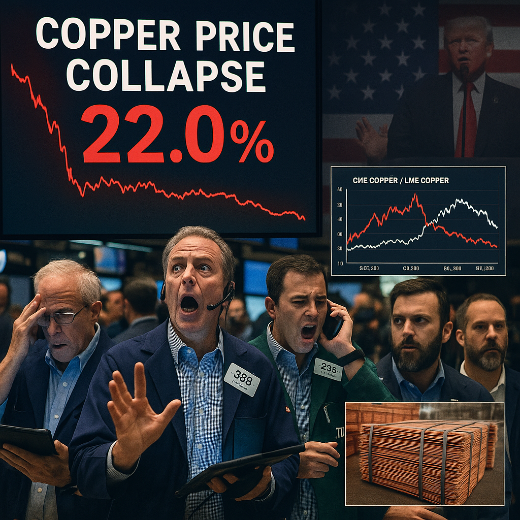
- Copper price collapse led by 22% Comex futures drop
- Tariff exemptions gutted arbitrage trade between Comex and LME
- U.S. warehouses now oversupplied after trader rush
- Trump delays refined copper tariffs until 2027
- Global metals markets left facing renewed uncertainty
The copper price collapse hit with unprecedented speed after the White House stunned commodity markets by exempting refined copper from a sweeping 50% import tariff. The policy swerve caused Comex copper futures in New York to plunge 22%—the sharpest one-day drop in recorded history.
The dramatic swing erased a lucrative arbitrage play that had driven U.S. copper prices to record highs versus the London Metal Exchange (LME), leaving traders overstocked and exposed.
“The blow-out in the CME-LME spread has been touted as one of the most profitable commodity trades in modern history,” said Daniel Ghali, senior commodity strategist at TD Securities. “In a single session, the White House’s proclamation on copper tariffs annihilated the spread and catalyzed CME copper’s largest intraday fall on record.”
Spread Unwinds Overnight
At peak spread levels, Comex copper traded at a premium of more than 30% over the LME benchmark. Following the exemption, that spread collapsed. Comex front-month contracts settled at $4.371 a pound—approximately $9,640 per metric ton—down 22%. In contrast, LME copper eased just 0.9% to $9,611.
The sudden copper price collapse left traders grappling with inventory risks and policy ambiguity, particularly as millions of pounds of copper had been shipped to U.S. ports in anticipation of steep tariffs.
Copper Futures Price Change – July 31, 2025
| Exchange | Price (USD/ton) | % Change |
|---|---|---|
| Comex | $9,640 | -22% |
| LME | $9,611 | -0.9% |
Traders Caught Flat-Footed
The White House confirmed that semi-finished copper goods—such as rods, tubes, and wires—would be hit with tariffs. But refined copper, including cathodes, anodes, and concentrates, was spared.
“This has badly deviated from market expectations,” said Li Xuezhi of Chaos Ternary Futures in Shanghai. “Those betting on higher U.S. prices have wasted all their efforts. Global copper flows will revert to normal.”
At least one vessel redirected to Hawaii in July, part of a late push to beat the tariff deadline, now risks being offloaded at a loss.
Policy Timeline Stretches
The Commerce Department proposed delayed tariffs on refined copper, starting at 15% in 2027 and rising to 30% in 2028. Trump has asked for a copper market update by June 2026.
While Goldman Sachs analysts were surprised by the move, they downplayed the likelihood of re-exports. “Comex prices should remain in line with LME benchmarks,” they wrote.
But the long-term implications of the copper price collapse extend beyond trader losses. With U.S. trade policy shifting unpredictably, metals markets now face broader questions about supply security, industrial planning, and investor confidence.
“This was a white-knuckle move,” said one trader. “They torpedoed a functioning market in a matter of hours—with no clear path forward.”