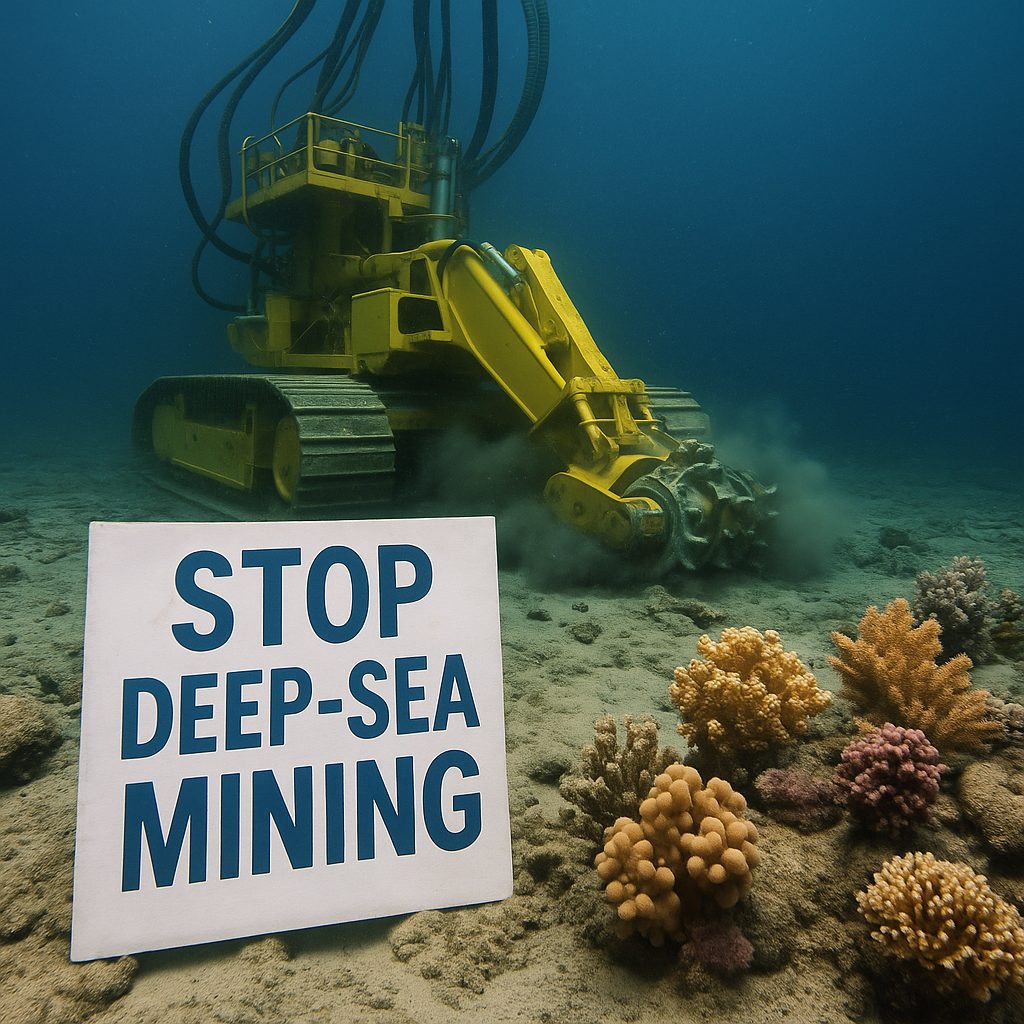
The Deep Sea Conservation Coalition (DSCC) is urging global governments to impose a moratorium on deep-sea mining, responding sharply to the Trump administration’s recent move to fast-track seabed mineral extraction.
An executive order signed earlier this month directs the Secretary of Commerce to expedite the review and issuance of exploration licenses and commercial recovery permits under the Deep Seabed Hard Mineral Resources Act (DSHMRA). Originally enacted in 1980 as a placeholder pending U.S. ratification of the United Nations Convention on the Law of the Sea (UNCLOS), DSHMRA remains in force even as the U.S. remains a non-party to UNCLOS.
“Fast-tracking deep-sea mining by bypassing the ISA’s global regulatory processes would set a dangerous precedent and violate customary international law,” said Duncan Currie, legal adviser to the DSCC.
Critics argue the move undermines the International Seabed Authority (ISA), the United Nations body responsible for regulating mineral activities in areas beyond national jurisdiction. The ISA is still finalizing global regulations for commercial mining, and deep-sea mining remains a politically fraught and technically unproven industry.
Related News
- Gold Fields Ghana Secures Damang Mine Lease Extension Amid Push for Local Ownership
- Critical Study Warns of Deep Sea Mining Risks, Highlights Environmental Impact of DSM
- New Cobalt Alternative Alloy Developed by U.S. Lab to Curb Reliance on China
- Ghana Tightens Resource Control with Takeover of Damang Mine in Mining Policy Shift
Multilateral Cooperation at Risk
The Trump administration’s order could expose U.S. firms to legal uncertainty, according to a Congressional Research Service report issued in 2024. Without the protections afforded under UNCLOS, licenses issued by NOAA would carry limited international recognition, leaving investors vulnerable.
The Metals Company, a would-be deep-sea miner, has signaled similar intent to bypass the ISA’s regulatory system, fueling further concern.
“The ramifications could extend beyond mining, affecting key UNCLOS-covered sectors such as fisheries, freedom of navigation, and maritime boundaries,” Currie said.
Environmental, Economic, and Legal Fallout
The DSCC, along with a growing coalition of environmental groups, corporations, and Indigenous communities, warns that accelerating deep-sea mining poses grave risks for minimal return.
“TMC is selling a pipe dream,” said Sian Owen, Executive Director of the DSCC. “Deep-sea mining presents major environmental, climate, and economic risks, all for highly uncertain benefits.”
Opposition within the United States is mounting. California, Oregon, Washington State, Hawaii, Guam, and American Samoa have all enacted bans on deep-sea mining within their jurisdictions. Meanwhile, major corporations such as Google, Apple, Microsoft, and Salesforce have pledged not to source minerals from the deep sea, citing environmental and social risks.
Matthew Gianni, DSCC co-founder and political adviser, notes that deep-sea mining ventures have repeatedly stumbled in the past.
“Financial and logistical challenges, environmental concerns, legal disputes, and widespread public opposition have derailed every serious attempt to begin deep-sea mining,” Gianni said.
The Metals Company’s primary target — polymetallic nodules rich in cobalt, nickel, and copper scattered across the eastern Pacific — lies at the heart of deep-sea ecosystems that scientists say could take millennia to recover from disruption.
A Call for a Global Moratorium
The DSCC insists that the deep sea, considered the common heritage of humankind under UNCLOS, must not be subjected to unchecked industrial exploitation.
“The deep sea is not a corporate free-for-all,” said Emma Wilson, DSCC Policy Officer. “Governments must assert responsible ocean governance based on science and equity, not industry pressure.”
Nicole Zanesco, DSCC’s North America Coordinator, added: “This is a high-risk, low-reward proposition. It’s a reckless gamble with irreversible consequences.”
Momentum for a moratorium is building as governments and corporations reevaluate the risks of opening an untested and fragile environment to large-scale mining operations. For the DSCC and its growing network of allies, the message to policymakers is unequivocal: a moratorium is no longer just advisable — it is imperative.