LONDON — April 30, 2025 — The global mining industry is in the throes of transformation, driven less by what companies extract from the ground and more by how they operate above it. In the wake of intensifying geopolitical risks, rising investor scrutiny, and mounting social demands, the future of mining organizations is being shaped by a new formula—where ESG in the mining industry is no longer optional, and adaptability is a core competency.
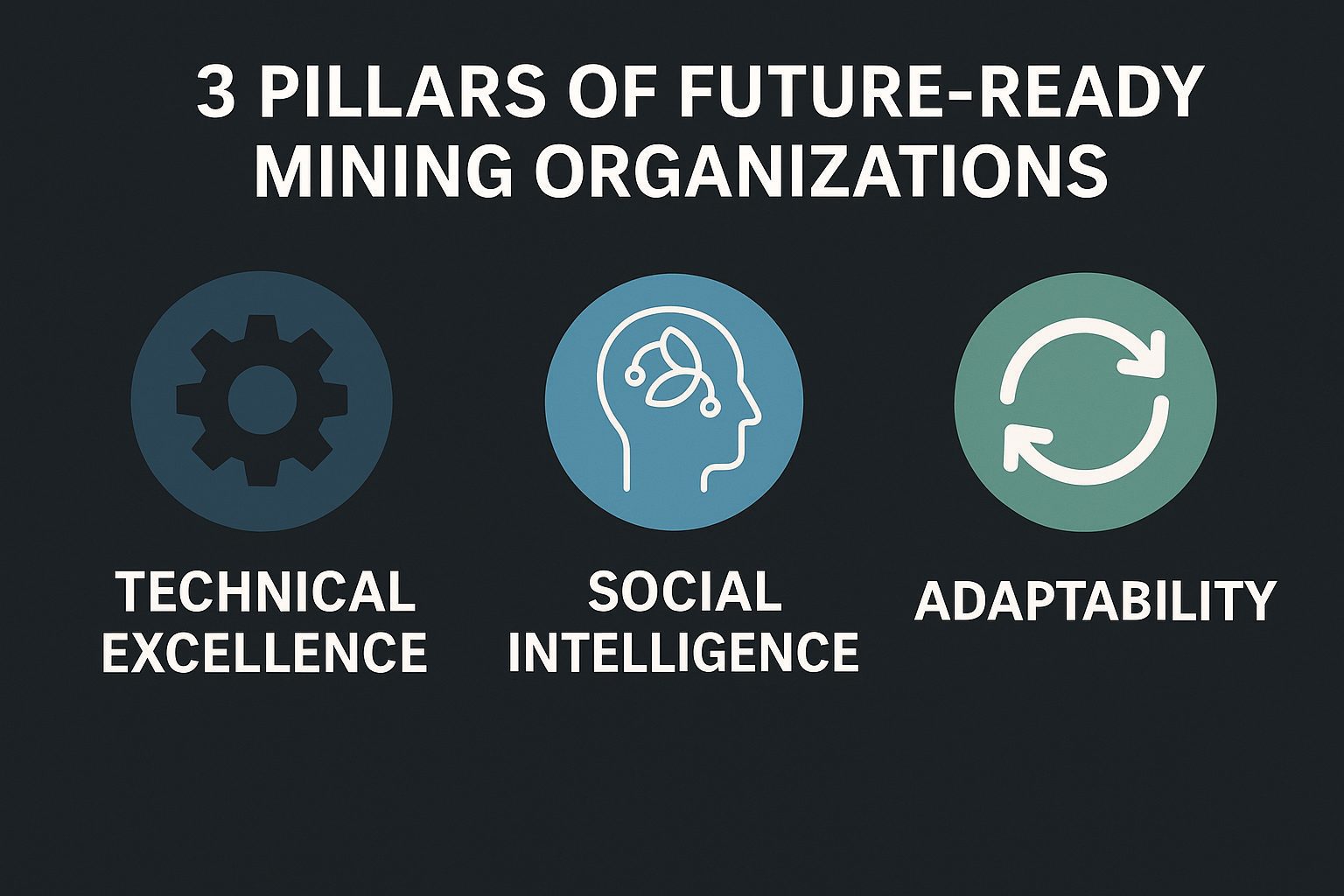
The firms best positioned to lead the next era of resource development won’t be those with the largest reserves or deepest pockets, but those that master three traits: technical excellence, social intelligence, and agility.
ESG Becomes Business Critical
Environmental, Social, and Governance (ESG) principles have rapidly evolved from investor preference to operational necessity. Global majors like Rio Tinto and Anglo American have embedded ESG into board-level strategy, but mid-tier and junior miners are under increasing pressure to show similar alignment or risk losing access to capital and community trust.
“ESG is now an operational lens, not just a reporting category,” said a sustainability officer at a Canada-based copper firm. “It shapes everything from permit timelines to workforce retention.”
Energy-intensive operations face scrutiny over emissions and water use. Social license remains elusive in jurisdictions where Indigenous rights are inadequately addressed. And investor coalitions such as Climate Action 100+ are pushing harder for measurable targets, especially in transition-critical metals.
Related News:
- Gold Fields Ghana Secures Damang Mine Lease Extension Amid Push for Local Ownership
- Critical Study Warns of Deep Sea Mining Risks, Highlights Environmental Impact of DSM
- New Cobalt Alternative Alloy Developed by U.S. Lab to Curb Reliance on China
- Ghana Tightens Resource Control with Takeover of Damang Mine in Mining Policy Shift
Organizations That Flex, Survive
The volatility of recent years—from pandemic-era disruptions to inflation-driven cost surges—has forced mining organizations to develop institutional flexibility. Traditional project lifecycles are giving way to real-time responsiveness.
“In the past, success was about scale and geology. Now, it’s about responsiveness and credibility,” said an executive at a mid-cap lithium producer.
Companies like B2Gold and Ivanhoe Mines have demonstrated that operational excellence can coexist with rapid pivoting—from localizing supply chains to digitizing remote site management. The future of mining organizations increasingly favors those that treat disruption as a constant.
Social Intelligence: The New Strategic Asset
Perhaps the most undervalued shift is the rise of social intelligence (SI) as a competitive advantage. Where once technical capability was king, the ability to build trust, manage stakeholder relationships, and navigate cultural nuance is now seen as equally critical.
Talent pipelines reflect the shift. Engineers and geologists remain vital, but new roles in Indigenous relations, ESG auditing, and climate scenario modeling are growing fastest. Mining companies, long male-dominated, are confronting internal culture wars as DEI initiatives face both global support and regional resistance.
“We’re not just hiring for degrees—we’re hiring for values,” said a recruiter for a major gold miner operating in West Africa. “Empathy and cross-cultural fluency are now as important as mine planning.”
Technology Must Serve a Broader Purpose
Digital transformation—once framed around productivity—is now evaluated through a social and environmental lens. Artificial intelligence, drone surveying, and autonomous haulage must contribute to ESG metrics, not just cost savings.
Companies are rethinking how technology can support transparency, reduce environmental impact, and empower local workforces. The mining tech stack of the future is being built not only for engineers but for regulators, communities, and capital markets.
From Extraction to Engagement
A new archetype is emerging: the mining organization as ecosystem manager, not just resource extractor. This redefinition reflects a deeper shift—from dominance to dialogue, from scale to significance.
“The industry’s credibility is at stake,” said a London-based analyst. “The companies that get this right won’t just survive—they’ll lead.”