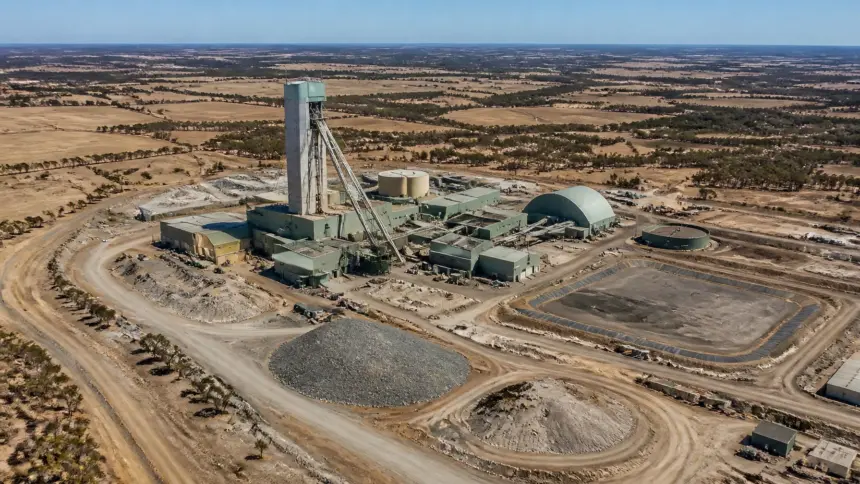
The Edna May processing hub near Westonia is expected to form one half of Forrestania Resources’ planned dual-hub gold operation in Western Australia.
Forrestania Resources has lifted its global gold mineral resource above 2 million ounces following completion of its acquisition of the Edna May Gold Hub from Ramelius Resources, marking a significant change in the company’s scale and development profile.
Forrestania reported a global mineral resource of 58.6 million tonnes at 1.1 grams per tonne gold for 2.078 million ounces. The Edna May assets account for approximately 945,000 ounces, including a substantial indicated resource component.
The transaction gives Forrestania control of a permitted processing facility, established mine infrastructure and a group of regional tenements in Western Australia’s Westonia district. It also moves the company closer to a planned return to production, although the restart remains subject to refurbishment, funding, technical execution and the conversion of resources into viable mine plans.
Edna May pushes Forrestania above two million ounces
The Edna May acquisition adds a JORC-compliant resource of 30.7 million tonnes at 1.0 g/t gold for 945,000 ounces, based on a 0.5 g/t cut-off grade, according to Forrestania’s ASX announcement.
The resource comprises:
| Edna May resource category | Tonnes | Grade | Gold ounces |
|---|---|---|---|
| Measured | 0.7 million | 1.1 g/t | 25,000 oz |
| Indicated | 23.0 million | 1.0 g/t | 700,000 oz |
| Inferred | 7.0 million | 1.0 g/t | 220,000 oz |
| Total | 30.7 million | 1.0 g/t | 945,000 oz |
The indicated category accounts for most of the Edna May estimate, providing a stronger technical foundation for mine planning than an inventory dominated by inferred material. However, the total remains a mineral resource, not an ore reserve. It does not, by itself, establish that all reported ounces can be economically mined or converted into payable production.
Forrestania’s full portfolio includes resources across the Southern Cross, Westonia, Coolgardie and Eastern Goldfields regions. The company’s Westonia project page identifies several nearby exploration and development assets, including the Burracoppin project, which has a separately reported 82,700-ounce resource that Forrestania says still requires its own review following acquisition.
The scale of the enlarged portfolio is important because it gives Forrestania more potential ore sources to support its processing strategy. It also increases the amount of technical work required to determine which deposits can provide consistent mill feed, at what grade and at what cost.
Acquisition adds a 2.9 Mtpa processing hub
Forrestania agreed to acquire Edna May from Ramelius for A$300 million, comprising at least A$200 million in cash and up to A$100 million in Forrestania shares. The transaction includes the Edna May mine, a conventional carbon-in-leach processing plant, associated infrastructure and the Tampia and Symes tenements.
The processing plant has a targeted capacity of approximately 2.9 million tonnes per year following refurbishment and upgrades. The facility was placed on care and maintenance in April 2025.

The Edna May mill is a conventional carbon-in-leach plant that Forrestania plans to refurbish before a potential restart.
Forrestania has targeted a restart of the Edna May mill in the first half of 2027. Its initial plan is to supply the plant with ore from nearby deposits, including existing Forrestania resources, before making longer-term decisions about restarting mining at Edna May itself.
That approach could shorten the path to initial processing compared with a greenfield mine development. The plant, accommodation facilities, power connection, tailings storage and other site infrastructure are already in place. Still, a care-and-maintenance restart is not risk-free. Equipment condition, procurement, commissioning and operating performance will determine whether the installed capacity can be returned to reliable service.
Forrestania is also refurbishing its Lake Johnston processing hub, which it expects to commission in late 2026. The company is targeting more than 6 Mtpa of combined milling capacity across Lake Johnston and Edna May during the first half of 2027.
The proposed structure is effectively a hub-and-spoke model. Regional deposits could be directed to the processing facility best suited to their location, metallurgy and production schedule. In principle, that can improve infrastructure utilization and reduce the need to build separate plants for smaller deposits.
Production history provides context : but not a forecast
Edna May is not an untested development. The operation has a long production history and was previously mined through open-pit and underground methods.
Ramelius acquired the asset in 2017 and operated the mine before underground mining ended in May 2024. Processing continued with stockpiled material and ore from satellite operations, including Marda, Symes and Tampia, until the site entered care and maintenance in April 2025.
Ramelius reports that Edna May produced approximately 376,000 ounces of gold during its ownership and generated A$167 million in free cash flow. Its asset disclosure also reports a remaining open-pit mineral resource of approximately 30 million tonnes at 1.0 g/t for 940,000 ounces.
The small difference between the 940,000-ounce figure in Ramelius’ asset summary and the 945,000 ounces cited in Forrestania’s acquisition materials reflects differences in reporting and rounding. Forrestania’s transaction document provides the more detailed breakdown used in the acquisition.
Past production demonstrates that the orebody and mill have operated commercially, but it does not guarantee future performance. Mining conditions, ore availability, metallurgical recovery, operating costs and gold prices can change materially between operating periods.
What the transaction means for investors
The Edna May deal gives Forrestania a larger resource base and an established route toward production. It also creates a more capital-intensive business with greater execution exposure.
The principal issues for investors and lenders to monitor are:
| Issue | Why it matters |
|---|---|
| Mill restart | The Edna May plant has been on care and maintenance since April 2025. Delays or cost overruns could push back the targeted 2027 restart. |
| Ore supply | The initial plan depends on nearby resources providing sufficient tonnage and grade to support the mill. Resource ounces must be converted into practical mine schedules. |
| Capital requirements | The acquisition and planned refurbishment require substantial funding. Further capital expenditure could affect funding needs and shareholder dilution. |
| Resource conversion | The 2.078-million-ounce figure is a mineral resource. Drilling, mine studies and reserve estimation are needed to establish economically mineable inventories. |
| Gold price exposure | Revenue and project economics remain sensitive to the gold price, foreign exchange rates, energy costs and consumables. |
| Dual-hub execution | Operating two processing hubs would add scale but also increase logistical, maintenance and scheduling complexity. |
Forrestania has said the Edna May transaction was supported by a capital raising of approximately A$310 million. The company also indicated that Ramelius would become a substantial shareholder through the share component of the acquisition.
That funding structure improves access to the asset but expands the company’s share count and places greater importance on disciplined deployment of capital. The key question is not simply whether Forrestania controls more ounces, but whether it can convert those ounces into sustained production and cash flow.
Geology and data confidence remain important
Edna May is hosted in the Westonia Greenstone Belt of Western Australia’s Yilgarn Craton. The deposit comprises a large, structurally controlled gold system hosted in altered granitoid gneiss, with higher-grade quartz lodes and stockwork mineralization.

Drill core review will remain important as Forrestania refines mine plans and evaluates resource extensions.
The resource estimate draws on extensive historical and modern drilling. Forrestania’s acquisition document states that more than 200 kilometres of drilling was used in the resource work, while also noting that some historical records require continued validation.
The company has identified further technical studies and potential exploration programs, including work on underground resource extensions and regional targets. Those programs could increase the inventory, but they could also change the balance between open-pit and underground development options.
For a project with a history of both mining and processing, reconciliation against past production is a useful reference point. It is not a substitute for updated feasibility work under current costs, mining conditions and gold-price assumptions.
Next milestones
The near-term timetable is likely to focus on refurbishment and commissioning rather than immediate expansion of the resource base.
Forrestania’s stated milestones include:
- Completing the integration of the Edna May assets and associated tenements.
- Advancing refurbishment and upgrade work on the 2.9 Mtpa mill.
- Continuing commissioning work at the Lake Johnston hub.
- Defining the initial ore sources for Edna May.
- Completing technical studies for a potential restart of mining operations.
- Updating mine plans and assessing resource-to-reserve conversion.

The Westonia district’s existing infrastructure is central to Forrestania’s regional hub strategy.
Forrestania’s move above 2 million ounces is therefore both a resource milestone and a test of execution. The Edna May acquisition provides scale, a processing asset and a platform for regional consolidation. The next phase will determine whether that platform can support dependable production without materially increasing cost, schedule or balance-sheet risk.
Related reading: Mining finance, project capital costs and funding conditions