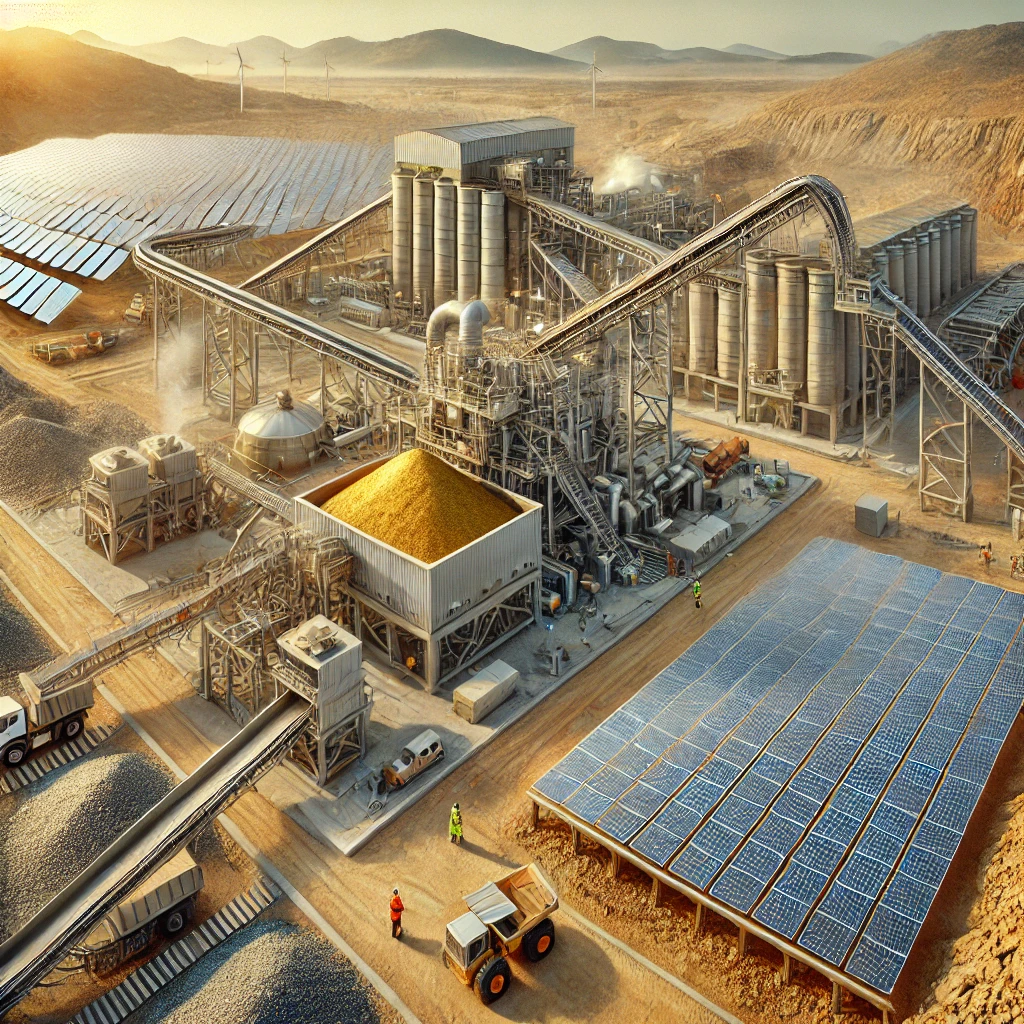

KADOMA, ZIMBABWE — April 2, 2025 | Golden Valley Mine, one of Zimbabwe’s leading gold producers, is investing approximately $600,000 in a dual initiative to modernize its gold processing plant and install a 2-megawatt solar photovoltaic (PV) power facility. The move reflects a strategic push to improve efficiency, stabilize power supply, and seize the opportunity presented by surging global gold prices.
Solar Energy Powers Mining Ambitions
The investment, first disclosed in the Chamber of Mines Commodity Outlook 2025, comes as Zimbabwe’s mining sector grapples with chronic power outages and rising electricity tariffs, which have hampered output across the industry. Golden Valley’s shift to renewable energy through a 2MW solar plant is designed to cut operating costs and reduce reliance on the national grid and costly diesel generators.
“Energy self-sufficiency has become a necessity, not a choice,” said an executive close to the project who requested anonymity due to internal disclosure policies. “This solar investment gives Golden Valley a critical edge in both cost management and sustainability.”
Golden Valley is one of several mines in Zimbabwe pivoting toward solar power, as companies attempt to ensure consistent production while contributing to the country’s green energy transition. Industry analysts say solar has quickly moved from a nice-to-have to an operational imperative.
Riding the Gold Price Wave
Golden Valley’s timing appears astute. Gold prices surged to $3,126.97 per ounce ($100/g) as of April 1, 2025, amid geopolitical uncertainty, persistent inflation concerns, and strong central bank demand. According to Fidelity Gold Refinery, local producers currently fetch $94.64/g for 90% purity gold, while fire assay rates have climbed to $95.14/g.
Financial institutions are bullish. Goldman Sachs now forecasts $3,300/oz ($106.08/g) by year-end, while some analysts suggest extreme conditions could drive prices to $4,500/oz ($144.76/g). With its upgraded processing capabilities and energy-secure operations, Golden Valley is positioned to capture additional margins in a bullish market.
“The capacity upgrades will allow us to increase throughput and improve recovery rates at a time when every gram counts,” said a plant engineer involved in the project.
Supporting Zimbabwe’s Economic Vision
Golden Valley’s expansion also aligns with the Zimbabwean government’s Vision 2030, a development framework that seeks to transform the country into an upper-middle-income economy. The mining sector is central to this ambition, contributing roughly 60% of export revenues.
Mineral earnings are projected to rise to $6 billion in 2025, up from $5.5 billion in 2024, according to the Ministry of Mines and Mining Development. The government’s strategic focus on value addition and renewable energy investments reinforces initiatives like Golden Valley’s.
“Renewable integration and efficiency upgrades are not only good business—they’re policy-aligned,” said a senior official at the Ministry of Energy. “This is the kind of forward-thinking investment we need across the sector.”
Model for Sector-wide Transformation
Golden Valley’s blueprint could serve as a case study for the broader mining community in Zimbabwe. By addressing the twin challenges of energy instability and processing inefficiency, the mine demonstrates how integrated investment can lead to both economic and environmental returns.
“In an environment where grid power is unreliable and diesel is prohibitively expensive, solar is quickly becoming the backbone of sustainable mining operations,” said Tapiwa Nyamadzawo, a renewable energy analyst with WattsUp Africa.
The long-term payoff could be sector-wide resilience, improved productivity, and enhanced investor confidence in Zimbabwe’s mining landscape.