Key Takeaways
- Red Mountain Mining has launched a targeted exploration program at Flicka Lake in Ontario.
- Vein samples returned standout gold grades up to 24.2 g/t and copper values up to 2,420 ppm.
- Soil grids aim to define new targets; exploration funded via shares and potential government grants.
- Geological setting mirrors world-class Archaean gold systems.
- Red Mountain offers exposure to cost-efficient gold exploration in a Tier-1 jurisdiction.
High-grade gold exploration is underway at Flicka Lake in northwestern Ontario, where Red Mountain Mining has launched a focused campaign targeting quartz veins that have returned assays as high as 24.2 grams per tonne.
The company’s efforts are centered on the Fry Lake Gold-Copper Project, a 100%-owned land package in the Superior Province’s Meen-Dempster Greenstone Belt — a region known for historically productive Archaean systems. The geological setting is the same that has produced multi-million-ounce deposits at Pickle Crow, Golden Patricia and other historic mines.
“This exploration program represents a significant step forward,” said Mauro Piccini, Company Secretary. “The exceptional gold values we’ve identified warrant this level of focus and scale.”
Systematic Approach to Vein Sampling
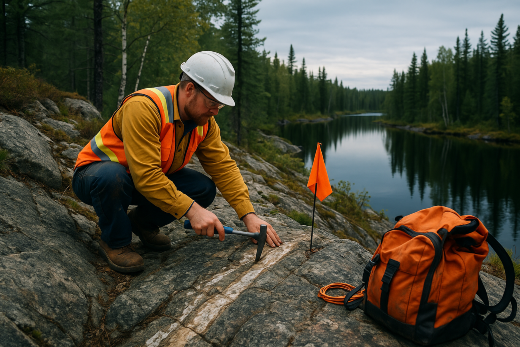
Field crews will conduct detailed channel sampling along three mapped veins within the Flicka Zone. Historical and 2024 results highlight strong continuity and grade potential:
| Vein | Historical Samples | RMX 2024 Samples |
|---|---|---|
| #1 | Up to 17.88 g/t Au | – |
| #2 | Up to 10.90 g/t Au | 24.2 g/t Au, 19.4 g/t Au |
| #3 | Up to 20.07 g/t Au | 9.35 g/t Au |
Sampling will be spaced every 25 meters, tightening around areas with structural complexity. The intent is to map vein geometry and grade distribution — essential steps toward future drilling.
Soil Grids Expand the Search
Beyond the Flicka veins, Red Mountain is testing four soil grids with 962 new sample sites, extending coverage over zones where 2024 assays returned up to 17.8 g/t Au and 2,420 ppm Cu.
- North Grid: Strong polymetallic anomalies, including gold, copper, lead and zinc — suggestive of VMS potential.
- Northwest Grid: Gold-only signature, possibly indicating blind vein-hosted gold.
- Central Grid: Targeting a high copper anomaly with accompanying silver and zinc.
- South Grid: Adjacent to Fry Lake #9 prospect; mixed gold-copper potential.
Financing the Program Without Dilution
Red Mountain has struck a non-cash arrangement with Fladgate Exploration, which will receive up to CAD $60,000 in RMX shares for its services. The company has also applied for CAD $120,000 in exploration rebates through Ontario’s Junior Exploration Program (OJEP). If approved, Red Mountain could fund the entire campaign without a net cash outlay.
“This is smart capital deployment,” said a Toronto-based fund manager following the junior gold space. “You’ve got fieldwork underway, equity alignment with contractors, and minimal dilution risk.”
Archaean Advantage
What elevates Fry Lake is its geologic context. The Meen-Dempster Greenstone Belt is part of a craton renowned for its Archaean orogenic gold systems. These deposits — formed 2.5 to 3.8 billion years ago — are typically hosted in shear zones and characterized by high grades and structural continuity.
“The geologic framework here matches what you see at some of Ontario’s most productive gold mines,” said one independent geologist familiar with the belt. “It’s early, but the grade is real and the structure is there.”
Looking Ahead
With sampling underway and assays expected in the coming weeks, Red Mountain is entering a critical phase. If channel results confirm continuity at high grade and soil grids expand the anomaly footprint, the company could be positioned to launch a targeted drill program by year-end.
For now, the strategy is to stay lean, drill-ready, and focused on confirming scale.
“Exploration success in Ontario still hinges on grade,” said the fund manager. “Red Mountain’s story is compelling because it starts with the one thing juniors can’t manufacture: strong gold at surface.”