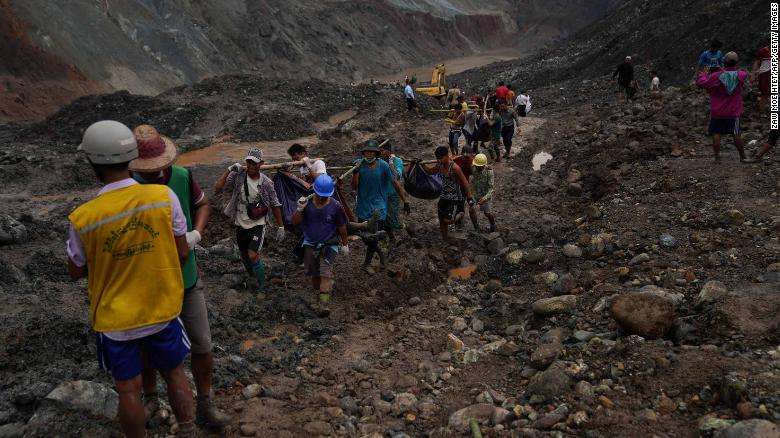
Around 200 rescuers are assisting in the hunt for missing miners at the Hpakant site, with some using boats to look for fatalities in a nearby lake.
According to rescue personnel, at least one person has been confirmed deceased, and up to 100 more have not been found after a landslide at a jade mine in northern Myanmar.
“About 70-100 people are missing in a landslide that happened at 4am” on Wednesday at the Hpakant mine in Kachin state, according to Ko Nyi, a member of the rescue squad.
“We’ve transported 25 people to the hospital and have found 1 person dead.”
There were almost 200 rescuers who were searching for bodies, and some of them were making use of boats to search for the deceased in a closeby lake, he said.
Hundreds of people stood on the edge of the lake, some releasing boats into the water, according to a photo posted on social media by a local journalist who claimed to be on the scene.
You might be interested in
- Environments Around Mines Are Less Harmful When Using Biometallurgy To Recycle Leached Metal Compounds
- United Mine Workers Of America Union Refused To Comment On MSHA’s Lack Of A Covid-19 Vaccination Requirement
- Concerns about safety force almost a quarter of coal mines in Shanxi to close
- Five workers killed after mine explosion at Chinese Coal Mine in Laos
- In Colombia, three miners were killed in an illegal operation
The landslide claimed the lives of 20 miners, according to the Kachin News Group.
Myanmar’s fire department said its workers from Hpakant and the neighboring town of Lone Khin were helping with the rescue mission but provided no estimates for the number of people killed or missing.
Every year, dozens of people lose lives while working in Myanmar’s lucrative but ill-managed and poorly controlled jade business, which employs low-wage migrant workers to scrape out a stone prized in China. Local villagers are regularly caught in the middle of the battle for control of the mines and income, which is exacerbated by a thriving drug and gun trade.
Heavy rains created a catastrophic landslide in Hpakant, Myanmar’s jade trading capital in Kachin state, that killed more than 170 people last year.
Even as warfare has risen since Myanmar’s military seized control in a coup in February, economic strains owing to the COVID-19 outbreak have pushed more migrants to the jade mines.
When Nobel Laureate Aung San Suu Kyi’s government was deposed in 2016, it promised to clean up the industry, but campaigners claim little has changed.
Myanmar produces 90% of all jade in the world. The majority comes from Hpakant, where human rights organizations claim that mining companies with ties to military officials and ethnic armed groups gain billions of dollars each year.
According to watchdog Global Witness, the February coup effectively ended any possibility of reforming the deadly and uncontrolled business.
As per a report released last week by Global Witness, Myanmar’s military now controls the country’s multibillion-dollar gemstone business.
According to the anti-corruption body, luxury jewelers risk subsidizing military abuses in Myanmar due to the military’s dominance of the sector.