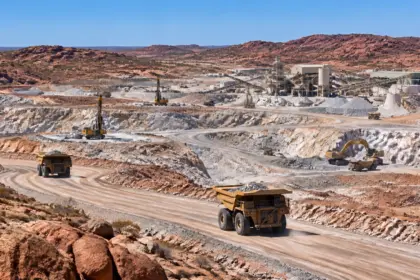
A tailings storage facility failure at Samancor’s Dikwena Chrome mine near Brits has put a practical question at the centre of mining ESG compliance in 2026: can an operator demonstrate that its tailings risks are identified, controlled, registered, monitored and disclosed before regulators, communities and investors demand the evidence?
The incident is still under investigation. But the early response already illustrates the growing overlap between operational safety, water regulation, environmental reporting and financial disclosure.
The northern wall of Compartment 1B failed on Aug. 13, releasing almost all of the tailings stored in that section, according to the South African Government News Agency. The flow damaged mine infrastructure, a railway line and Eskom power lines, while also affecting an unnamed tributary. No fatalities or injuries have been reported.
The Department of Water and Sanitation (DWS), working with the Limpopo-Olifants Catchment Management Agency (LOCMA), is investigating the failure and its water impacts. DWS has also issued a verbal directive for Samancor Dikwena to stop depositing tailings into its tailings dams while the investigation continues.
That immediate halt is an operational restriction. Its wider significance is as a test of whether mining companies can connect site-level engineering data with the regulatory and sustainability information now expected by capital markets and supply-chain customers.
What happened at Dikwena?
The facility is located in South Africa’s North West province, near Brits and close to Northam Platinum’s Eland Mine. Tailings flowed toward neighbouring infrastructure, with railway embankments and containment berms helping prevent the material from reaching the R566 provincial road, DWS said.
The authorities have not yet established the technical cause. Investigators will need to examine the facility’s design and construction history, deposition practices, water balance, drainage, freeboard, inspection records, instrumentation and recent weather conditions.
DWS and LOCMA have collected water samples, but laboratory results are required before the chemical and ecological effects can be assessed. A visible slurry release confirms a physical failure, but it does not by itself establish whether specific metals, reagents or other contaminants entered the watercourse at harmful concentrations.
| Confirmed or reported issue | Compliance significance |
|---|---|
| Northern wall of Compartment 1B failed | Requires technical cause analysis and corrective action |
| Large volume of stored tailings released | Tests consequence assessment, emergency response and closure planning |
| Railway, mine infrastructure and power lines damaged | Demonstrates exposure of third-party assets and shared infrastructure |
| Unnamed tributary affected | Triggers water-quality investigation and potential remediation obligations |
| DWS verbal directive to stop deposition | Creates an immediate operational and permitting risk |
| DWS/LOCMA investigation under way | Regulatory findings may affect registration, engineering and disclosure |
The Mining Weekly report on the site inspection quoted Mineral and Petroleum Resources Minister Gwede Mantashe as saying that slime dams must be treated as part of mining operations rather than as a separate water-management matter.
That distinction matters for ESG reporting. A tailings facility is not only an environmental asset or a water-risk location. It is also part of the mine’s production system, internal control environment, financial planning and licence to operate.
Registration under the National Water Act is back in focus
Water and Sanitation Minister Pemmy Majodina has renewed her call for mining companies to register tailings dams that meet the minimum criteria for classification as dams with a safety risk under South Africa’s National Water Act.
Registration allows DWS to maintain oversight through the national register and apply dam-safety requirements, inspections and directives. It does not replace engineering controls or company accountability, but it provides a formal regulatory entry point for facilities that may pose significant consequences if they fail.
The Dikwena case has intensified attention on whether all qualifying tailings facilities are correctly identified and registered. Civil society organisations have pointed to the public dams register published in 2025 and questioned whether the Dikwena facility appeared on it.
The status of registration, classification and permitting should be established through official records and the investigation. It would be premature to infer a causal link between any registration question and the wall failure before the authorities release their findings.
For operators, however, the compliance lesson is immediate: a corporate tailings inventory should reconcile the facility list used by engineering teams with the facilities reported to regulators, insurers, lenders, auditors and sustainability-reporting functions.
Why the incident matters for IFRS S1 and S2
IFRS S1 requires companies to disclose sustainability-related risks and opportunities that could reasonably affect cash flows, access to finance or cost of capital over the short, medium or long term.
It does not prescribe a single tailings metric. Instead, tailings become relevant when they create a material risk to the company’s prospects. Potential examples include:
- remediation and rehabilitation liabilities;
- production interruptions caused by a deposition halt;
- higher insurance premiums or reduced coverage;
- regulatory penalties or permit restrictions;
- loss of access to infrastructure;
- community and water-related disputes;
- higher borrowing costs; and
- impairment or accelerated closure of a mine or facility.
IFRS S1 organises the disclosure around governance, strategy, risk management, and metrics and targets. A credible disclosure therefore needs more than a statement that tailings are monitored. It should explain who has oversight, how risks are assessed, which controls are in place, how failures could affect operations and finance, and whether the company is meeting its targets.
IFRS S2 adds a climate-related lens. Heavy rainfall, flooding, drought, heat and changing water availability can affect tailings stability and water management. Regulatory expectations linked to climate resilience may also raise transition costs.
This does not mean every tailings facility must automatically be reported as a climate risk. The connection must be supported by site-specific analysis, such as rainfall thresholds, flood mapping, water-balance modelling and engineering assessments.
CSRD applies a wider materiality test
The European Union’s Corporate Sustainability Reporting Directive uses double materiality. Mining companies within scope must consider both:
- Financial materiality: how tailings risks affect enterprise value; and
- Impact materiality: how tailings affect people, water, ecosystems and communities.
That is a broader test than the investor-focused materiality lens in IFRS S1. A tailings impact may require reporting even if management cannot yet quantify a direct effect on cash flows.
For mining groups with European operations, listings, customers or parent-company reporting obligations, tailings data may intersect with ESRS topics covering pollution, water and marine resources, biodiversity and ecosystems, and resource use and circular economy.
This increases the importance of facility-level information. Aggregate group-wide statements may not adequately explain where tailings are located, how much material is stored, which communities are exposed, what failure modes exist or how emergency response plans operate.
Skillings has previously examined the broader ISSB and CSRD reporting landscape for mining companies. The Dikwena failure shows why the question is moving from reporting departments into operational decision-making.
EU Battery Regulation extends supply-chain scrutiny
The EU Battery Regulation covers due diligence for selected raw materials, including cobalt, natural graphite, lithium and nickel. Its definition of recycled sources also recognises material recovered from mining waste, including tailings.
The regulation’s due-diligence obligations have been postponed to Aug. 18, 2027 under Regulation (EU) 2025/1561, but companies are already preparing supply-chain systems.
For miners, this creates a data-consistency requirement. A company may need to provide customers with information about the origin of battery materials, environmental risks, mitigation measures and management systems. If the same facility appears differently in a GISTM disclosure, CSRD report, customer questionnaire and regulatory filing, the inconsistency can become a risk in its own right.
GISTM provides the technical backbone
The Global Industry Standard on Tailings Management contains 15 principles and 77 auditable requirements covering the tailings lifecycle.
Its Principle 15 focuses on public disclosure and access to information. At facility level, companies are expected to disclose information such as:
- facility description and location;
- consequence classification;
- relevant risk-assessment findings;
- potential impacts and exposed populations;
- monitoring and performance information;
- emergency preparedness arrangements;
- recent independent review dates;
- material changes to the facility; and
- financial capacity for closure, reclamation and post-closure obligations.
GISTM is not a financial reporting standard, and it does not replace the National Water Act or other local requirements. Its value is that it creates a structured technical dataset that can support IFRS, CSRD, lender and customer disclosures.

Technical teams review monitoring data used to assess tailings integrity and environmental risk.
The cost of poor data quality
The most underestimated cost in mining ESG compliance is often not the reporting software. It is the work required to make site data reliable.
Many operators inherit facility records from different owners, engineering consultants and operating systems. Definitions may vary: stored volume may be measured differently across sites, consequence classes may not be updated after downstream development, and inspection dates may sit in unconnected document repositories.
Data quality costs arise from:
- surveying and reconciling facility geometry;
- digitising historical engineering records;
- installing or upgrading piezometers, inclinometers, radar and remote sensing;
- validating rainfall, water-level and pore-pressure readings;
- confirming ownership and registration status;
- mapping downstream populations and infrastructure;
- aligning closure-cost estimates with engineering assumptions; and
- obtaining independent assurance.
These costs are operational investments, but they also affect the credibility and auditability of disclosures. A company cannot reliably quantify tailings risk if it cannot confidently state how many facilities it owns, where they are, how much material they contain or who is responsible for each one.
Mining ESG compliance 2026 checklist
| Control area | Evidence an operator should be able to produce |
|---|---|
| Facility inventory | Complete list of active, inactive, closed and abandoned tailings facilities |
| Legal status | Registration, permits, classification and regulator correspondence |
| Governance | Board and executive accountability, accountable executive and engineer roles |
| Engineering | Design basis, construction records, inspections and independent reviews |
| Monitoring | Current data for water levels, pore pressure, deformation, rainfall and seepage |
| Risk assessment | Failure modes, consequence classification and downstream exposure mapping |
| Emergency response | Warning systems, evacuation routes, drills and coordination with authorities |
| Water protection | Sampling plan, baseline data, laboratory results and corrective actions |
| Closure planning | Closure design, post-closure monitoring and funded cost estimate |
| Disclosure alignment | Consistent data across GISTM, IFRS S1/S2, CSRD, customer and regulatory reports |
| Assurance | Documented review trail, control testing and independent assurance conclusions |
| Incident response | Time-stamped records of notification, containment, remediation and lessons learned |

Tailings facilities require integrated monitoring of containment structures, drainage and downstream water pathways.
What operators and investors should watch next
The Dikwena investigation should clarify the technical cause, the extent of the water impact, the condition of Samancor’s remaining facilities and the regulatory basis for resuming deposition.
The most consequential findings will likely concern whether design, operating controls, inspection, registration and emergency planning worked together as intended. They will also indicate whether South African authorities pursue broader inspections or changes in reporting expectations.
For mining companies, the practical standard is becoming clear: tailings compliance cannot remain a standalone ESG narrative. It must be supported by engineering evidence, regulatory records, tested emergency plans, reliable site-level data and financial provisions that reflect credible closure and remediation scenarios.
For investors, lenders and customers, the quality of that evidence may increasingly matter as much as the existence of a published policy. The Dikwena failure has shown how quickly a facility-level event can become a water, production, infrastructure, regulatory and disclosure issue at the same time.
The investigation remains open, and responsibility for the failure has not been determined. But the compliance direction is already visible: register qualifying facilities, strengthen independent oversight, disclose material risks and build one reconciled data record that can withstand scrutiny across every reporting regime.