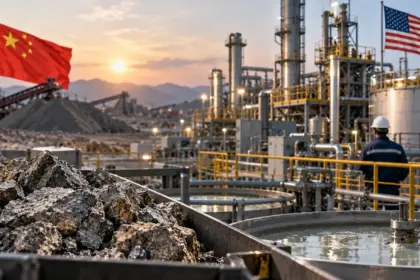
The finalization of the $1.6 billion federal investment package for USA Rare Earth in early 2026 has fundamentally altered the trajectory of the global critical minerals market. For a decade, the rare earths supply chain was characterized by a “wait-and-see” approach from Western capital, deterred by China’s dominant market share and aggressive pricing strategies. That era ended in January 2026 when the U.S. government transitioned from nonbinding letters of intent to a finalized, high-stakes equity and debt position.
This capital injection, which includes a $1.3 billion senior secured loan and a significant equity stake, is more than a single-company bailout; it is the cornerstone of a broader 2026 rare earths supply chain shift. By de-risking the Round Top heavy rare earth project in Texas and the Stillwater magnet manufacturing facility in Oklahoma, the deal has signaled to global investors that the midstream processing gap: long the “Achilles’ heel” of Western energy security: is finally being bridged.
The Stillwater/Round Top Nexus: Execution Over Intent
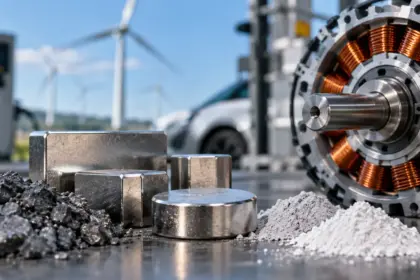
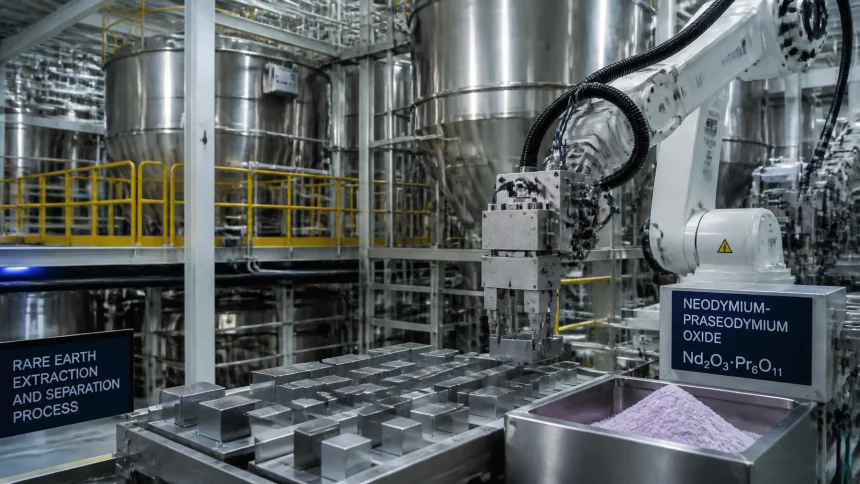
For years, the industry’s primary challenge was not the lack of ore, but the absence of specialized separation and magnet-making capacity outside of China. The $1.6 billion Final Investment Decision (FID) equivalent finalized this year targets exactly that bottleneck. The Stillwater facility is now on track to become the first domestic producer of sintered neodymium-iron-boron (NdFeB) magnets at scale since the closure of Magnequench decades ago.
The Round Top project, located in Hudspeth County, Texas, is equally critical. Unlike the light rare earth deposits that dominate most Western discoveries, Round Top is rich in heavy rare earths (HREE) like dysprosium and terbium. These minerals are essential for high-temperature magnet performance in electric vehicle (EV) motors and defense applications. With commercial production now pulled forward to 2028, the project represents the first viable alternative to the HREE mines of Southern China and Myanmar.

Mapping the 2026 Global Processing Hubs
While the U.S. has captured headlines with the USA Rare Earth deal, the 2026 rare earths supply chain shift is a multi-polar phenomenon. We are seeing the emergence of three distinct non-Chinese processing corridors:
- The North American Hub: Centered on Mountain Pass (MP Materials) in California, the Stillwater plant in Oklahoma, and the burgeoning separation capacity in Texas. This hub is increasingly vertically integrated, moving from ore to oxide to magnet within the USMCA trade block.
- The Australian-Asian Hub: Australia has moved beyond being a mere exporter of concentrate. Iluka Resources’ Eneabba refinery is now processing heavy rare earths, while Arafura Rare Earths’ Nolans Project has progressed toward commissioning its integrated mine-to-oxide facility. This corridor relies on the strategic partnership with Malaysia (Lynas) and Japan’s technical expertise.
- The European-African Nexus: Though trailing North America, the European Union’s Critical Raw Materials Act has accelerated projects in Scandinavia and established “green corridors” with African producers such as those in Malawi and Namibia.
| Project Name | Location | Capacity (Est. 2026/27) | Primary Focus |
|---|---|---|---|
| Mountain Pass (MP) | USA | 40,000t REO concentrate | NdPr Separation |
| Eneabba (Iluka) | Australia | 17,500t REO | Heavy Rare Earths |
| Nolans (Arafura) | Australia | 4,400t NdPr | Fully Integrated |
| Stillwater (USAR) | USA | 1,000t+ Magnets | Downstream Magnets |
| Guanaba (Meteoric) | Brazil | 4,000t REO | Ionic Clay Extraction |
Domestic Sourcing: Breaking the Heavy RE Bottleneck
The 2026 landscape is defined by a pivot toward “Ionic Clay” deposits and heavy rare earth extraction. For too long, the West relied on hard-rock light rare earths (LREE), which are easier to process but less valuable for the energy transition. The emergence of Brazilian ionic clay projects, such as Meteoric Resources’ Caldeira and Viridis Mining’s Colossus, has introduced a new variable. These projects offer lower capital intensity and higher HREE concentrations compared to traditional hard-rock mines.
In the United States, the focus remains on ensuring that domestic sourcing is backed by domestic processing. The $1.6 billion commitment has forced a realization that mining without refining is a strategic dead end. As noted in the China critical minerals strategy analysis, the risk of export bans on processing technology remains high. Consequently, the 2026 shift is characterized by “technology on-shoring,” where firms are building proprietary separation circuits that do not rely on Chinese intellectual property.

Investor Implications: The “Friend-Shoring” Premium
For investors and mining operators, the 2026 rare earths supply chain is no longer a purely speculative venture. The “friend-shoring” premium is now tangible. Projects that align with the U.S. Department of Defense (DoD) and the Department of Energy (DOE) requirements are receiving lower-cost capital and guaranteed off-take agreements that provide a floor against price volatility.
However, the sector remains sensitive to operational risks. The technical challenge of rare earth separation is significant; many projects that achieved FID in 2024 are now grappling with commissioning delays and chemical reagent costs. Investors are increasingly looking past the resource size and focusing on the purity of the final oxide and the reliability of the midstream partner.

Looking Ahead: The 2026 Outlook
As we move through the second half of 2026, the rare earths market is entering its most critical phase: the transition from construction to commercial delivery. The $1.6 billion FID was the catalyst, but the true measure of success will be the volume of non-Chinese magnets entering the EV and defense supply chains by 2027.
The decoupling is not complete, but the map has changed. The concentration of supply is shifting from a single geography to a network of allied processing hubs. For operators and decision-makers, the priority has shifted from finding the next big deposit to securing the chemical expertise and state-backed financing required to survive a volatile market.