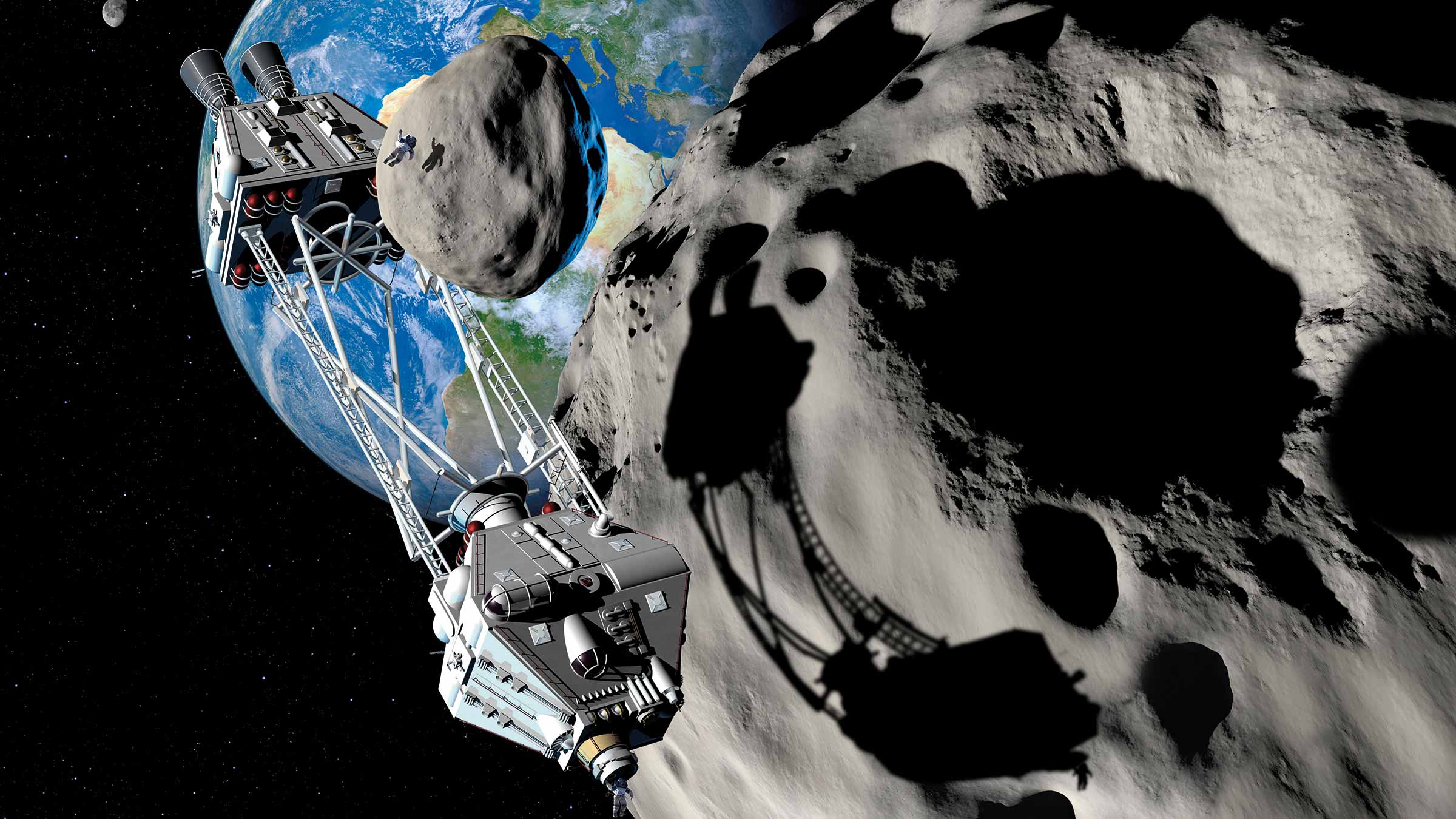
Metallic asteroids near Earth may contain valuable metals worth $11.65 trillion, according to recent calculations by scientists. According to some estimates, the precious metals contained in the pricey nugget are equal to or more than all of the world’s known metal deposits combined.
In the Planetary Science Journal commentary, the two “may be potential targets for asteroid mining in the future.” Space mining has garnered momentum in the scientific community because experts think that the accomplishment may supply low-cost metals for a colony on the moon or Mars, eventually expanding humanity’s reach in exploring space. A cosmic mine would eliminate the need for construction materials to survive the costly shuttle trip from Earth to space. Mathematicians also believe that these unusual floating orbs may provide insight into the validity of another metallic treasure NASA plans to visit in 2022: the enigmatic 16 Psyche satellite.
The strange body is believed to be made up of pure metal hills and valleys rather than forests, seas, or even dirt. A curious thing to note is how remarkably similar Earth’s partially exposed core seems to be. It’s no coincidence that the numerous minor asteroids discovered in the current study have been nicknamed “mini Psyches.” These asteroids were likely shards that broke off from a comparable bare core, but the research team does not believe these fragments are descendants of 16 Psyche.
you Might be interested in
- Authorities warn of brewing space mining war among US, China and Russia
- Authorities warn of brewing space mining war among US, China and Russia
- Remote mining Technology Uses on isolated mines, launchpad for Australia’s space industry!
- 5G and satellites ushers in a new era of mining!
- BHP and Caterpillar are collaborating to accelerate the development of zero-emissions mining trucks
Science and the general public have both taken an interest in the 16 Psyche discovery, with some speculating that the site may contain minerals worth $10,000 quadrillion. Scientists are skeptical about the astronomical price tag since they don’t know what 16 Psyche is composed of until it is inspected by an orbiting spacecraft on a future mission. Spectrum analysis is limited by distance since 16 Psyche is too far away. This scientific technique uses electromagnetic emission and absorption signals to figure out what materials are in things.
Until a thorough study can be conducted, which NASA’s mission plans to do, experts must accept the possibility that the object is nothing more than debris. They can provide us an early glimpse into their namesake’s characteristics, making data from the “little Psyches” valuable. Because the boulders are so close to Earth, scientists may more easily collect spectral data using equipment they already have.
By analyzing the gathered data, scientists discovered that the orbiting chunks contain 85% metal, such as iron and nickel, with 15% silicate, which is a more typical rock. Future missions may now clarify 16 Psyche’s future role as an addition to the crew of treasure troves for prospective space miners due to the baby versions of 16 Psyche.
A NASA grant helped finance the research. Associate professor Vishnu Reddy at the University of Arizona’s Lunar and Planetary Laboratory said finding these “little Psyches” near the Earth was gratifying.