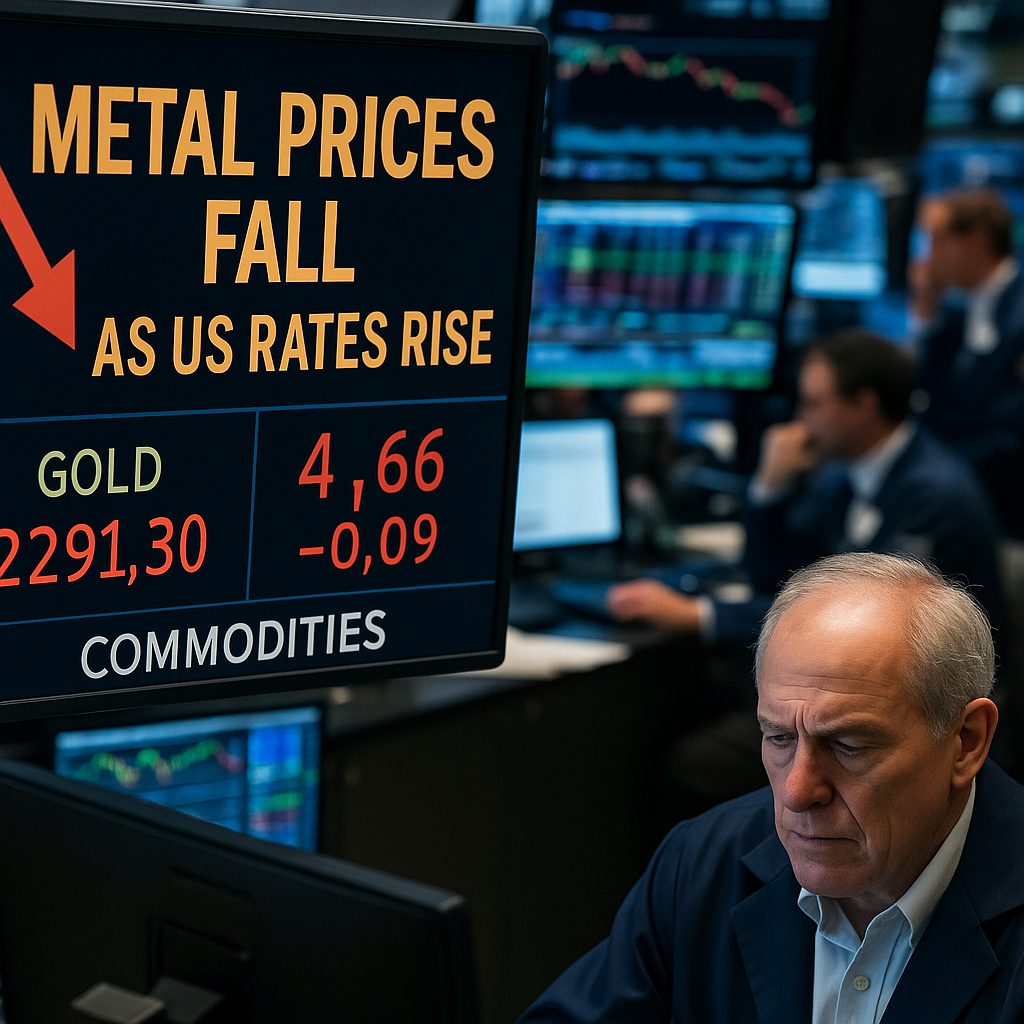
Metal markets are under renewed pressure as US rates rising continue to tighten financial conditions, casting a long shadow over gold, copper, and other industrial commodities.
Gold futures, long viewed as a hedge against uncertainty, have begun to falter. “The market is suddenly making lower highs and lower lows,” said veteran analyst Ira Epstein, citing the technical breakdown in the yellow metal. With real yields climbing, gold’s role as a safe haven is eroding in the face of a persistently hawkish Federal Reserve.
Rising Yields Weigh Heavily on Metal Prices
The Fed’s latest signal—keeping benchmark rates elevated through year-end—has reverberated through commodity desks. For gold, which offers no yield, the opportunity cost of holding bullion rises with every tick upward in Treasury rates. Meanwhile, base metal prices, including copper and aluminum, are equally vulnerable.
“The higher-for-longer narrative is choking off speculative flows into metals,” said one London-based metals strategist. “It’s a different environment than the 2020–2021 liquidity boom.”
US Rates Rising Curtail Demand Expectations
Beyond financial mechanics, US rates rising are also dampening global growth expectations. Industrial metals such as zinc and nickel, closely tied to construction and manufacturing, have posted multi-week losses as traders adjust to a more restrictive macro backdrop.
“The Fed is not just raising rates. It’s signaling that inflation stickiness justifies a prolonged stance,” said a senior economist at ING. “That has serious consequences for demand-sensitive metal prices.”
China’s Stimulus Offers Only Limited Cushion
While some optimism surrounds recent Chinese stimulus efforts—particularly measures to support real estate and infrastructure—their effect on global metal prices has been muted. Traders view the moves as defensive rather than growth-positive, and confidence in sustained demand recovery remains fragile.
“China can only do so much when U.S. monetary policy is tightening the screws,” said an analyst at the London Metal Exchange.
Related News:
- Stardust Power’s Oklahoma Lithium Facility Avoids Wastewater Permit with Closed-Loop System
- Carney Assembles Economic Team with Ex-Goldman Banker and Quebec Power Broker
- Sanatana Resources Secures Gold Strike Two in Yukon Mining Project Expansion
- Peru Suspends Mining After Pataz Gold Mining Massacre Leaves 13 Dead
Gold Faces Technical Breakdown
Gold, which briefly breached $2,400/oz in early April, is now hovering near $2,290. For chart-watchers, the recent pattern of lower highs and lower lows confirms a bearish reversal. Rising real yields, a stronger dollar, and dwindling ETF inflows have all contributed to the pullback.
According to data from the World Gold Council, global gold ETF holdings have declined for four consecutive weeks. The erosion in sentiment reflects how deeply US rates rising have reshaped the investment landscape.
Broader Implications for Commodities
The broader commodities complex—from precious metals to energy—is now in a holding pattern, contingent on the Fed’s next move. The CME FedWatch tool currently shows markets pricing in only one rate cut by Q4 2025, a sharp revision from earlier expectations of multiple cuts.
This recalibration has squeezed not only speculative positioning but also commercial hedging strategies, many of which had anticipated a looser policy cycle.
Repricing in Real Time
The effects of US rates rising are not theoretical—they are materializing across markets. Open interest in gold futures on COMEX has dropped 8% month-over-month, while LME copper inventories have climbed to a five-month high, suggesting softening demand.
For metal traders, the message is clear: until the Fed pivots, the path for metal prices remains constrained.