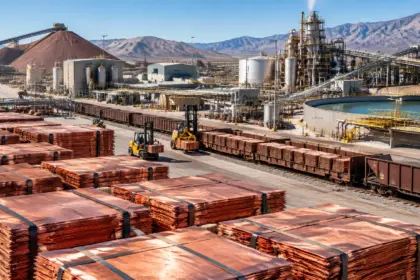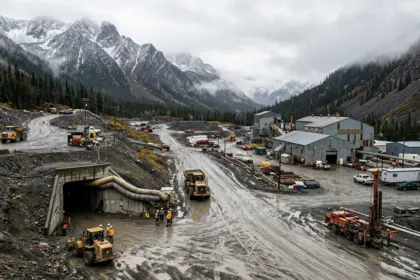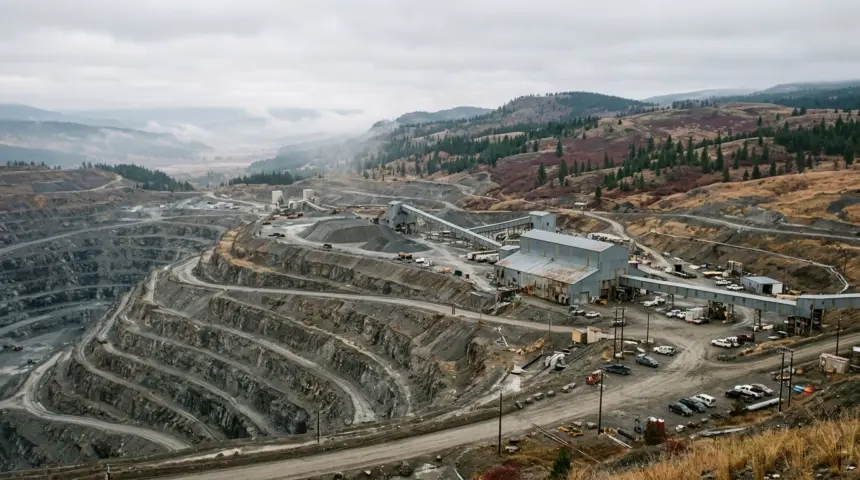
On Saturday, October 24, 2026, approximately 1,200 unionized workers represented by United Steelworkers Local 7619 commenced strike action at approximately 8:00 a.m. Pacific Time at the Highland Valley Copper (HVC) operations near Logan Lake, British Columbia (CFJC Today Kamloops), following a 72-hour strike notice issued on October 21, with Teck Resources Limited issuing its formal corporate operational announcement at 15:18 Eastern Time. Canada’s largest open-pit copper mine continues to operate at reduced capacity under management contingency plans focused on safety and environmental management, though Teck has not disclosed the exact percentage of mill throughput currently curtailed (MineListings). Yet the outbreak of a major North American labor disruption has collided with an apparent physical contradiction: London Metal Exchange (LME) copper remains above US$14,000 per metric tonne—with cash copper settling at US$14,415 per tonne and three-month futures at US$14,270 per tonne on October 23—just as visible LME warehouse inventories surged 21.4 percent in six trading sessions (Westmetall).
Evaluating whether copper above US$14,000 per tonne is justified requires establishing the precise scale of Highland Valley’s production exposure without treating the mine’s entire annual output as immediately lost supply. In its October 2025 operational review, Teck lowered Highland Valley’s 2026 copper production guidance to 115,000–135,000 tonnes (midpoint: 125,000 tonnes), down 10.7 percent from its previous 130,000–150,000 tonne outlook, while guiding 2025 output to 120,000–130,000 tonnes and 2027 output to 135,000–155,000 tonnes as higher-grade Lornex pit ore shifts into 2027. In third-quarter 2025, Highland Valley produced 28,100 tonnes of copper—a figure that represents actual quarterly metal output rather than the size of a production shortfall—as lower grades near the Lornex fault zone and unplanned mill maintenance weighed on throughput (Teck Operational Review).
Using Teck’s 2026 midpoint guidance of 125,000 tonnes per year, Highland Valley produces an average of roughly 342 tonnes of contained copper in concentrate per day. Because the mine continues operating at reduced capacity, an illustrative scenario assuming a 50 percent curtailment implies approximately 171 tonnes per day of deferred copper in concentrate. Under that explicit assumption, a one-week strike removes roughly 1,200 tonnes of contained copper—just 0.004 percent of global annual refined output of ~27 million tonnes—while a two-week stoppage removes 2,400 tonnes and a four-week strike removes 4,800 tonnes. Even a complete shutdown over four weeks would defer roughly 9,600 tonnes of copper in concentrate.
Why has the copper market remained above US$14,000 per tonne when six days of LME warehouse inflows added five times more metal than a month-long complete shutdown at Highland Valley would remove? A rigorous audit of official exchange inventories across the LME, COMEX, and the Shanghai Futures Exchange (SHFE) demonstrates that the market is experiencing a tariff-driven geographic redistribution of refined cathode into the United States alongside genuine tightness in mine concentrates.
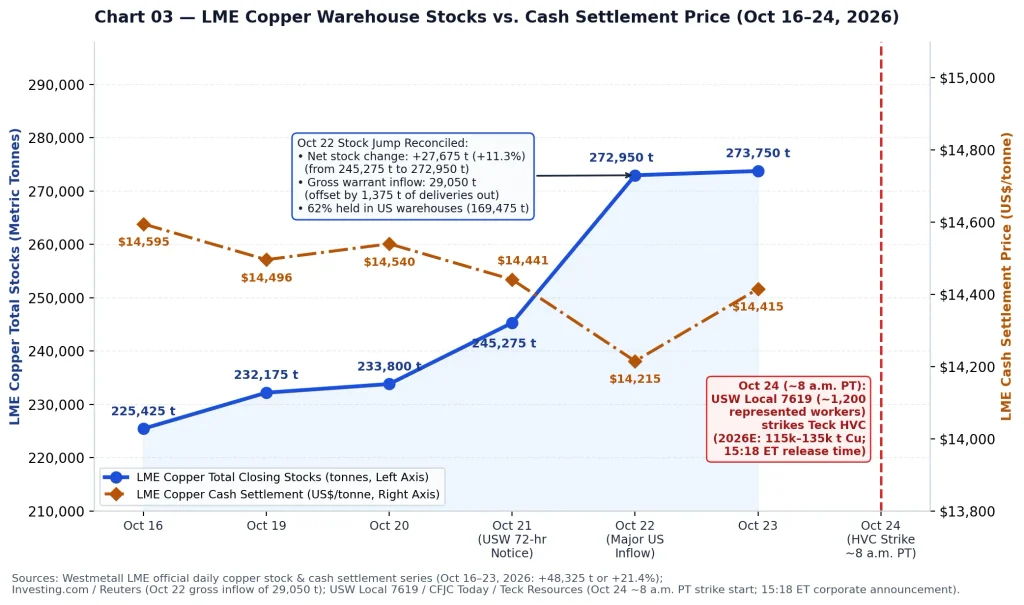
On the LME, official daily warehouse reports compiled by Westmetall establish a verified six-session stock build from October 16 through October 23, 2026. Total LME copper stocks rose from 225,425 tonnes on October 16 to 232,175 tonnes on October 19 (+6,750 tonnes), 233,800 tonnes on October 20 (+1,625 tonnes), and 245,275 tonnes on October 21 (+11,475 tonnes). On Thursday, October 22, total LME stocks jumped to 272,950 tonnes—their highest level since July 24 (276,775 tonnes)—before adding 800 tonnes on Friday, October 23 to close at 273,750 tonnes (Westmetall; Investing.com). Across the six sessions from October 16 to October 23, total LME stocks increased by 48,325 tonnes, or 21.4 percent, though they remain 15.7 percent below their July 1, 2026 level of 324,850 tonnes.
Crucially, analysts must reconcile a statistical discrepancy on October 22 between wire reports citing a 29,050-tonne daily inflow (+11.9 percent) and Westmetall’s closing stock series, which rose by 27,675 tonnes (+11.3 percent) from 245,275 tonnes to 272,950 tonnes (Investing.com; Westmetall). The reports describe different stock-flow measures: 29,050 tonnes of reported inflows versus a 27,675-tonne rise in closing stocks. Their 1,375-tonne numerical difference is clear, but the cited reports do not independently establish the precise balance of deliveries out, warrant changes, or timing differences. Live on-warrant holdings also reportedly rose by 70,100 tonnes over two days (Business Recorder).
Warehouse geography reveals why these inflows do not represent a global industrial glut. Throughout 2026, merchants shipped massive volumes of refined cathode to the United States to front-run potential 2027 U.S. import tariffs. As of October 23, 2026, COMEX copper warehouses held 798,516 short tons (724,401 metric tonnes), split between 472,644 short tons registered and 325,872 short tons eligible, with COMEX copper at US$6.48 per pound. When the front-month COMEX premium flipped to a discount against the LME in mid-October, traders delivered stranded U.S. cathode into LME warehouses in New Orleans and Baltimore (Business Recorder). Consequently, 62 percent of all LME copper stocks—169,475 tonnes, a 12.5-year high—now sit in U.S. warehouses, logistically stranded from Asian consumers (Investing.com).
In China, which accounts for 55 percent of global copper demand, SHFE copper warrant stocks stood at just 19,058 tonnes on October 23 (with active futures at RMB 107,310, or ~US$16,088 per tonne). Meanwhile, China’s September copper imports rose 20.7 percent month-on-month to 461,000 tonnes and the Yangshan import premium hit US$148 per tonne, its highest since October 2022 (Investing.com). The exchange figures use different inventory definitions—LME total stocks, COMEX registered plus eligible inventory, and SHFE warrant stocks—and must not be summed as freely deliverable global cathode. Because LME warehouses hold refined cathode whereas Highland Valley produces smelter concentrate—at a time when Red Chris Q3 copper output fell 29 percent year-over-year to 14.771 million pounds and BHP’s quarterly output dropped 19 percent to 400,700 tonnes—the market is pricing regional physical scarcity outside U.S. tariff stockpiles despite the International Copper Study Group’s forecast of a 104,000-tonne global refined surplus in 2026.
What development would materially change this article’s conclusion? Sustained LME deliveries into Asian and European warehouses paired with a collapse in the Yangshan premium below US$60 per tonne and a rapid ratification at Highland Valley would confirm a genuine global surplus, whereas warrant cancellations and a multi-week Highland Valley shutdown would tighten concentrate treatment charges further.
Three Key Takeaways (Copper)
- Highland Valley Strike Exposure in Context: USW Local 7619 (~1,200 represented workers) began strike action at Teck’s Highland Valley Copper in B.C. on October 24, 2026 at approximately 8:00 a.m. PT (announced by Teck at 15:18 ET; 2026 guidance: 115,000–135,000 tonnes; midpoint 342 tpd contained Cu). At an illustrative 50 percent curtailment, deferred production is ~1,200 tonnes per week (0.004 percent of global refined supply), tightening smelter concentrate rather than refined cathode.
- LME Six-Session Surge Reconciled: LME copper stocks rose 21.4 percent (+48,325 tonnes) from 225,425 tonnes on October 16 to 273,750 tonnes on October 23. On October 22, net closing stocks rose by 27,675 tonnes (+11.3 percent, from 245,275 t to 272,950 t), while a separate report cited 29,050 tonnes of inflows; the 1,375-tonne difference has not been fully reconciled.
- Tariff Hoarding Strands Cathode in U.S. Warehouses: Roughly 62 percent of LME copper stocks (169,475 tonnes, a 12.5-year high) and 798,516 short tons (724,401 metric tonnes) of COMEX inventory sit in U.S. warehouses ahead of potential 2027 tariffs, whereas SHFE warrant stocks in China stand at just 19,058 tonnes and the Yangshan import premium reached US$148/tonne (a four-year high).
Chart 03 & Global Exchange Inventory Comparison
Sources
- Teck Resources — Highland Valley Copper Strike Update (Oct 24, 2026): https://www.teck.com/news/news-releases/2026/teck-provides-update-on-highland-valley-copper-operations
- Teck Resources — Operational Review & 2025–2028 HVC Guidance (Oct 7, 2025): https://www.teck.com/news/news-releases/2025/teck-announces-completion-of-comprehensive-operational-review-and-updated-outlook
- United Steelworkers Local 7619 — 72-Hour Strike Notice (~1,200 Represented Workers, Oct 21, 2026): https://usw.ca/steelworkers-at-highland-valley-copper-issue-72-hour-strike-notice/
- CFJC Today Kamloops — Workers Begin Strike at Highland Valley Copper Mine (~8:00 a.m. PT, Oct 24, 2026): https://cfjctoday.com/2026/10/24/workers-begin-strike-at-highland-valley-copper-mine/
- Westmetall — Official LME Copper Daily Cash Settlement & Stocks (2026): https://www.westmetall.com/en/markdaten.php?action=table&field=LME_Cu_cash
- Investing.com / Kedia Advisory — LME Copper Inflows & Yangshan Premium (Oct 23, 2026): https://in.investing.com/news/commodities-news/copper-slides-as-fresh-inflows-into-lme-warehouses-ease-global-supply-concerns-5650046
- Business Recorder — LME US Warehouse Share & On-Warrant Inflows (Oct 24, 2026): https://epaper.brecorder.com/2026/10/23/91-page/1124554-news.html
- MetalCharts — COMEX Copper Inventory (Oct 23, 2026): https://metalcharts.org/comex/copper
- MetalCharts — SHFE Copper Warrant Inventory (Oct 23, 2026): https://metalcharts.org/shfe/copper