

Detailed Mining and Extraction Strategy Ready for Federal Approval
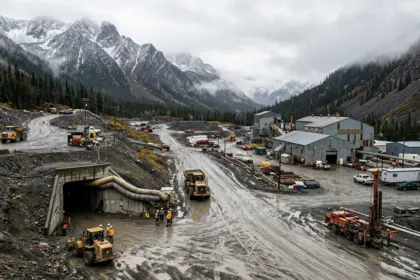
North Bay Resources Inc. has announced the completion of the Operating Plan for its Mt. Vernon Gold Mine, marking a significant milestone as the company prepares to begin production. The plan is now ready for submission to the Federal Mine Regulators (MSHA) for approval. North Bay has outlined detailed 3D modeling, mineral extraction methods, and surface operations, alongside comprehensive safety and logistical planning. Modern mining equipment and essential consumables are already on-site, poised to support the initial mining phase.
High-Grade Gold Zones Targeted in Initial Mining Phase
The initial production phase will involve blasting, loading, sorting, and shipping approximately 500 tons of ore from the center of the deposit. This zone has consistently yielded gold grades exceeding one ounce per ton, with peak grades reaching up to 4.8 ounces per ton across a 150-foot span. The extracted material will play a critical role in optimizing mining, milling, and metallurgical processes, as well as in producing gold bars and platinum buttons for sale.
Related News
- The Origins of Critical Minerals Demand and the Geographic Power Struggle
- Patronus Resources Completes Merger with PNX Metals, Expanding Mineral Asset Portfolio
- Quebec Chosen as Site for First Phosphate’s High-Tech 10,000tpa Plant
- Miners Partner with Grid Africa in 72MW Solar Plant to Ease Power Crisis
- First Majestic Acquires Gatos Silver: Expanding Silver Production in Mexico
Simple Gravity Extraction Method Enhances Gold Recovery
Previous gravity separation and extraction tests for gold, platinum, and silver have indicated that the ore from the Mt. Vernon Mine is highly suitable for simple crushing and gravity table recovery. These findings make the ore ideal for processing at the company’s 100-ton-per-day Bishop Gold Mill in Inyo County. The use of gravity extraction aligns with North Bay Resources’ strategy to maximize recovery while maintaining cost efficiency.
Geological Overview: A High-Grade, Underdeveloped Gold Deposit
The Mt. Vernon Mine, relatively underdeveloped until now, presents a robust geological profile. Sampling by qualified mining engineers has confirmed gold concentrations exceeding one ounce per ton, with some sections boasting grades of up to 4.8 ounces per ton over a 150-foot distance. The mine’s access tunnel intersects a known 200-foot-wide gold-bearing zone and runs perpendicular to a channel spanning up to 500 feet in width and over 2,000 feet across the property.
The channel, with varying thickness between 4 and 20 feet, contains the highest gold grades in the lowest four feet. Historically, this channel was mined at the nearby Ruby Mine, renowned as North America’s richest mine. Mt. Vernon is equipped with modern underground infrastructure, including a portal, tunnel, ventilation, power, and equipment. The ore body is estimated at 954,000 tons based on the known channel, signaling a significant production potential for the future.
Production Outlook and Next Steps
With the Operating Plan ready for federal filing and approval, North Bay Resources is on the cusp of a major step forward in its production timeline. The company’s focus on detailed planning and readiness underscores its commitment to advancing the Mt. Vernon Gold Mine into a fully operational asset, leveraging its high-grade ore to generate substantial returns.